Understanding levers and friction
A lever trades distance for force: the longer the arm on your side relative to the load side, the less force you need – but you have to move further. Friction holds knots, brakes and rope wraps. Knowing these two principles lets you move loads more safely and understand why many techniques work – and when they fail.
- 10 minutes to read
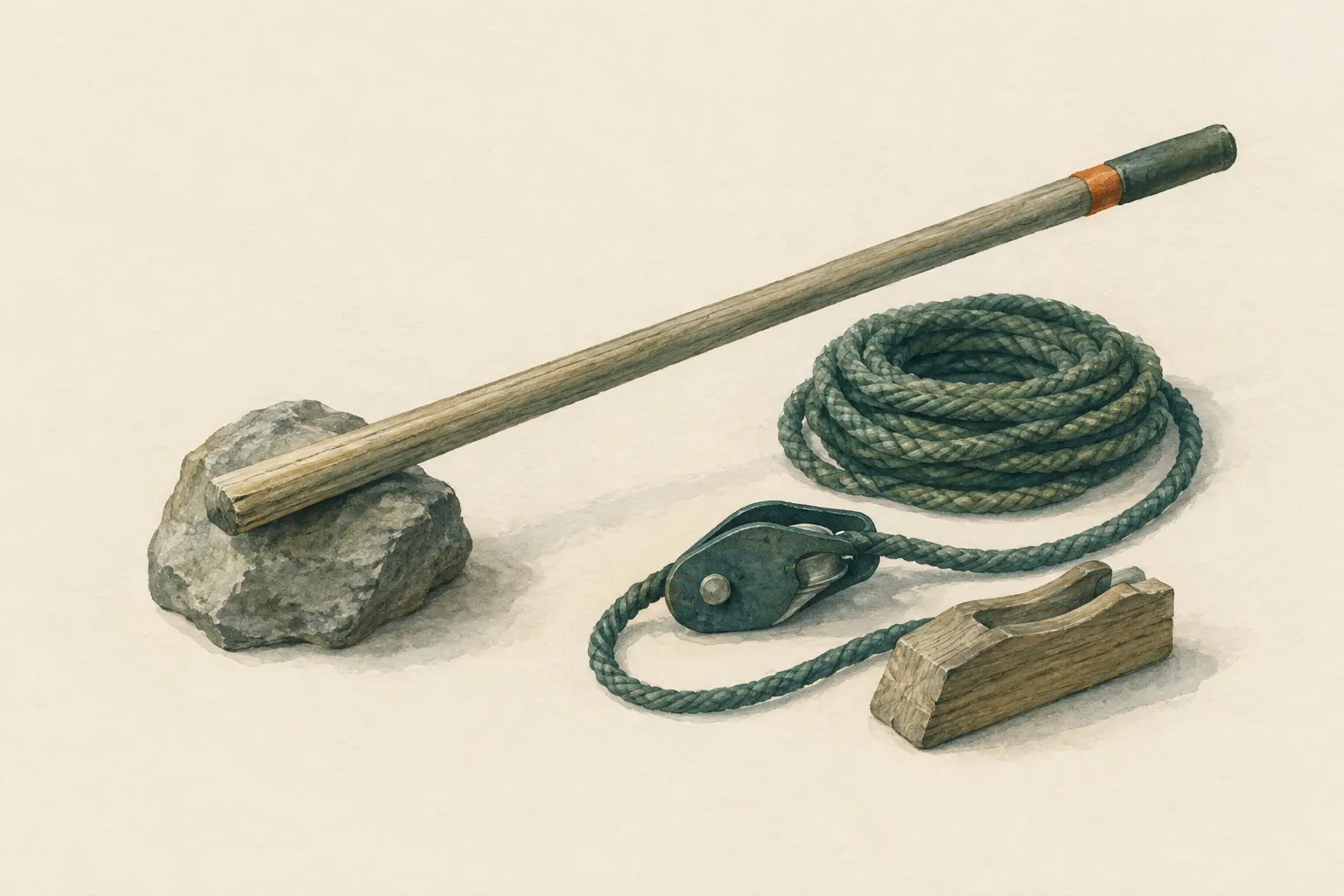
Explained simply
Do you know the seesaw at the playground? A light child can lift a heavier one if they sit further from the pivot in the middle. That is a lever. A lever is a bar that turns around a point. The longer your part of the bar, the less force you need – but you have to move your end further. So you trade distance for force.
Friction is what stops things from sliding. It arises when two surfaces are pressed together. Friction holds knots tight, lets shoes grip the ground and allows you to wrap a rope around a tree and hold it with little force. On ice or wet surfaces friction is much smaller – that is why you slip there.
Very important: heavy loads such as cars or debris are not lifted with improvised levers. A branch can break and the load falls back. If someone is trapped, call the emergency number (112 in the EU) immediately.
How a lever works
Every lever has three parts: the pivot (also called the fulcrum), the load, and the point where you push or pull. The distance from the pivot to the load is the load arm, the distance from the pivot to your hand the effort arm. In balance: force times effort arm equals load times load arm. If your arm is four times as long as the load arm, in theory you need only a quarter of the force.
There is a price: your end of the lever has to travel four times as far as the load. The work – force times distance – stays the same, it is only shared out differently. So a lever never gives you anything “for free”. But it lets you trade a force you do not have for a distance you can cover.
Levers are everywhere: a screwdriver (when prising open a paint tin lid), pliers, a wheelbarrow, a bottle opener, a door handle, scissors. On a wheelbarrow the load sits between the wheel and the handles; on a seesaw the pivot is in the middle. With tweezers you even press between the pivot and the tip – there you gain no force advantage, but precision.
How friction works
Friction arises where two surfaces are pressed together. Even surfaces that look smooth have tiny bumps that catch on each other. The harder the surfaces are pressed together, the greater the friction. And it depends on the material: rubber on dry rock grips well, metal on ice hardly at all.
Water, oil, mud or ice act like a lubricant between surfaces and greatly reduce friction. That applies to shoe soles as much as to knots or a lever resting on a stone. Anyone who assumes something holds as well when wet as when dry is often in for a nasty surprise.
Friction is particularly impressive with ropes wrapped around a tree or post. Each wrap increases friction, and the effect grows very quickly with each additional wrap. That is why you can hold a much larger pull with one hand when the rope runs several times around a post. Knots also hold only through friction between parts of the rope – which is why smooth, stiff or wet ropes hold less well.
What really matters
The pivot should be as close to the load as possible and firm in itself. A stone that rolls away, or soft ground the lever sinks into, wipes out the whole calculation. The lever itself has to withstand the force: a rotten, thin or cracked branch breaks precisely when the load is already in the air.
The calculated values only apply in the ideal case. In reality there are friction losses, the lever bends, the ground gives way. Improvised levers are therefore hard to judge. They are good for loosening a stuck lid, moving a light stone or tensioning a tent line – not for lifting heavy things.
If you understand levers and friction, you also understand many other techniques better: why a tensioning hitch holds on a guyline, why a longer spanner loosens a tight nut more easily (and can also damage threads or valves in the process), and why shoes with worn soles slip on wet rock.
Safety: what to watch out for
If a person is trapped under a load, a vehicle or debris, call the local emergency number (112 in the EU) immediately. Lifting such loads is a task for rescue services, who have suitable equipment and know how to secure a load so it does not slip back. An improvised lever that slips or breaks can make the situation worse.
With smaller loads too: never reach under or behind a raised load with your hands or feet. Keep your feet out of the zone the load would fall into, and out of the direction the lever could spring back. Levers and rope systems are never used to secure or lift people.
How to practise it
You can experience levers safely at the kitchen table. Lay a ruler over a pencil as a pivot, put a small weight such as a cup on one end and press on the other with a finger. Move the pencil closer to the cup and further away and feel how the force needed changes.
Friction can be tried with a piece of string and a chair leg: hang a light bag from one end, wrap the string once, twice, three times around the chair leg and hold the other end. You will notice how much less force you need with each wrap. Do the same with a wet string.
Small experiments like these help more than any formula. Once you have felt how strongly friction works and how easily a pivot slips, you judge situations outdoors more realistically.
Quick view
Materials
Sturdy sticks / poles
For light demonstrations only
Do not cut live wood where prohibited.
Suitable for
- Understanding knots, guylines and tools
- Moving light loads safely in daily life
Not suitable for
- Lifting vehicles, debris or loads under which people are trapped – a task for rescue services
- Securing or lifting people
Prerequisites
- None
Safety
- Branches and improvised levers can break suddenly. Never reach under or behind a raised load; keep feet out of the drop zone.
How it works
A lever rotates around a pivot. In balance, force times force arm equals load times load arm. If your arm is four times as long as the load arm, you need in theory a quarter of the force, but move the end of the lever four times as far. Friction arises where surfaces are pressed together; it grows with the pressing force. A rope wrapped several times around a tree or post can therefore hold a larger pull with little holding force – each wrap increases friction.
Advantages
- Helps to understand techniques rather than copy them
- Allows small loads to be moved with less force
Disadvantages
- Improvised levers are hard to judge
- Calculated values only apply without friction losses and material failure
Deep knowledge
Background
The law of the lever and friction are fundamentals of classical mechanics covered in every physics textbook, for example “Fundamentals of Physics” by Halliday, Resnick and Walker.
In practice the material's strength matters more than the calculation. A lever that breaks is more dangerous than none at all – which is why lifting heavy loads belongs in the hands of professionals with suitable equipment.
Variants
- Everyday examples
- Screwdrivers, pliers, wheelbarrows and bottle openers are levers. A longer spanner loosens a tight nut more easily – but can also damage threads and valves if too much force is applied.
- Friction in knots
- Knots hold through friction between parts of the rope. Smooth, stiff or wet ropes hold less well; that is why some knots are unsuitable for certain materials.
Common mistakes
- Pivot too far from the load
- Using a rotten branch as a lever
- Hands under the raised load
- Assuming friction stays the same when wet or icy
Limits and risks
- No guidance on rescue from debris or vehicles
- No pulley or rope systems for people
Sources
David Halliday, Robert Resnick, Jearl Walker – John Wiley & Sons: Fundamentals of Physics
Law of the lever (torque) and friction as fundamentals of mechanics