Measuring distance: pace counting and timing
Knowing how far you have walked helps you find targets and notice mistakes. You measure your own pace on a known distance and count double paces on the move; over longer distances, timing helps. Other people's figures do not help – only your own measurement, checked in the terrain, counts.
- Walk a test course once; count along the way
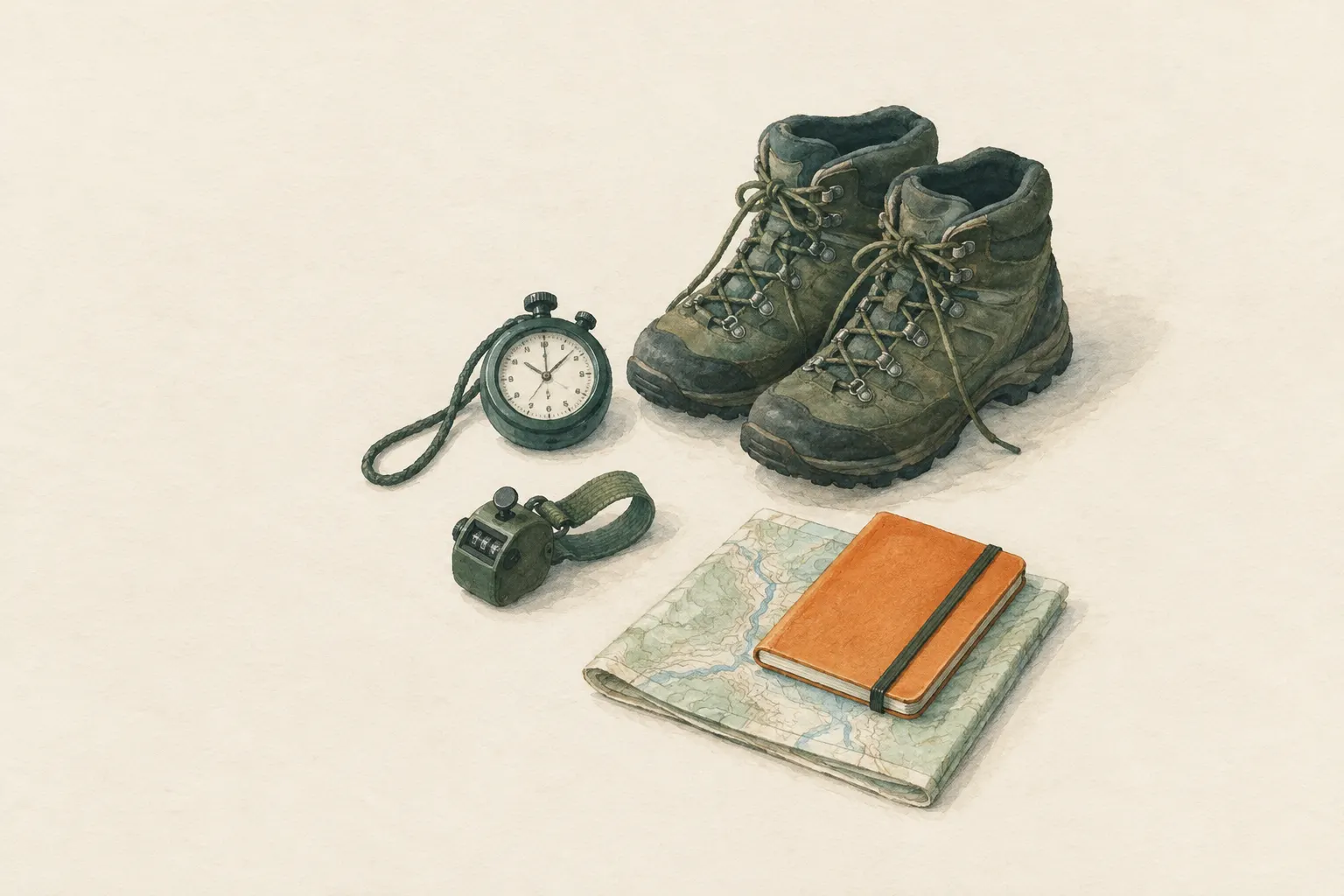
Explained simply
When you are looking for a target in fog, direction alone is not enough. You also need to know how far you have walked – otherwise you might walk past the target or start searching far too early. So you count your steps, the way you count to a hundred in hide-and-seek.
For counting to be useful, you first need to know how long your own steps are. Everyone has a different stride – a child a shorter one, a tall adult a longer one. So once, you walk a distance whose length you know, for example 100 metres, and count. Usually people count 'double paces': only each time the same foot lands, for example always the left.
Over longer distances the clock helps too: if you know roughly how fast you walk, you can estimate from the time how far you have got. Both together are better than either alone.
How it works
For one person on similar ground, pace length is surprisingly consistent. If you know how many double paces you need for 100 metres, you can convert any distance on the map into double paces and count along the way. People count double paces because they then only have to count half as far and lose count less often.
But pace length changes: uphill your steps get shorter, downhill shorter or longer depending on the steepness. Long grass, snow, scree, a heavy pack, fatigue and darkness shorten them too. So you do not measure only once on a level path, but also in rough terrain, uphill and downhill – and estimate the deviations.
Timing works in a similar way: if you know your own walking speed, you can estimate the distance from the time that has passed. There are rules of thumb for walking times, such as Naismith's rule from the 19th century. But they only give guide values that you must adapt to yourself, your load and the terrain.
What really matters
Only your own values count. Figures from other people, books or the internet do not help, because pace length depends on height, leg length, gait and terrain. Write your values for different surfaces on a small card or directly on the compass.
Losing count is the most common mistake, especially during interruptions: you stop, look at the map, talk to someone – and afterwards no longer know whether it was 63 or 73. Aids make this easier: pace beads on a cord, where you slide one bead along after every 100 metres, knots in a cord, or small pebbles you move from one trouser pocket to the other.
Note the time at the start of each leg. Then you have a second, independent estimate. If paces and time roughly agree, you can be fairly sure. If they differ a lot, something is wrong – and you look more closely.
When it makes sense – and when not
Pace counting is especially valuable on short compass legs: from the attack point to the target, in fog, in forest or at dusk. Here, knowing the distance often decides whether you find a small target.
Over long distances it becomes tiring and inaccurate, because small errors add up. So divide long distances into short legs with checkpoints. In very steep or bouldery terrain, where every step is different, pace counting is of little use – there the time, and above all observing the terrain, help more.
Very important: if you have reached the counted distance and the target is not there, do not just keep walking. Stop, look around and search systematically, for example in small loops around your position, before you lose track of where you started.
How to practise it
Find a distance whose length you know for certain – for example on a sports ground, or a stretch you have measured on an accurate map. Walk it at your normal hiking pace and count the double paces. Repeat it a few times and take the average. Then do the same on a forest path, uphill and downhill.
If you carry a GPS or an app, you can check your values on the move: count a stretch and compare with the recorded distance. That way your values keep improving over time.
For children, pace counting is a nice game: how many steps to the next bench? Who guesses best? Along the way they learn to judge distances.
Step by step
Calibrate your pace
Walk a known distance at normal pace and count double paces (each time the same foot lands). Repeat in rough terrain, uphill and downhill.
- 1
Calibrate your pace
Walk a known distance at normal pace and count double paces (each time the same foot lands). Repeat in rough terrain, uphill and downhill.
- 2
Write the values down
Note your count per distance for different surfaces on a card or on the compass.
- 3
Count on the move
Measure the leg length on the map, convert to double paces and count. Aids: pace beads, knots in a cord or pebbles moved from one pocket to another.
- 4
Record time
Note the start time of each leg. Together with your speed this gives a second estimate of distance.
- 5
Compare with the terrain
If the counted distance is reached but the target is missing, do not keep walking: stop and search systematically.
Common mistakes
- Using someone else's pace values
- Losing count during interruptions
- Ignoring slope and surface
- Not noting the time
Quick view
Materials
Topographic map
Check the publication date – paths and buildings may have changed.
Protect from wet (map case or bag).
Field notebook and pencil
Suitable for
- Short compass legs
- Fog, forest, night
- Attack point to target
Not suitable for
- Long distances without intermediate checks
- Very steep or bouldery terrain (irregular steps)
Prerequisites
- A known distance for calibration
How it works
Pace length is fairly constant for one person on similar ground, but changes uphill, downhill, with load, snow, fatigue and darkness. So you calibrate on a known distance and estimate the deviations. For timing you know your own walking speed; rules of thumb such as Naismith's rule give guide values that you must adapt to yourself.
Advantages
- No device needed
- Improves any compass navigation
- Errors become visible early
Disadvantages
- Tiring over long distances
- Inaccurate in difficult terrain
Deep knowledge
Background
Pace counting is part of military and civilian navigation training; pace beads ('ranger beads') are a common aid.
Naismith's rule is a rule of thumb dating from the 19th century for walking times in hill country. It is often adapted because walking speed depends strongly on person, load and terrain.
Variants
- Compare with a GPS track
- If you carry a GPS, you can check and refine your pace values along the way.
Common mistakes
- Using someone else's pace values
- Losing count during interruptions
- Ignoring slope and surface
- Not noting the time
Limits and risks
- No standard values – only your own measurements
- Deviations grow with distance
Sources
Headquarters, Department of the Army (USA) (2001): FM 3-25.26 Map Reading and Land Navigation
Pace counting and distance estimation
The Mountaineers Books (2017): Mountaineering: The Freedom of the Hills, 9th edition
Time and distance estimation in the mountains