Distillation and solar still
In distillation, water evaporates and condenses on a cooler surface; salt, turbidity and pathogens stay behind. Distillation is the only method described here that removes salt. A solar still, however, usually yields only small amounts, and volatile chemicals can carry over.
- Building a solar still takes 30–60 minutes of digging; yield is low and depends heavily on sun, soil and temperature
Explained simply
Do you know the steamed-up bathroom mirror after a shower? Warm water evaporates, the vapour hits the cooler mirror and turns back into droplets. A still works in exactly the same way. The special thing: salt, dirt and germs do not travel with the vapour. They stay behind. That way you can even make drinkable water from seawater.
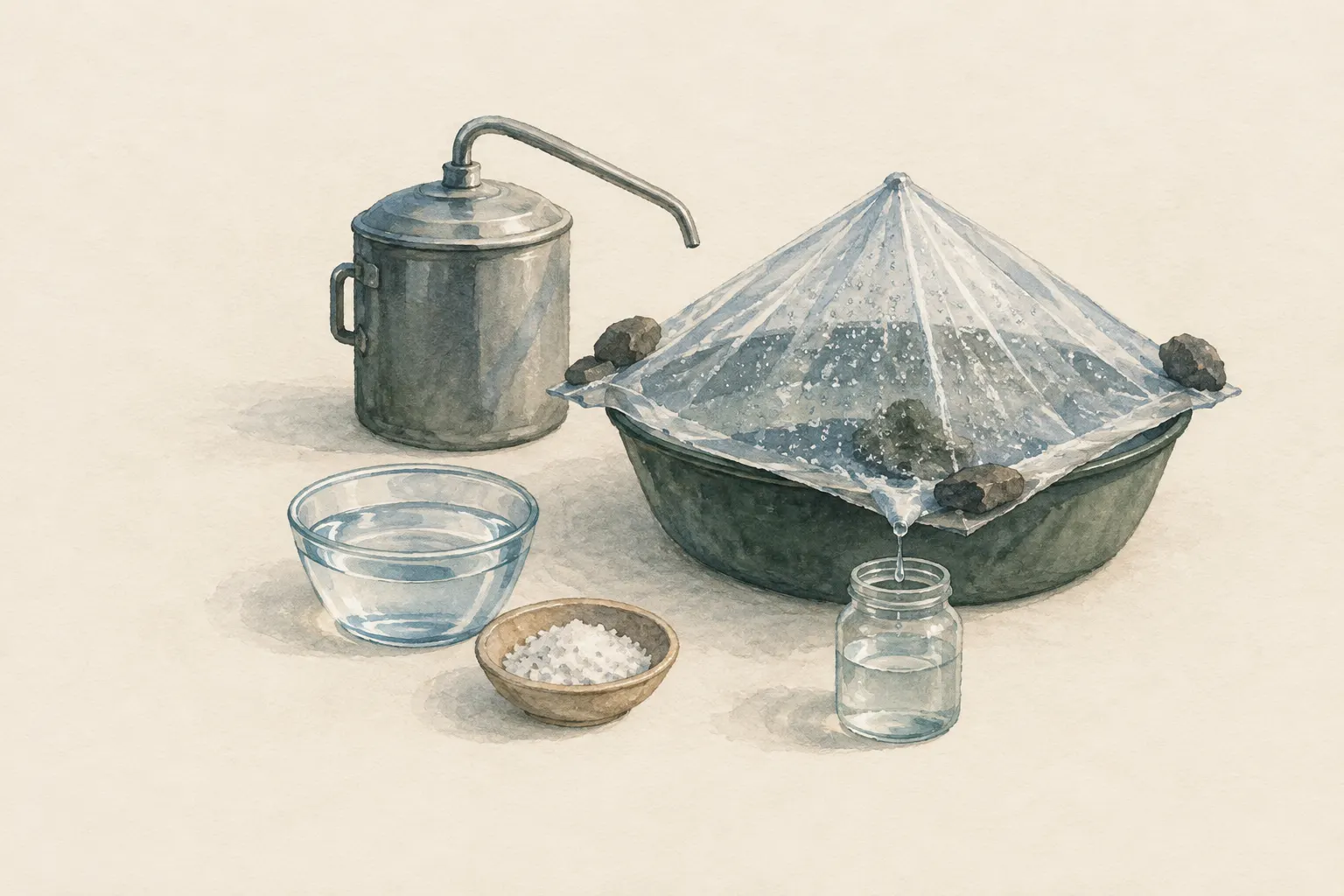
For a solar still, you dig a pit, put a cup in it, pour salt water around it and cover everything with a clear plastic sheet. The sun warms it, water evaporates, collects as drops under the sheet and runs to a stone in the middle, from where it drips into the cup.
That sounds great, but usually only a little water collects. If you dig in the midday heat, you may sweat out more than the still will ever deliver. That is why it is only ever a supplement, never your only water source.
How it works
When water absorbs heat, it evaporates: individual water molecules break free and rise as invisible vapour. Dissolved salts, suspended matter and microorganisms are not carried along. When the vapour meets a cooler surface, it condenses back into liquid water. If you collect this condensate separately, you have separated the water from the salt.
In a solar still, the sun provides the heat. Under the sheet it becomes warm and humid, while the sheet itself is somewhat cooler because of the outside air. Drops form there, run along the underside to the lowest point – the stone in the middle – and fall into the collecting vessel.
There is one important exception: substances that evaporate more easily than water, such as components of fuels or solvents, can pass over with the vapour and end up in the distillate. Distillation is therefore very effective against salt and pathogens, but not a solution for water containing such volatile chemicals.
What you can realistically expect
The yield of a solar still is usually small and hard to predict. It depends on solar radiation, the moisture in the soil or the amount of salt water added, the temperature difference between inside and outside, and how well the sheet is sealed. Often the result is disappointingly small.
Military survival manuals describe the solar still but regard it as a supplement, not a reliable supply. Never plan it as your only water source, and do not stop looking for other sources just because a still is running.
The sums have to add up: digging costs sweat, and sweat is water. So dig in cooler times of day, stay in the shade in between, and consider whether several small stills or another measure – such as catching rain – would yield more.
What really matters
Choose a sunny spot, ideally with moist ground, for example in a hollow. Place a clean collecting vessel in the centre of the pit. Pour the salt or brackish water into the pit around the vessel – never into it, or the vessel becomes salty again.
The sheet must be sealed all round with soil so that the vapour cannot escape. A small stone in the middle creates a low point exactly above the vessel. The sheet must not touch the vessel, and it should hang steeply enough for the drops to run down rather than falling off early.
Open the sheet as rarely as possible, because every opening lets the warm, humid vapour escape. A drinking tube from the vessel to the outside lets you drink without opening the still. Use a clean, undamaged sheet – dirt on it runs with the condensate into the vessel.
Distillation with a heat source
With a stove or fire you can distil considerably more water. The principle stays the same: salt water is heated in a pot, the vapour condenses on a cooler lid or tube and is collected separately – apart from the water in the pot. The catch is the high fuel consumption.
Operate stoves and fires only outdoors, never in a tent, vehicle or enclosed room, because carbon monoxide can form. Check local rules on fires and wildfire risk. Hot steam scalds skin quickly – keep hands and face away from where it escapes.
For life rafts and boats there are hand-operated desalinators that work on the principle of reverse osmosis: water is pressed through an extremely fine membrane that holds back the salt. These devices are not described in detail here; they are used according to the manufacturer's instructions.
Safety: what to watch out for
The greatest danger is relying on the still. Its yield is small and uncertain. Watch your own water balance: confusion, severe dizziness or very little urine mean serious danger – if possible, call the local emergency number (112 in the EU).
Do not put suspect liquids into the still, such as water with an oily film, a smell of fuel or from industrial waste water. Volatile substances can pass into the distillate, and then even the seemingly pure water is contaminated.
The distillate itself is usually free of salt and pathogens, but it is easily contaminated again: by a dirty sheet, an unclean vessel, falling sand or splashes of salt water. If in doubt, disinfect it additionally, for example by boiling or by chlorination according to instructions.
Step by step
Choose the site
Choose a sunny spot with moist ground, e.g. in a hollow. Dig during cooler times of day.
- 1
Choose the site
Choose a sunny spot with moist ground, e.g. in a hollow. Dig during cooler times of day.
- 2
Dig the pit
Dig a pit about one metre across and place the clean collecting vessel in the centre of the bottom.
- 3
Add moisture
Pour seawater or brackish water into the pit around the vessel – not into it.
- 4
Lay and seal the sheet
Lay the sheet over the pit and seal the edges all round with soil. A small stone in the centre creates a low point directly above the vessel without the sheet touching the vessel.
- 5
Harvest without opening
Open the sheet as rarely as possible, since every opening lets vapour escape. A drinking tube from the vessel to the outside allows drinking without opening.
Common mistakes
- Overestimating the yield and giving up other water searches
- Pouring salt water into the collecting vessel
- The sheet touches the vessel or has no low point
- Edges not sealed – vapour escapes
- Digging in the midday heat
Quick view
Materials
Plastic sheet / large bin bag
Clear or translucent, undamaged
Tears easily; never pull over the head (suffocation risk).
Do not use for drinking water unless food-grade.
Metal pot (stainless steel, aluminium, titanium)
Collecting vessel; also for heating in the stove variant
Hot – scalding risk.
Food-grade water container
Only use containers that never held chemicals or fuel.
Stove
For distillation with a heat source
Never operate inside a tent, shelter or enclosed room – carbon monoxide and fire risk.
Suitable for
- Seawater or brackish water when no other freshwater source exists
- Supplementary water production in sunshine over longer periods
Not suitable for
- Meeting full daily needs from a solar still alone
- Water containing fuel, solvents or other volatile chemicals
- Situations where digging in the heat costs more water than it yields
Prerequisites
- Sun and diggable ground (solar still) or fuel (stove distillation)
- A clean collecting vessel
Safety
- Volatile chemicals such as fuels or solvents can evaporate along with the water and end up in the distillate. Do not put suspect liquids into the still.
- The distillate is easily recontaminated by a dirty sheet, collecting vessel, sand or splashes. If in doubt, additionally disinfect.
How it works
Solar heat or a heat source makes water evaporate. The vapour contains no salt and no particles; it condenses on the cooler sheet or a cooling element and drips into a collecting vessel. What does not evaporate – salt, suspended matter, microorganisms – stays behind. Substances that evaporate more easily than water, however, can carry over.
Advantages
- Removes salt
- Separates turbidity and pathogens
- Solar still needs no fuel
Disadvantages
- Very low, uncertain yield (solar still)
- High fuel use (stove distillation)
- Volatile chemicals can carry over
- Laborious to build
Deep knowledge
Background
The solar still is described in military survival manuals, but there it is regarded as a supplement, not a reliable supply. Its yield depends on solar radiation, soil moisture, temperature difference and sealing and is often disappointingly low.
As a separation process, distillation is in principle very effective against dissolved salts and microorganisms. The weak points are practical: contaminated sheets and vessels, condensate running along dirty surfaces, and volatile substances that evaporate along with the water. Where fuel, solvents or industrial waste water are involved, distillation is not a safe solution either.
Variants
- Distillation with a heat source
- Water is heated in a pot; the vapour condenses on a cooler lid or tube and is collected separately. Yields more than a solar still but uses a lot of fuel.
- Emergency desalinators
- Hand-operated reverse-osmosis desalinators exist for life rafts and boats. They are not part of this entry; use according to the manufacturer's instructions.
Common mistakes
- Overestimating the yield and giving up other water searches
- Pouring salt water into the collecting vessel
- The sheet touches the vessel or has no low point
- Edges not sealed – vapour escapes
- Digging in the midday heat
Limits and risks
- Low yield
- Volatile chemicals are not reliably separated
- Distillate can become contaminated
Material alternatives
Derived from material properties: a substitute must have all relevant properties. Observe the notes on the substitute.
- Plastic sheet / large bin bag
- Tarp, Emergency blanket (Tears easily once punctured; short-term shelter only.), Document folder (waterproof) (Store securely – contains sensitive personal data.), Rain poncho (When used as a shelter, it no longer protects your body from rain.), Bivy bag (Never fully close off the face.), Tent (Do not cook or heat inside the tent (fire and carbon monoxide danger).), Heavy-duty bin bag (large) (Suffocation risk: never pull plastic bags over the head or face and keep them away from small children.), Group shelter bag (Airtight – ventilate regularly.)
- Metal pot (stainless steel, aluminium, titanium)
- Single-wall stainless steel bottle (Heat only single-wall bottles without paint/plastic; remove the lid before heating.)
- Food-grade water container
- Single-wall stainless steel bottle (Heat only single-wall bottles without paint/plastic; remove the lid before heating.), Double-wall insulated bottle (Never heat directly.), PET bottle (clear, max. 2 litres) (Do not heat or place in a fire.), Airtight food-grade storage container (Fill only when clean and completely dry; never use containers that previously held chemicals.), Collapsible water container or bag (Protect from sharp objects.), Food-grade water bag (Use only for drinking water, never for chemicals or fuel.), Fermentation jar or crock (Use only food-grade containers of glass, food-safe glazed stoneware or food-grade plastic – no metal containers for acidic food.), Resealable food bags (Use only bags intended for food; do not use with boiling water unless the manufacturer explicitly allows it.)
Results come exclusively from structured entries. No improvised instructions are generated.
Sources
Headquarters, Department of the Army (USA) (2002): FM 3-05.70 Survival
Construction and limitations of the solar still