Boiling water
A rolling boil reliably kills bacteria, viruses and protozoa and is regarded as one of the most effective ways to disinfect water. It does not, however, remove chemicals or salt, costs fuel and does not protect against recontamination.
- 10–30 minutes including cooling depending on volume and stove; consider fuel use
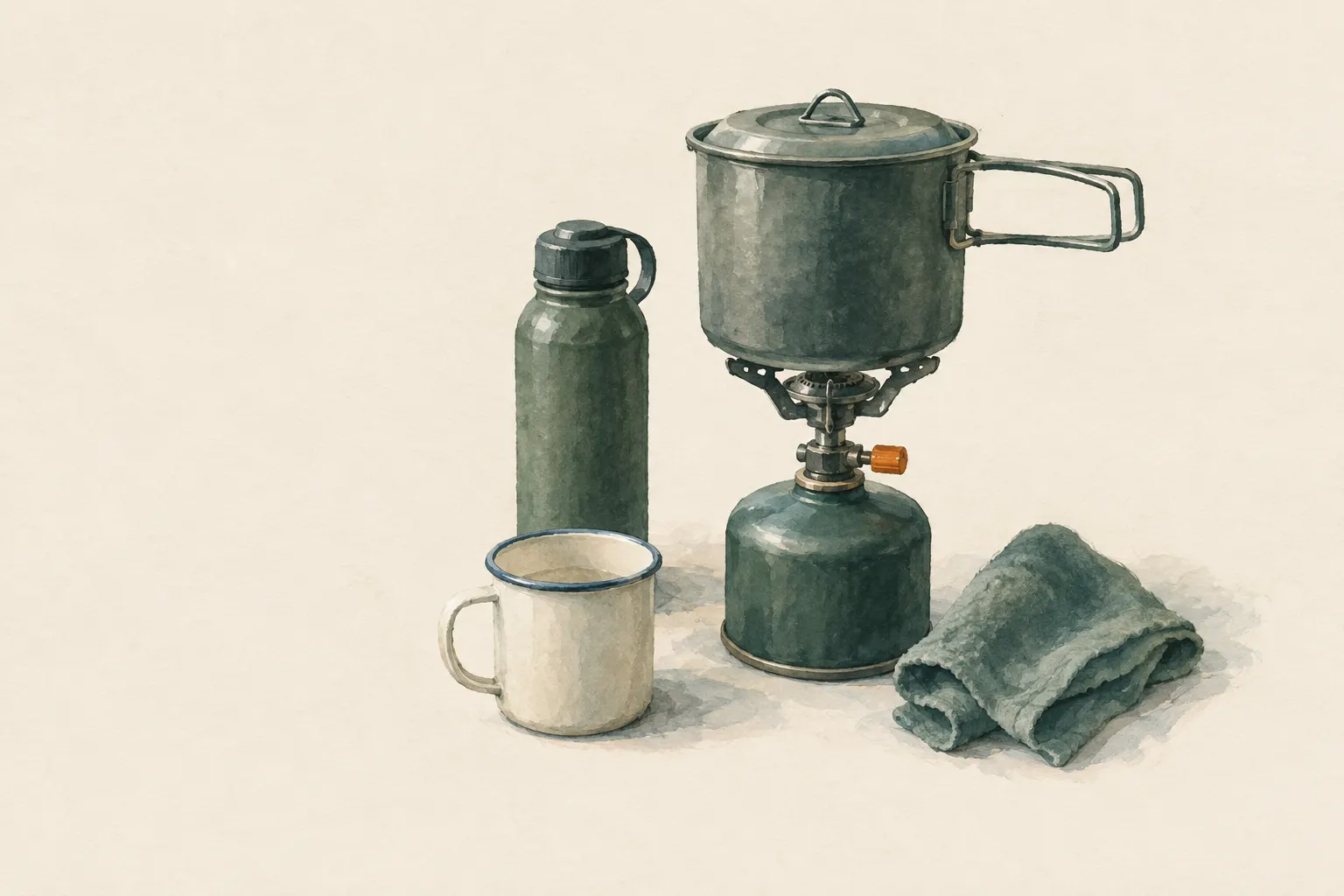
Explained simply
When you boil an egg, the runny egg white turns firm and white – and it never becomes runny again. Heat changes it for good. Exactly the same happens to tiny germs in water: the heat destroys the building blocks they are made of. That is why boiling is one of the most reliable ways to make water germ-free.
What matters is that the water boils properly, with lots of big bubbles everywhere, not just a few little bubbles on the bottom. The US health authority CDC recommends keeping it boiling for at least one minute, and three minutes high up in the mountains (above about 2,000 metres). Up there, water boils at a lower temperature.
Look after yourself: boiling water scalds the skin, and stoves belong outdoors only, never in a tent. And boiling does not help against poison or salt in the water.
How it works
Microorganisms are made of proteins and other delicate structures that are permanently destroyed at high temperatures. A rolling boil reaches a temperature at which bacteria, viruses and protozoa – including Cryptosporidium, which is very resistant to chlorine – are inactivated within a short time.
The boiling point depends on air pressure. The higher you are, the lower the air pressure and the lower the temperature at which water boils. The World Health Organization (WHO) regards reaching a rolling boil as sufficient. As a safety margin, the CDC recommends one minute at a rolling boil and three minutes above about 2,000 metres.
Boiling also works with moderately cloudy water, because the heat penetrates all of the water and is not shielded by dirt particles the way light or chlorine is. You should still clarify very cloudy water first.
What really matters
You recognise a rolling boil by the water bubbling vigorously and continuously, with the bubbles not disappearing even when you stir briefly. A few bubbles on the bottom of the pot or a quiet hum are not enough. From this moment the boiling time counts.
Afterwards, let the water cool in the covered pot. Do not add ice or raw water to cool it – that would contaminate it again immediately. Pour the cooled water into a clean, closable container and scoop with clean vessels, not with your hands.
Boiled water often tastes flat because dissolved air has escaped. If you pour it back and forth several times between two clean vessels, or let it stand covered for a few hours, it tastes fresher.
Safety: what to watch out for
Never operate stoves or fires inside a tent, vehicle, shelter or indoors without adequate ventilation. Carbon monoxide can form – a gas you can neither see nor smell and which can kill. Headache, nausea or dizziness while cooking are alarm signs: get into fresh air immediately and, if symptoms persist, call the local emergency number (112 in the EU). With open fires, check local rules and fire bans.
Scalds are among the most common accidents when boiling water. Set the pot down stably, keep children away, hold handles with a cloth and do not pour hot water into plastic containers that are not made for it.
Boiling removes neither chemicals nor salt. Because water evaporates during boiling, dissolved substances such as nitrate or heavy metals can even become more concentrated. If fuel, industrial or flood contamination is suspected, only another source helps.
Fuel and planning
Boiling costs fuel and time, especially for large volumes over several days. A lid on the pot and a windscreen save a noticeable amount of fuel. Plan consumption for the whole period, not just for one meal.
If you are cooking anyway, you can combine boiling and cooking: water for tea or soup is automatically disinfected after a rolling boil. In winter, boiling can be combined with melting snow.
At home, during an official boil-water advisory: follow the authorities' instructions exactly, including for brushing teeth, ice cubes and washing fruit and vegetables if they say so. Boiling longer than recommended adds no extra safety against pathogens but costs fuel.
Good to know
Boiling is regarded as one of the most effective disinfection methods, because it works against all three groups of pathogens – bacteria, viruses and protozoa – and because the result is easy to recognise: either it is at a rolling boil or it is not.
Its big weakness is that it leaves no residual protection. Boiled water that comes into contact with dirty hands, vessels or raw water is immediately contaminated again. Clean, covered containers are therefore an integral part of the method.
Boiling is one building block, not a cure-all: excellent against pathogens, useless against chemicals and salt. Seawater needs distillation or a desalination device.
Step by step
Pre-clarify cloudy water
If the water is cloudy, let it settle or pour it through a clean cloth or coffee filter.
- 1
Pre-clarify cloudy water
If the water is cloudy, let it settle or pour it through a clean cloth or coffee filter.
- 2
Bring to a rolling boil
Heat the water until it boils vigorously and continuously – not just a few bubbles on the bottom.
- 3
Keep it boiling
Following CDC guidance, keep the water at a rolling boil for at least 1 minute; above about 2,000 m (6,500 ft), for at least 3 minutes.
- 4
Let it cool covered
Let the water cool in the covered vessel. Do not add ice or raw water to cool it.
- 5
Store cleanly
Pour the cooled water into a clean, closable container. Scoop with clean vessels, not with your hands.
Common mistakes
- Heating only until the first bubbles appear
- Cooling with raw water or ice
- Pouring boiled water into the unwashed raw-water container
- Treating boiling as sufficient when chemicals are suspected
- Running a stove inside the tent
- Underestimating fuel needs for several days
Quick view
Materials
Metal pot (stainless steel, aluminium, titanium)
Hot – scalding risk.
Stove
Outdoors or well ventilated only
Never operate inside a tent, shelter or enclosed room – carbon monoxide and fire risk.
Lighter, matches or ferro rod
Observe local fire bans.
Dry firewood
Collect only where permitted.
Single-wall stainless steel bottle
Single-wall only, heat without lid
Heat only single-wall bottles without paint/plastic; remove the lid before heating.
Never heat double-wall (vacuum-insulated) bottles – risk of rupture.
Cotton cloth / T-shirt
To pre-clarify cloudy water
Removes coarse particles only – no disinfection.
Suitable for
- Microbiologically contaminated water from streams, lakes, rain or snow
- Boil-water advisories at home
- Cloudy water when no clear source is available (clarify first)
Not suitable for
- Water suspected of containing chemicals, fuel or heavy metals
- Seawater or brackish water
- Situations without enough fuel
Prerequisites
- A heat-resistant vessel
- Enough fuel
- Safe handling of fire or stove
Safety
- Scalding hazard: set the pot down stably, keep children away, do not pour hot water into unsuitable plastic containers.
How it works
Heat destroys the proteins and structures of microorganisms. A rolling boil reaches a temperature at which bacteria, viruses and protozoa are inactivated within a short time. At increasing altitude water boils at a lower temperature, so it is boiled for longer there.
Advantages
- Effective against bacteria, viruses and protozoa including Cryptosporidium
- Effective even with moderately cloudy water
- No chemicals, no special equipment
- Result easy to recognise (rolling boil)
Disadvantages
- Requires fuel and time
- No effect on chemicals and salt
- No protection against recontamination
- Scalding, fire and CO hazards
Deep knowledge
Background
WHO recommends bringing water to a rolling boil; reaching this state is regarded as sufficient to inactivate pathogens. The CDC gives a boiling time of one minute, and three minutes at high altitude, as a safety margin, because the boiling point drops with altitude.
Boiling leaves no residual protection. If boiled water comes into contact with dirty hands, vessels or raw water, it is contaminated again. Clean, covered containers are therefore part of the method.
Boiling does not help against dissolved chemicals such as nitrate, heavy metals, pesticides or fuels; some substances even become more concentrated as water evaporates.
Variants
- Improving the taste
- Boiled water tastes flat. Pouring it back and forth between two clean vessels or letting it stand covered for a few hours improves the taste.
Common mistakes
- Heating only until the first bubbles appear
- Cooling with raw water or ice
- Pouring boiled water into the unwashed raw-water container
- Treating boiling as sufficient when chemicals are suspected
- Running a stove inside the tent
- Underestimating fuel needs for several days
Limits and risks
- Does not remove chemicals, salt or turbidity
- Depends on fuel
- No residual protection
Material alternatives
Derived from material properties: a substitute must have all relevant properties. Observe the notes on the substitute.
- Metal pot (stainless steel, aluminium, titanium)
- Single-wall stainless steel bottle (Heat only single-wall bottles without paint/plastic; remove the lid before heating.)
- Lighter, matches or ferro rod
- Ferro rod (Practise before you need it.), Fire striker and hard stone (Carbon steel, not stainless.), Bow drill set (bow, spindle, hearth board, bearing block) (Use only dry wood.), Burning lens / magnifier (Never leave lying in the sun – fire risk.), Fire piston (Maintain the seal.)
- Dry firewood
- Tinder (Carry in waterproof packaging.), Char cloth (charred cotton) (Store dry in a tin.), Finest-grade steel wool (Store separately from batteries – fire risk.), Fatwood (resin-rich wood) (Collect only dead wood where permitted.), Stove fuel (canister, liquid fuel, alcohol) (Store fuels apart from food and in original containers or bottles intended for them.), Petroleum jelly cotton balls (Use only pure cotton.)
Results come exclusively from structured entries. No improvised instructions are generated.
Sources
World Health Organization (2015): Boil water – Technical brief
A rolling boil as an effective method of disinfection
Centers for Disease Control and Prevention: Making Water Safe in an Emergency
Boiling time of 1 minute, 3 minutes above 6,500 ft (approx. 2,000 m)
World Health Organization (2022): Guidelines for drinking-water quality, fourth edition incorporating the first and second addenda
Limits of boiling for chemical contamination