UV disinfection and solar water disinfection (SODIS)
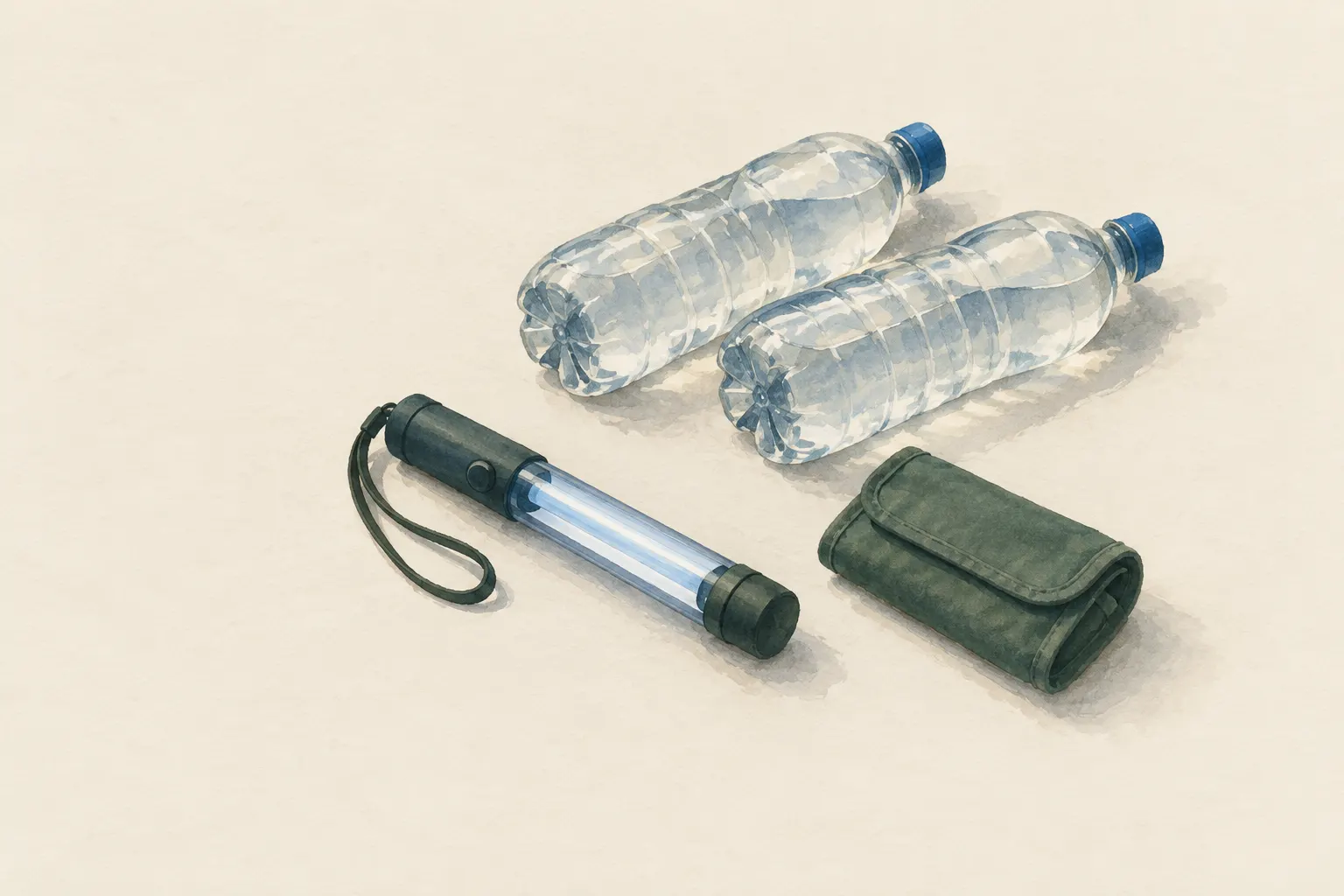
UV radiation damages the genetic material of microorganisms. Battery-powered UV-C devices treat clear water in a short time according to the manufacturer; with SODIS, clear PET bottles lie in the sun for hours. Both methods work only in clear water, remove no chemicals and leave no residual protection.
- UV-C device: short, per manufacturer; SODIS: 6 hours of full sun, two days when heavily overcast
Explained simply
The sun can give you sunburn. Its invisible UV light can also damage tiny germs – it destroys their „blueprint“ so that they can no longer multiply. People use this in two ways: with a small battery-powered UV wand that you hold in the water, or with the sun itself.
With the sun method, called SODIS, you fill clear water into a see-through plastic bottle and lay it in full sun for six hours, or for two days when it is very cloudy. But: the light has to get through the water. In cloudy water, germs hide in the shadow of dirt particles. A test: stand the full bottle on a newspaper headline. If you cannot read it from above, the water is too cloudy.
Important: UV light leaves no protection in the water. So drink the water soon and do not pour it into a dirty container. And UV does not help at all against poison or salt in the water.
How it works
Ultraviolet light has more energy than visible light. When it hits microorganisms, it damages their genetic material, their DNA or RNA. The pathogens are not necessarily destroyed at once, but they can no longer multiply and can no longer cause disease.
UV-C devices work with a lamp or LEDs that emit very high-energy UV-C light. This light practically does not reach the Earth's surface naturally, because the atmosphere absorbs it. The devices therefore deliver a high dose in a short time. SODIS, on the other hand, uses the sun's weaker UV-A light plus some warming of the water over many hours.
Both methods share the same weak spot: light must reach the pathogens. Particles absorb and scatter the light and cast tiny shadows in which germs can survive. That is why UV and SODIS only work with clear or well pre-clarified water.
Using SODIS correctly
SODIS was developed by the Swiss research institute Eawag for households in sunny regions. The manual specifies clear, undamaged PET bottles of at most 2 litres. Coloured, badly scratched or larger bottles let too little light through or are too thick for the sun to reach all of the water equally well. Labels are removed.
Check clarity beforehand with the newspaper test: stand the filled bottle on a headline and look down through it. If the text is not readable, the water is too cloudy and must first settle or be pre-filtered. Then lay the closed bottles flat on a reflective surface such as corrugated metal or an emergency blanket – flat, so that the layer of water is thin.
The exposure time is 6 hours of full sun. When heavily overcast, two consecutive days are needed. SODIS does not work during continuous rain. Afterwards, drink straight from the bottle or pour into a clean vessel without mixing the water with raw water.
UV-C devices
Portable UV-C devices come as wands that you dip into the water or as bottle caps with built-in LEDs. According to manufacturers and the US Centers for Disease Control and Prevention (CDC), they work in clear water against bacteria, viruses and protozoa. The volume, duration and method are set by the manufacturer – you must follow them exactly.
Typically you fill the specified volume into a vessel with a suitable opening, immerse the lamp and move it during the cycle so that all the water is irradiated. The device indicates when the cycle is complete. If it is interrupted, for example because the battery is flat, the water counts as untreated.
The weak spot is energy: without charged batteries the device does not work, and cold weakens many batteries. Spare batteries or a second method as a backup are therefore sensible. Do not look into the lit UV-C lamp – UV-C light can damage eyes and skin.
Safety: what to watch out for
Water can look clear and still be inadequately treated if fine turbidity shades the light. If in doubt, pre-clarify or choose another method, such as boiling. With SODIS, follow the conditions exactly: the effect on bacteria is the best documented, while viruses and parasites vary in sensitivity by species.
UV and SODIS leave no residual protection. Keep treated water in the same clean vessel and drink it soon. If it comes into contact with dirty hands, vessels or raw water, it is contaminated again.
UV light does not work against chemicals, heavy metals and salt. Water from contaminated sources, flood water suspected of carrying fuel, or seawater does not become drinkable this way.
When it makes sense – and when not
SODIS is ideal when it is sunny, the water is clear and time does not matter – for example at a fixed camp or at home in a sunny region when fuel is short. It costs almost nothing, needs no chemicals and does not change the taste. Rotating several bottles can cover a small daily requirement.
UV-C devices suit trips with clear water from springs and streams, when things need to be quick and no waiting time is possible. They are light but depend on batteries and an intact device.
Both are unsuitable for cloudy water, for large volumes and whenever chemical contamination is suspected. SODIS is also ruled out in rain, persistent overcast, in the shade and with glass or coloured bottles. Then boiling or chemical disinfection are the better options.
Step by step
Ensure clarity
Let cloudy water settle and pre-filter it. For SODIS: stand the filled bottle on a newspaper headline and look down through it; if the text is not readable, the water is too cloudy.
- 1
Ensure clarity
Let cloudy water settle and pre-filter it. For SODIS: stand the filled bottle on a newspaper headline and look down through it; if the text is not readable, the water is too cloudy.
- 2
Use a UV-C device
Fill the volume specified by the manufacturer into a vessel with a suitable opening, immerse the lamp and move it for the stated duration until the device indicates completion.
If the cycle is interrupted (e.g. empty battery), the water counts as untreated.
- 3
SODIS: fill bottles
Fill clear, undamaged PET bottles of at most 2 litres, close them and remove labels.
- 4
SODIS: lay in the sun
Lay the bottles flat on a reflective surface (e.g. corrugated metal or an emergency blanket) in full sun – 6 hours in sunshine, two consecutive days when heavily overcast. SODIS does not work during continuous rain.
- 5
Drink from the bottle
Drink the water straight from the bottle or pour it into a clean vessel; do not mix it with raw water.
Common mistakes
- Irradiating cloudy water
- Using scratched, coloured or oversized bottles for SODIS
- SODIS in rain or in the shade
- Assuming a UV cycle completed despite a weak battery
- Pouring treated water into an unwashed container
Quick view
Materials
UV-C purifier
For the device variant
Works only in clear water; check battery level.
PET bottle (clear, max. 2 litres)
For SODIS: clear, undamaged, max. 2 litres
Do not heat or place in a fire.
Emergency blanket
Reflective base for SODIS
Tears easily once punctured; short-term shelter only.
Conductive – keep away from power lines.
Cotton cloth / T-shirt
For pre-clarification
Removes coarse particles only – no disinfection.
Suitable for
- Clear water from streams, springs or rain
- Situations without fuel
- SODIS: sunny regions with time for exposure
Not suitable for
- Cloudy water
- Chemically contaminated water or seawater
- SODIS: rain, persistent overcast, large volumes, glass or coloured bottles
Prerequisites
- Clear or well pre-clarified water
- For devices: charged batteries
- For SODIS: reliable sunshine and time
Safety
- UV and SODIS leave no residual protection. Keep treated water in the same clean vessel and drink it soon.
- No effect on chemicals, heavy metals or salt.
How it works
Ultraviolet light damages the DNA and RNA of microorganisms so they can no longer reproduce. UV-C lamps deliver a high dose in a short time. SODIS uses the sun's UV-A light and some warming of the water over many hours. Turbidity absorbs and scatters the light and weakens both methods.
Advantages
- No taste, no chemicals
- SODIS: no fuel, almost no cost
- UV-C: very fast with clear water
Disadvantages
- Clear water only
- No residual protection
- UV-C: depends on batteries and device
- SODIS: slow, weather-dependent, small volumes
Deep knowledge
Background
SODIS was developed by Eawag for households in sunny regions. The manual specifies clear PET bottles up to 2 litres, 6 hours of full sun or two consecutive days when heavily overcast, and a simple newspaper test for turbidity. The effect on bacteria is the best documented; viruses and protozoan cysts vary in sensitivity by species, which is why the conditions must be followed exactly.
UV-C devices deliver a defined dose in a short time. Their effect depends on clarity, correct use and battery level; devices usually indicate whether a cycle was completed. For both methods: they do not change the water chemically and leave no protection against recontamination.
Variants
- UV-C device
- Battery-powered wands or bottle caps with UV-C LEDs or lamps. Effectiveness, volume and duration per manufacturer; according to manufacturers and the CDC, effective against bacteria, viruses and protozoa in clear water.
- SODIS
- Solar water disinfection in PET bottles according to the Eawag manual. Free and requires no power source, but slow, weather-dependent and limited to small volumes.
Common mistakes
- Irradiating cloudy water
- Using scratched, coloured or oversized bottles for SODIS
- SODIS in rain or in the shade
- Assuming a UV cycle completed despite a weak battery
- Pouring treated water into an unwashed container
Limits and risks
- Not for cloudy water
- Does not remove chemicals, salt or turbidity
- No residual protection
Sources
Eawag – Swiss Federal Institute of Aquatic Science and Technology (2016): SODIS manual – Guidance on solar water disinfection
SODIS instructions: bottles, exposure time, cloud cover, turbidity test
Centers for Disease Control and Prevention: CDC Yellow Book: Health Information for International Travel – Water Disinfection
UV disinfection with portable devices and SODIS; the importance of clear water
World Health Organization (2022): Guidelines for drinking-water quality, fourth edition incorporating the first and second addenda
UV disinfection and lack of residual protection