Storing and carrying water safely
Treated water stays safe only if containers are clean, food-grade and closed and are not contaminated when water is taken out. Containers that ever held chemicals or fuel are off-limits for drinking water.
- Cleaning 10–15 minutes per container; regular checks
Explained simply
Clean water can get dirty again very quickly – like freshly washed hands reaching into a puddle. That is why storing water correctly is just as important as making it clean. You need clean containers with lids that are made for food.
Never dip your hand or a cup into the water supply. Pour it out instead, or use a can with a tap. Keep the containers cool and dark, not in the sun, and write on them what is inside and when you filled them.
Very important: never use cans or bottles that once held petrol, oil, cleaning products or other chemicals. Even after rinsing, residues stay inside that can make you ill.
Why storage matters so much
Water can become contaminated again between source and cup. Most contamination of stored water happens during filling and drawing – through hands, cups, dirty threads or an open lid. That is why safe storage is an integral part of the World Health Organization's multi-barrier principle.
Boiled water or water treated with UV light has no built-in protection: any germ that gets in can multiply. Chlorinated water is somewhat better protected, because residual chlorine keeps making newly introduced germs harmless for a while. But that has limits too.
Light and warmth promote the growth of algae and germs. Cool, dark storage slows these processes. Narrow openings, lids and taps ensure that hands and vessels never touch the water in the first place.
Choosing the right container
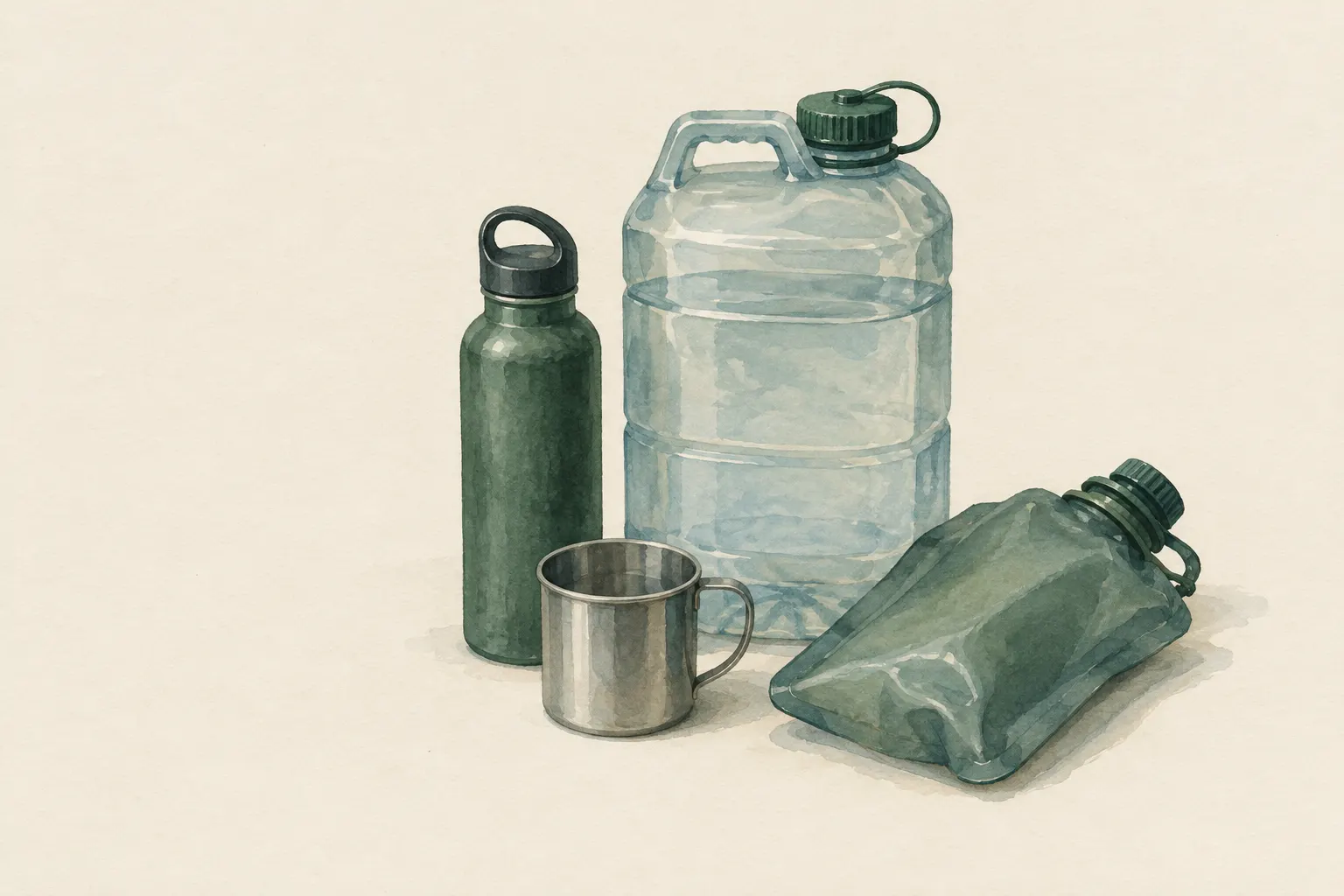
Suitable containers are food-grade, tightly closable ones, ideally with a narrow opening or a tap. In the EU, materials intended for contact with food can often be recognised by the glass-and-fork symbol. Water cans from specialist shops, clean drinks bottles and single-wall stainless-steel bottles are common solutions.
Containers that ever held chemicals, fuel, cleaners or oil are off-limits. Residues cannot be reliably removed, not even by thorough rinsing. Galvanised buckets and plastics of unknown origin are also unsuitable, because they can release substances into the water.
Think about weight as well: one litre of water weighs about one kilogram. A large can quickly becomes too heavy to carry or pour. Several medium-sized containers are often more practical than one huge one and reduce the risk that the whole supply is affected if one becomes contaminated.
Cleaning, filling and labelling
Before filling, wash containers with detergent and clean water and rinse thoroughly until no foam or smell remains. Public-health authorities publish instructions for disinfecting containers with a bleach solution – use only their figures, and never mix bleach with other cleaners.
Fill in only treated water, without touching the inside or the threads with your fingers, and close the container immediately. A clean funnel helps you avoid spills. With containers that may be exposed to frost, leave some space: water expands when it freezes and can burst containers.
Label each container with contents and date. That way you know when it needs replacing and you avoid mix-ups. In camp, a colour code helps, for example coloured tape: one colour for raw water, another for drinking water.
Storing and rotating
Store water cool, dark and away from chemicals, fuels and strong-smelling substances. Some plastics can absorb odours from their surroundings. Direct sun warms the water and promotes algae and microbial growth.
Replace self-filled stocks as recommended by your public authority; the intervals differ between authorities and depending on how the water was treated. Bought bottled water keeps until its best-before date if it is sealed and stored properly. If you regularly use up stocks and buy more, you always have fresh water in the house.
For quantity, the BBK gives around two litres per person per day as a planning figure for emergency preparedness, plus a reserve for heat, children, sick people and pets. If space allows, plan extra water for hygiene.
Safety: what to watch out for
Never use containers that held chemicals, fuel or cleaners. This is the most important rule – poisoning from residues cannot be fixed by any water treatment.
Do not dip hands or cups into the supply. Draw water through a tap or by pouring it into a clean vessel. Keep raw-water and drinking-water containers strictly separate and clearly marked so they cannot be mixed up.
Open buckets, barrels and tubs of water can be a drowning hazard for small children. Cover them and keep them out of reach. And remember: storage does not make unsafe water safe. Only treated water belongs in the drinking-water supply.
Step by step
Choose containers
Use food-grade, tightly closable containers, ideally with a narrow opening or a tap.
- 1
Choose containers
Use food-grade, tightly closable containers, ideally with a narrow opening or a tap.
- 2
Clean
Wash containers with detergent and clean water and rinse thoroughly. Public-health authorities give instructions for disinfecting containers with a bleach solution – use only those figures.
- 3
Fill hygienically
Fill in treated water without touching the inside or the threads with your fingers, and close immediately.
- 4
Label and store
Label contents and date and store cool, dark and away from chemicals and fuels.
- 5
Rotate regularly
Replace self-filled stocks as recommended by your public authority; bottled water according to its best-before date.
Common mistakes
- Using old fuel or cleaner cans
- Scooping from the supply with a cup
- Storing containers in the sun or next to fuel
- Mixing up raw-water and drinking-water containers
Quick view
Materials
Food-grade water container
Only use containers that never held chemicals or fuel.
PET bottle (clear, max. 2 litres)
Do not heat or place in a fire.
Single-wall stainless steel bottle
Heat only single-wall bottles without paint/plastic; remove the lid before heating.
Never heat double-wall (vacuum-insulated) bottles – risk of rupture.
Unscented household bleach (sodium hypochlorite)
For container disinfection only following official instructions
Only unscented, without additives, with known concentration.
Dose depends on concentration – use only following official public-health instructions.
Never mix with other cleaners.
Suitable for
- Emergency stock at home
- Carrying water on trips
- Separating raw and drinking water in camp
Not suitable for
- Containers that held chemicals, fuel, cleaners or oil
- Galvanised buckets and unknown plastics
Prerequisites
- Food-grade, closable containers
- Clean water for rinsing
Safety
- Do not dip hands or cups into the supply; take water out through a tap or by pouring.
How it works
Most contamination of stored water happens during filling and drawing. Narrow openings, lids and taps prevent hands and vessels from touching the water. Cool, dark storage slows algae and microbial growth; residual chlorine from chlorination provides extra protection.
Advantages
- Prevents recontamination of treated water
- Makes stockpiling possible
Disadvantages
- Weight and space required
- Requires regular maintenance
Deep knowledge
Background
Water can become contaminated again between source and cup. Safe storage is therefore part of WHO's multi-barrier principle.
Authorities such as Germany's BBK and the CDC recommend food-grade containers, cool and dark storage and regular replacement of self-filled stocks. Specific intervals vary between authorities and depending on treatment.
Variants
- Colour code in camp
- Clearly mark raw-water and drinking-water containers (e.g. with tape) so they cannot be mixed up.
Common mistakes
- Using old fuel or cleaner cans
- Scooping from the supply with a cup
- Storing containers in the sun or next to fuel
- Mixing up raw-water and drinking-water containers
Limits and risks
- Storage does not make unsafe water safe
Material alternatives
Derived from material properties: a substitute must have all relevant properties. Observe the notes on the substitute.
- Food-grade water container
- Single-wall stainless steel bottle (Heat only single-wall bottles without paint/plastic; remove the lid before heating.), Double-wall insulated bottle (Never heat directly.), PET bottle (clear, max. 2 litres) (Do not heat or place in a fire.), Airtight food-grade storage container (Fill only when clean and completely dry; never use containers that previously held chemicals.), Collapsible water container or bag (Protect from sharp objects.), Food-grade water bag (Use only for drinking water, never for chemicals or fuel.), Fermentation jar or crock (Use only food-grade containers of glass, food-safe glazed stoneware or food-grade plastic – no metal containers for acidic food.), Resealable food bags (Use only bags intended for food; do not use with boiling water unless the manufacturer explicitly allows it.)
- Unscented household bleach (sodium hypochlorite)
- Chlorine tablets (NaDCC) for drinking water (Follow the manufacturer's dose and contact time.), Chlorine dioxide tablets or drops (Only approved drinking-water products; follow manufacturer instructions.), Iodine water purification tablets (Not in pregnancy, thyroid disease or iodine allergy without medical advice.)
Results come exclusively from structured entries. No improvised instructions are generated.
Sources
Centers for Disease Control and Prevention: Making Water Safe in an Emergency
Safe storage of water and cleaning of containers
Bundesamt für Bevölkerungsschutz und Katastrophenhilfe (BBK), Deutschland: Ratgeber für Notfallvorsorge und richtiges Handeln in Notsituationen
Stockpiling drinking water at home
World Health Organization (2022): Guidelines for drinking-water quality, fourth edition incorporating the first and second addenda
Safe storage as part of the multi-barrier principle