Common water treatment mistakes
The most dangerous mistakes come not from poor technique but from wrong assumptions: that clear water is safe, that a filter removes everything, or that boiling helps against chemicals. No single method covers every risk.
- About 6 minutes to read
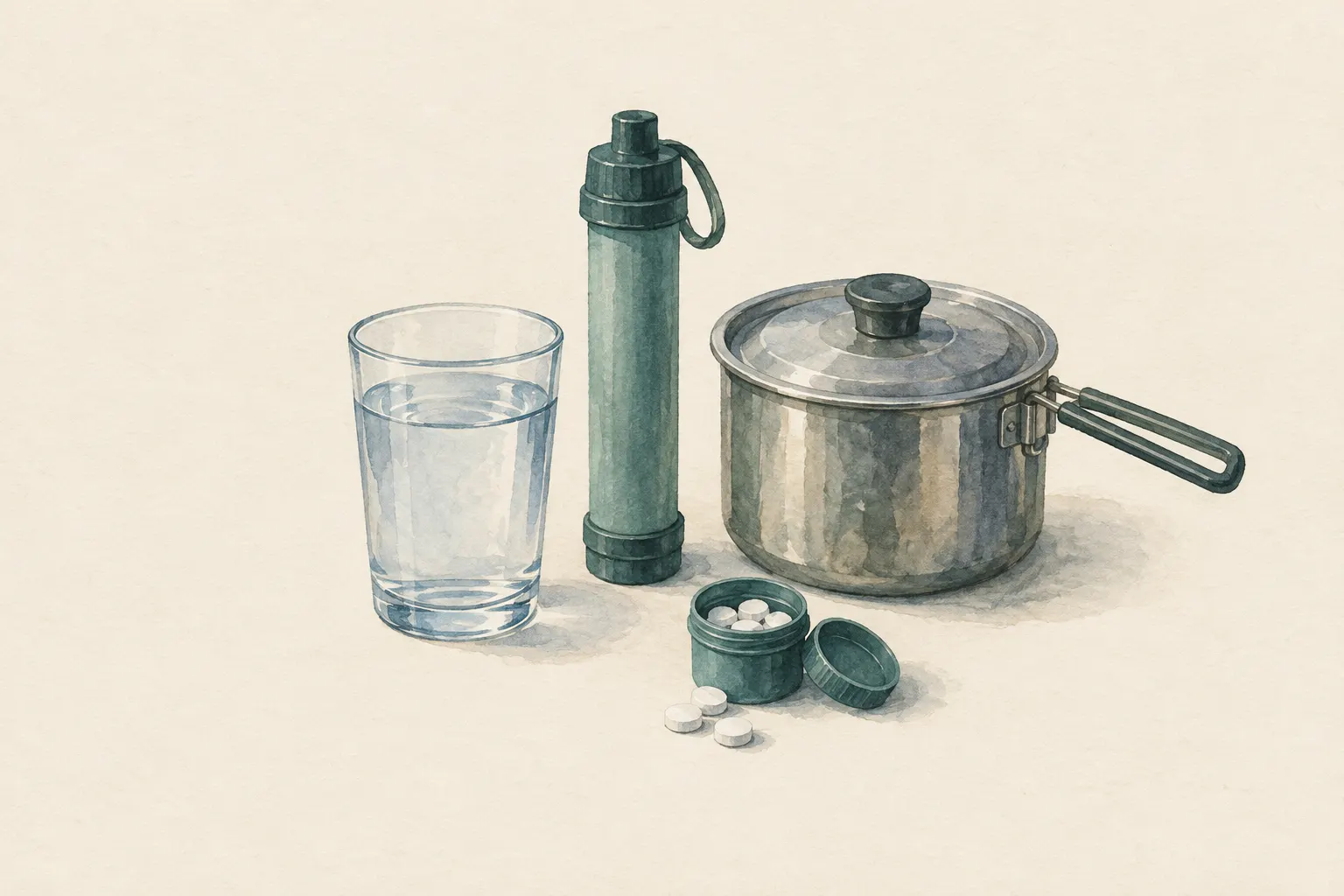
Explained simply
Water can make you ill in four different ways: it can be cloudy, it can contain tiny germs, it can contain dissolved chemicals, or it can be salty. Picture a house with four doors. Every method for making water safe closes only some of those doors – none closes all of them at once.
Most mistakes happen because people believe something that is not true. For example: “The water is so clear, it must be clean.” Or: “My filter stops everything.” But germs are so small that you cannot see them. And a filter that stops bacteria can still let some even smaller germs through.
The most important point: clear water is not automatically safe water. First think about which problems your water might have, then combine the right steps. If you suspect chemicals, boiling will not help – you need a different water source.
How it works: four problems, many barriers
Experts call this the multi-barrier approach. A barrier is a step that reduces one particular danger. Settling and pre-filtering remove cloudiness. Boiling, chemical disinfection, UV light or fine filters act against pathogens – but each works differently well against bacteria, viruses and protozoa (single-celled parasites such as Giardia or Cryptosporidium). Chemicals and salt stay in the water with most of these methods.
The groups of pathogens behave very differently. Viruses are so tiny that common outdoor filters do not reliably hold them back. Some protozoa have a tough shell and survive chlorine for a surprisingly long time. Bacteria, on the other hand, are handled well by most methods. That is why WHO evaluates household methods separately for these three groups.
Safe treatment therefore does not mean knowing “the best method”; it means knowing the gaps in every method. Boiling covers all three pathogen groups. A filter plus chemical disinfection can do the same, because each makes up for the other’s weaknesses.
Common misconceptions – and what is actually true
“Clear, cold or flowing water is safe.” – Wrong. A mountain stream can be crystal clear and still contain pathogens from animal droppings that entered the water further up. Cold and current do not kill germs either. “A cloth, sand or charcoal filter makes water germ-free.” – Wrong. Such filters reduce cloudiness, taste or some substances, but they are not disinfection. You still need to disinfect afterwards, for example by boiling.
“My hollow-fibre filter also stops viruses.” – Not reliably with common filters whose pores are around 0.1 to 0.2 micrometres, because many viruses are much smaller. “Chlorine kills everything.” – At usual doses chlorine has very little effect on Cryptosporidium. “Boiling also helps against chemicals.” – No. When water boils it evaporates, and some dissolved substances become even more concentrated.
“You can boil or filter seawater.” – The salt stays in the water either way. Only distillation or special desalination devices separate the salt. Drinking seawater makes the body’s water shortage worse.
What really matters: time, temperature, cloudiness
Chemical products need contact time. That is the time the active ingredient needs to reach and kill the pathogens. In cold water chemical reactions run more slowly – which is why many product instructions extend the waiting time for cold water. If you shorten this time because you are thirsty, you may be drinking water that is still contaminated. Always follow the product’s instructions.
Cloudiness is more than a cosmetic problem. Suspended particles can shield pathogens from UV light and use up part of the chlorine before it can work. They also clog filters. So the order is: clarify first (let it settle, pre-filter through a clean cloth), then disinfect.
The gear itself can also fail. Many hollow-fibre filters can be damaged if the water inside them freezes – and you cannot see the damage from outside. A filter that has frozen should therefore be checked or replaced according to the manufacturer before you trust it again.
Safety: what to watch out for
The most dangerous case is chemical contamination. After floods, or near industry, mining, roads or intensively farmed fields, water can contain substances that cannot be removed in the field. Here there is only one safe decision: use another source or officially supplied water and follow the authorities’ instructions.
A second, often overlooked mistake is recontamination. Clean water quickly becomes unsafe again if you pour it into an unwashed container, scoop it out with the raw-water cup or touch the bottle opening with dirty hands. Keep raw and drinking water strictly separate.
If symptoms such as severe diarrhoea, vomiting or signs of poisoning appear after drinking, get medical help or call the local emergency number (112 in the EU). This entry is a general overview – product information and official instructions always take precedence.
How to check your own routine
Ask four questions at every source: Is the water cloudy? Are there people or animals upstream? Are there signs of chemicals such as an oily film, a smell or industry? Is it salty? For every question you answer with “yes” or “maybe”, you need a matching barrier – or a different source.
At home, write down once which methods you carry and which pathogen groups they work against. If, for example, you only own a hollow-fibre filter, you are missing the barrier against viruses. You can then add chemical disinfection or boil the water. This way you discover gaps before you are outside.
Practise the sequence calmly: collect water, clarify, disinfect, fill cleanly, wait out the contact time. If you know the steps, you will make fewer mistakes even when tired, cold or rushed.
Step by step
Assess the source
Ask: Is the water cloudy? Are there people or animals upstream? Are there signs of chemicals? Is it salty?
- 1
Assess the source
Ask: Is the water cloudy? Are there people or animals upstream? Are there signs of chemicals? Is it salty?
- 2
Clarify first
Reduce turbidity by settling and pre-filtering before you disinfect or filter.
- 3
Then disinfect deliberately
Choose a method or combination that covers bacteria, viruses and protozoa – e.g. boiling, or a filter plus chemical disinfection.
- 4
Store cleanly
Keep treated water in clean, closed containers.
Common mistakes
- Assuming clear, cold or flowing water is safe
- Treating cloth, sand or charcoal filters as disinfection
- Assuming 0.1–0.2 µm hollow-fibre filters stop viruses
- Assuming chlorine works against Cryptosporidium
- Shortening contact times, especially with cold water
- Using UV or chlorine on cloudy water without clarifying it
- Treating boiling as sufficient when chemicals are suspected
- Boiling or filtering seawater and assuming it is drinkable
- Continuing to use filters that have frozen
- Recontaminating treated water with raw water, dirty hands or containers
Quick view
Suitable for
- Checking your own treatment routine
- Choosing a combination of methods
Not suitable for
- Replacing a product's instructions
Safety
- No single method removes turbidity, all pathogens, chemicals and salt at once. Combine methods deliberately.
How it works
Water can have four kinds of problems: turbidity, pathogens (bacteria, viruses, protozoa), chemicals and salt. Each method acts on only part of them. Safe treatment means assessing the risks of the source and combining barriers so that every relevant risk is covered.
Deep knowledge
Background
WHO describes drinking-water safety as a sequence of barriers: source protection, clarification, disinfection and safe storage. If one barrier fails, the others should absorb the risk. This principle transfers directly to the field.
WHO evaluates household methods separately for bacteria, viruses and protozoa because their effectiveness differs greatly between pathogen groups. A method that works excellently against bacteria may fail against protozoa or viruses. The barrier overview makes these gaps visible.
Illustrations
| Method | Turbidity | Bacteria | Viruses | Protozoa (Giardia, Cryptosporidium) | Chemicals | Salt |
|---|---|---|---|---|---|---|
| Boiling water | No | Yes | Yes | Yes | No | No |
| Disinfection with chlorine | No | Yes | Yes | Partly | No | No |
| Disinfection with chlorine dioxide | No | Yes | Yes | Depends | No | No |
| UV disinfection and solar water disinfection (SODIS) | No | Yes | Depends | Depends | No | No |
| Hollow-fibre and membrane filters | Partly | Yes | No | Yes | No | No |
| Ceramic filters | Partly | Yes | No | Yes | No | No |
| Activated carbon | No | No | No | No | Partly | No |
| Improvised sand and gravel filter (teaching model) | Partly | No | No | No | No | No |
| Distillation and solar still | Yes | Yes | Yes | Yes | Partly | Yes |
| Sedimentation and pre-filtering | Partly | No | No | No | No | No |
Common mistakes
- Assuming clear, cold or flowing water is safe
- Treating cloth, sand or charcoal filters as disinfection
- Assuming 0.1–0.2 µm hollow-fibre filters stop viruses
- Assuming chlorine works against Cryptosporidium
- Shortening contact times, especially with cold water
- Using UV or chlorine on cloudy water without clarifying it
- Treating boiling as sufficient when chemicals are suspected
- Boiling or filtering seawater and assuming it is drinkable
- Continuing to use filters that have frozen
- Recontaminating treated water with raw water, dirty hands or containers
Limits and risks
- General overview – product information and official instructions take precedence
Sources
World Health Organization (2022): Guidelines for drinking-water quality, fourth edition incorporating the first and second addenda
Multi-barrier approach to drinking-water safety
World Health Organization (2016): Results of Round I of the WHO International Scheme to Evaluate Household Water Treatment Technologies
Evaluation of household methods separately for bacteria, viruses and protozoa
Centers for Disease Control and Prevention: CDC Yellow Book: Health Information for International Travel – Water Disinfection
Effectiveness of different methods per pathogen group