Activated carbon
Activated carbon binds certain dissolved substances to its large internal surface and thus improves smell and taste, for example after chlorination. It does not reliably remove pathogens, removes no salt and only some chemicals. Charcoal from a campfire is not activated carbon.
- Usable immediately; replace cartridges per manufacturer
Explained simply
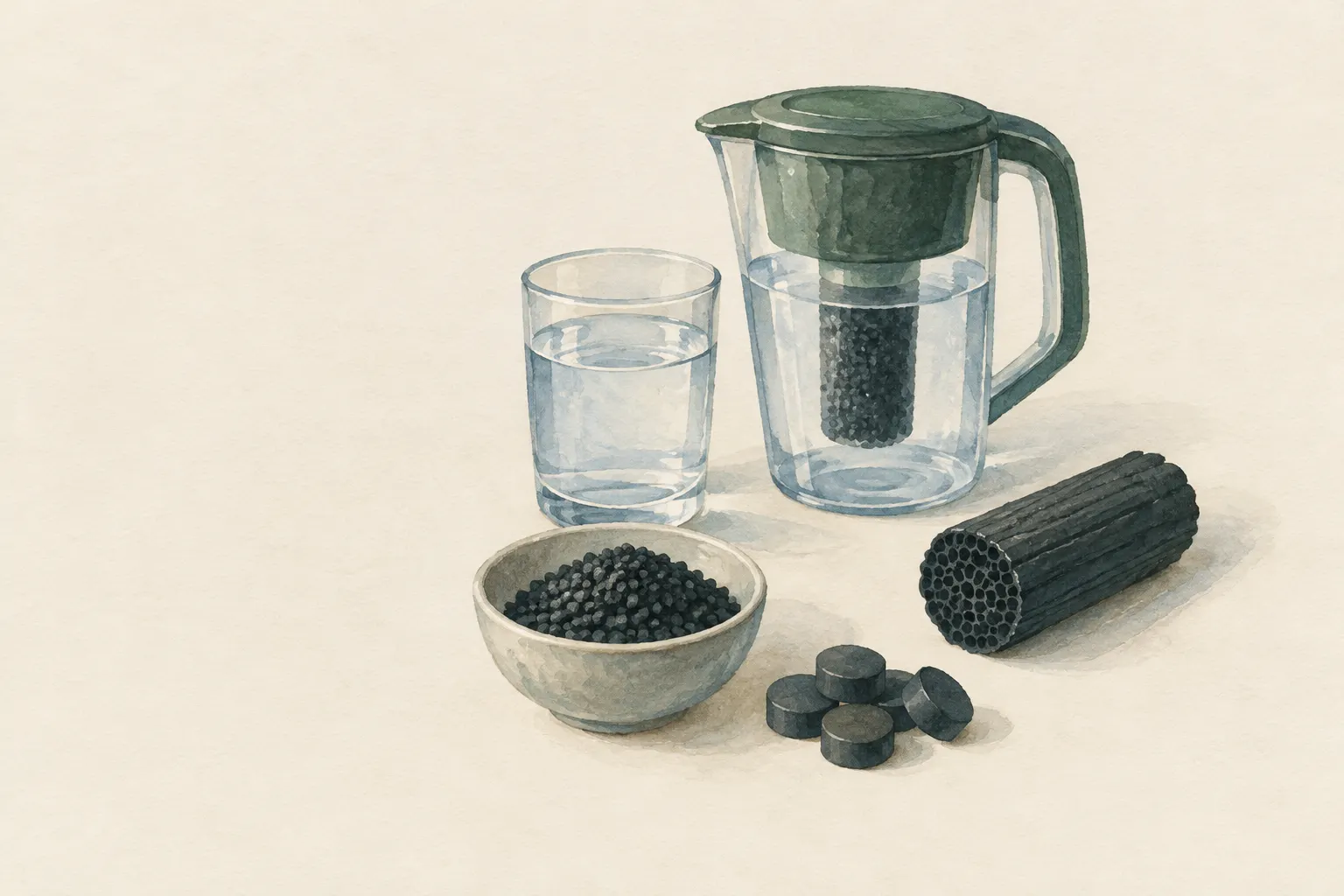
Activated carbon looks like black crumbs, but inside it is full of tiny caves and tunnels. That gives it a huge surface, much larger than you would guess from the small piece. Certain substances stick to this surface, a bit like fluff on a lint roller – for example substances that make water smell bad or taste of chlorine.
But: activated carbon does not make water germ-free. Water can taste wonderful afterwards and still contain germs. Salt stays in too. So activated carbon is only ever an addition. You still have to disinfect the water before or afterwards.
And one more thing: charcoal from the campfire or barbecue briquettes are not activated carbon. They hardly help, and briquettes can even contain additives.
How it works
Activated carbon is made from carbon-rich materials and „activated“ in a way that creates a dense network of extremely fine pores. Its internal surface is therefore exceptionally large. When water flows through, certain molecules attach to this surface. This is called adsorption – attaching to a surface, not soaking up like a sponge.
Chlorine and many organic compounds that cause smell and taste are bound well. Salts, nitrate and many metals, on the other hand, are bound poorly or not at all. Microorganisms are not reliably retained; in a moist, loaded carbon bed they can even multiply.
The effect is finite: once the surface is occupied, the carbon binds nothing more. You cannot see when that point is reached. Performance depends on carbon type, quantity, contact time and previous loading and cannot be checked in the field.
When it makes sense – and when not
Activated carbon is ideal for improving the taste of water that has already been disinfected – for example after chlorination. It removes the chlorine taste and many unpleasant smells. As part of a tested system it can also reduce certain organic substances.
Many outdoor and household filters combine a membrane or ceramic with an activated-carbon part. It is important to understand who does what: the membrane or ceramic holds back the pathogens, not the carbon. The carbon takes care of taste and smell.
Activated carbon is unsuitable for disinfection, for desalination and as the only measure for water containing heavy metals, nitrate or unknown chemicals. If chemical contamination is suspected, another source is the right answer.
What really matters
First settle microbiological safety: disinfect the water beforehand, or plan disinfection afterwards. Then pass the water slowly through the cartridge according to the manufacturer's instructions. The longer the water is in contact with the carbon, the better it can bind.
After chlorination, order matters: the chlorine's full contact time must have passed first. If you use the carbon too early, it removes the chlorine before it has made the germs harmless. Afterwards it removes the taste, but also the residual protection – the water should then be drunk soon or stored especially cleanly.
Note how much water you have filtered or how long the cartridge has been in use, and replace it as the manufacturer specifies. Do not wait until the water tastes bad – by then the carbon is long exhausted.
Safety: what to watch out for
Activated carbon is not a disinfection method. Good looks, good smell and good taste say nothing about pathogens. Always disinfect water from nature – before or after the carbon – for example by boiling or chlorination according to instructions.
Campfire charcoal and barbecue briquettes are not activated carbon. Their effect is small and unknown, and briquettes may contain binders and other additives. They do not belong in a water filter, not even an improvised one.
Exhausted cartridges, or cartridges kept damp for a long time, no longer bind anything and can promote microbial growth. Follow the manufacturer's replacement interval and store cartridges as the instructions say.
Myths and facts
A common myth says: „A carbon filter makes water clean.“ That is a dangerous misconception. Carbon makes water more pleasant, not safe. Precisely because the water tastes good afterwards, it tempts people to skip the actual disinfection.
A second myth: „Any charcoal filters.“ Ordinary charcoal has a much smaller and unknown internal surface. Activated carbon is made specifically to create this surface – without that process, the effect is largely missing.
In drinking-water treatment, activated carbon is a proven component against taste, smell and certain organic trace substances. Used correctly, it is a sensible addition – always together with a method that reliably makes pathogens harmless.
Step by step
Settle microbiological safety
Disinfect the water beforehand or plan disinfection afterwards.
- 1
Settle microbiological safety
Disinfect the water beforehand or plan disinfection afterwards.
- 2
Pass through the cartridge
Pass the water slowly through the cartridge according to the manufacturer's instructions; a longer contact time improves adsorption.
- 3
Replace in time
Track volume or time of use and replace the cartridge as specified – not only when the water starts tasting bad.
Common mistakes
- Treating activated carbon as a disinfection method
- Using campfire charcoal as a substitute
- Using cartridges beyond their capacity
- Using carbon too early after chlorination and removing the residual chlorine before the contact time is over
Quick view
Materials
Activated carbon (filter cartridge)
Does not reliably remove pathogens; replace regularly.
Food-grade water container
Only use containers that never held chemicals or fuel.
Suitable for
- Improving taste and smell after chlorination
- Reducing certain organic substances as part of a tested system
- Post-treatment of disinfected water
Not suitable for
- Disinfection
- Seawater or salt removal
- Water with heavy metals, nitrate or unknown chemicals as the only measure
Prerequisites
- Water already microbiologically safe, or disinfection afterwards
- Cartridge within its rated capacity
Safety
- Exhausted cartridges no longer bind anything and can promote microbial growth. Follow the manufacturer's replacement interval.
How it works
Activated carbon is manufactured to have a very large internal surface. Certain molecules – such as chlorine and many organic compounds that cause smell and taste – attach to it (adsorption). Once the surface is occupied, the effect ends. Salts, many metals and nitrate are bound poorly or not at all, and microorganisms are not reliably retained.
Advantages
- Clearly improves taste and smell
- Reduces chlorine and some organic substances
- No fuel
Disadvantages
- No disinfection
- Limited capacity that is not visible
- Ineffective against salt, nitrate and many metals
Deep knowledge
Background
In drinking-water treatment, activated carbon is a method against taste, smell and certain organic trace substances. Its performance depends on carbon type, quantity, contact time and loading, and cannot be checked in the field.
The idea that a carbon filter makes water ‘clean’ is a common and dangerous misconception. Water that tastes good can still contain pathogens; activated carbon is therefore always a complement to a disinfection method, never a substitute.
Variants
- Combination filters
- Many outdoor and household filters combine a membrane or ceramic with activated carbon. Pathogen retention then comes from the membrane or ceramic, not from the carbon.
Common mistakes
- Treating activated carbon as a disinfection method
- Using campfire charcoal as a substitute
- Using cartridges beyond their capacity
- Using carbon too early after chlorination and removing the residual chlorine before the contact time is over
Limits and risks
- Does not reliably remove bacteria, viruses or protozoa
- Only partial effect on chemicals
- Does not remove salt
Material alternatives
Derived from material properties: a substitute must have all relevant properties. Observe the notes on the substitute.
- Food-grade water container
- Single-wall stainless steel bottle (Heat only single-wall bottles without paint/plastic; remove the lid before heating.), Double-wall insulated bottle (Never heat directly.), PET bottle (clear, max. 2 litres) (Do not heat or place in a fire.), Airtight food-grade storage container (Fill only when clean and completely dry; never use containers that previously held chemicals.), Collapsible water container or bag (Protect from sharp objects.), Food-grade water bag (Use only for drinking water, never for chemicals or fuel.), Fermentation jar or crock (Use only food-grade containers of glass, food-safe glazed stoneware or food-grade plastic – no metal containers for acidic food.), Resealable food bags (Use only bags intended for food; do not use with boiling water unless the manufacturer explicitly allows it.)
Results come exclusively from structured entries. No improvised instructions are generated.
Sources
Centers for Disease Control and Prevention: CDC Yellow Book: Health Information for International Travel – Water Disinfection
Activated carbon improves taste and reduces some chemicals but does not reliably remove pathogens
World Health Organization (2022): Guidelines for drinking-water quality, fourth edition incorporating the first and second addenda
Adsorption on activated carbon in drinking-water treatment