Ceramic filters
Ceramic filters retain protozoa and – depending on pore size and quality – bacteria and can be cleaned by scrubbing. Viruses are not reliably removed, nor are chemicals and salt. Cracks make the filter ineffective without any visible change in the water.
- Slow flow; pumping or gravity, regular cleaning
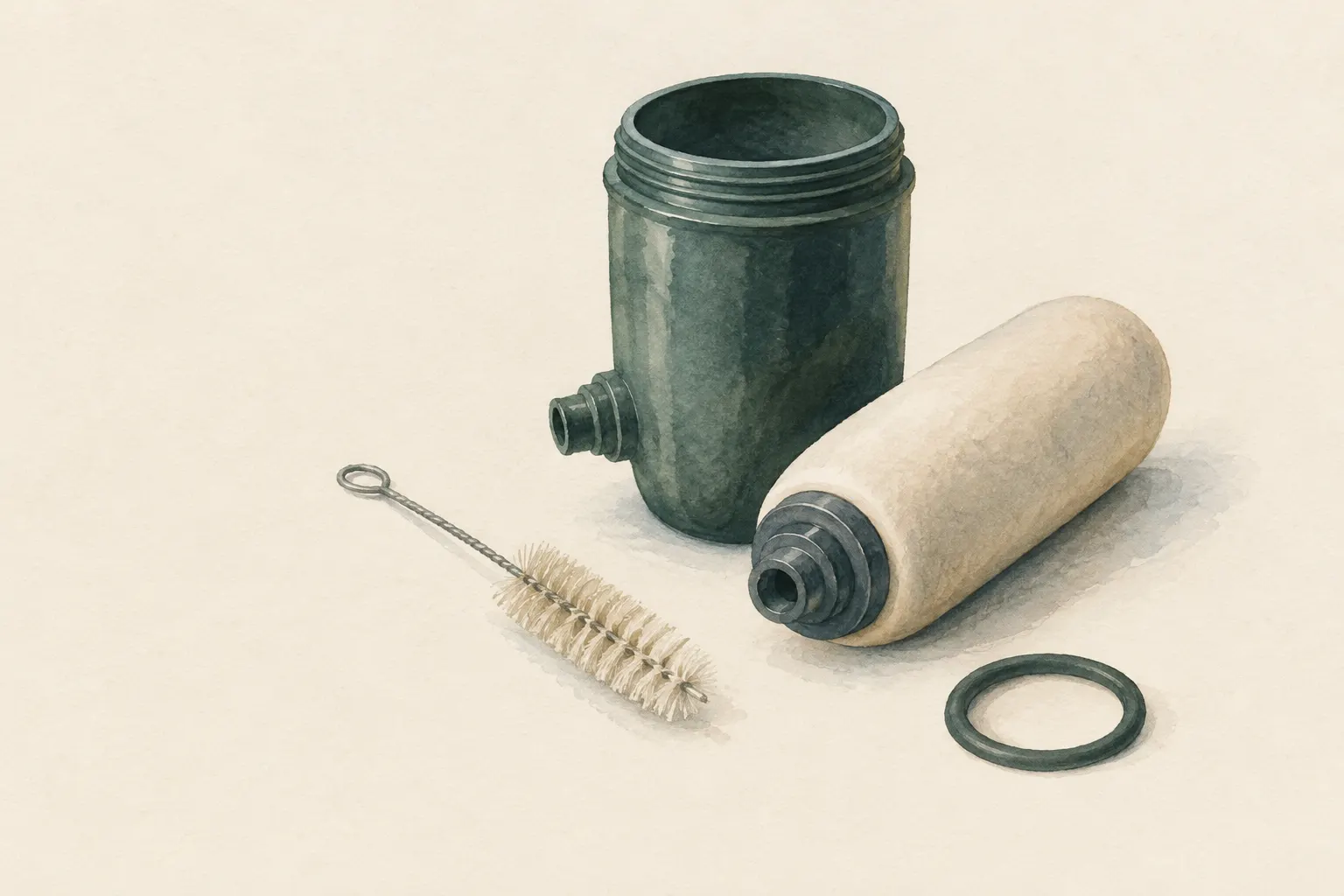
Explained simply
A ceramic filter is a piece of fired clay, a bit like a flowerpot, only made much more finely. It is full of tiny channels. Water seeps slowly through, but dirt and larger germs such as parasites and – depending on the filter – bacteria stay stuck on the outside. When the filter clogs, you simply scrub the layer of dirt off.
You need to know two things. First: viruses are so tiny that they can slip through the channels, and dissolved substances such as salt or poison pass through too. So filtered water is not automatically safe. If people live nearby or you are unsure, you also make the water germ-free afterwards, for example by boiling.
Second: ceramic can break. Even a fine crack that you can hardly see lets germs through – and the water still looks clear. So check the filter before every use and every time it has been dropped.
How it works
Firing creates a network of fine, winding pores in the ceramic. Water is pumped through the wall or seeps through by gravity. Particles and pathogens larger than the narrowest points of these pores stay mainly on the outer surface. Protozoa are reliably retained this way, bacteria depending on the pore size and quality of the filter.
Because the dirt collects on the surface, it can be scrubbed off. Each time, a very thin layer of ceramic is removed. That is why every element has a minimum wall thickness; some manufacturers include a gauge for checking when the element must be replaced.
Some elements are treated with silver to inhibit the growth of germs inside the filter itself; others contain a core of activated carbon for better taste. Neither changes the fact that viruses, salt and many chemicals can pass through the filter.
What really matters
Before each use, check the ceramic element and the seals: cracks, chips or a crooked fit rule it out. Let cloudy water settle first or pour it through a cloth – this protects the ceramic, because you need to scrub it less often.
With a pump filter, the intake hose always stays on the raw-water side and the outlet points into a clean container. With a gravity filter, the raw-water vessel is on top and the clean-water vessel below; they must never be swapped. When the flow slows down, scrub the surface according to the instructions.
Cleaning requires care: hands, outlet and clean side must not come into contact with raw water. It is best to clean with clean water and wash your hands afterwards before reassembling the filter.
Safety: what to watch out for
A cracked or chipped element lets pathogens through, and you cannot tell from the water. Check after any fall and before each use; replace if in doubt. Although ceramic is less frost-sensitive than hollow fibres, frost or knocks can cause fine hairline cracks. A filter whose integrity you cannot check counts as ineffective.
Ceramic filters do not reliably retain viruses. Where people live, where sewage or flood water is involved, or whenever you are unsure, additionally disinfect the filtrate – with chlorine, chlorine dioxide or by boiling. Whenever the authorities issue advice, such as boil-water notices, always follow it.
The filter does not help against salt and chemicals. Seawater or water suspected of containing fuel, pesticides or heavy metals does not become drinkable this way.
Designs and typical situations
Pump filters with a ceramic candle are compact hand pumps for trips. They are robust against clogging because they can be cleaned, but they are heavier and slower than hollow-fibre filters. That makes them less suited to quick, lightweight supply on the move.
At home and in development work, pot and candle filters are common: a ceramic pot or filter candle sits between two vessels, and the water drips through by gravity. This filters larger volumes without effort – ideal for households, base camps and groups with time.
In each of these situations the multi-barrier principle applies: pre-clarify, filter and, where viruses are a risk, disinfect. Keep the filtered water in clean, closed containers so that it is not contaminated again.
Good to know
Ceramic filters are among the oldest industrially made water filters and are used worldwide in household water treatment. Their performance depends heavily on manufacture and quality control. Retention claims apply only to the specific tested product – not to „ceramic“ in general, and certainly not to home-fired clay.
Compared with a hollow-fibre filter, ceramic is heavier, slower and more fragile, but cleanable, long-lasting and less frost-sensitive. Which filter suits you better depends on whether weight and speed or durability and volume matter more.
The flow is a good indicator of condition: when it slows, dirt is building up and it is time to clean. The wall thickness tells you how long the element will last – plan a replacement in good time.
Step by step
Inspect the element
Check the ceramic element and the seals for cracks, chips and correct fit.
- 1
Inspect the element
Check the ceramic element and the seals for cracks, chips and correct fit.
- 2
Pre-clarify
Let cloudy water settle or pour it through a cloth to protect the ceramic.
- 3
Filter
Pump or gravity-filter according to the instructions into a clean container. The intake hose stays on the raw-water side.
- 4
Disinfect if required
If viruses are a concern, disinfect the filtrate chemically or boil it.
- 5
Clean and check wear
Scrub the surface according to the instructions when flow drops, and check the wall thickness with the supplied gauge, if provided.
Common mistakes
- Continuing to use a dropped element without checking it
- Assuming the filter protects against viruses
- Touching the clean side with dirty hands
- Scrubbing the element below its minimum wall thickness
Quick view
Materials
Ceramic filter
Fragile; cracks make the filter ineffective.
Food-grade water container
Clean receiving container
Only use containers that never held chemicals or fuel.
Cotton cloth / T-shirt
Pre-filter
Removes coarse particles only – no disinfection.
Suitable for
- Households, base camps, groups with time
- Slightly cloudy water (cleanable)
- Water from areas with low virus risk
Not suitable for
- Water with a virus risk without additional disinfection
- Chemically contaminated water or seawater
- Quick, lightweight supply on the move
Prerequisites
- Undamaged filter element
- Manufacturer's instructions on cleaning and replacement
Safety
- Ceramic filters do not reliably retain viruses. If viruses are a risk, additionally disinfect chemically or boil.
- When cleaning, do not contaminate the clean side, the outlet or your hands with raw water.
How it works
Fired ceramic contains a network of fine pores through which water slowly seeps. Larger pathogens and particles stay on the surface and are removed by scrubbing. Some elements are treated with silver to inhibit microbial growth in the filter or contain an activated-carbon core to improve taste.
Advantages
- Cleanable and long-lasting
- No fuel, no chemicals
- Reliably retains protozoa
- Less frost-sensitive than hollow fibres
Disadvantages
- Fragile
- Slow, heavier
- No reliable virus retention
- No effect on chemicals and salt
Deep knowledge
Background
Ceramic filters are among the oldest industrially made water filters and are used worldwide in household water treatment. Their performance depends heavily on manufacture and quality control; retention claims apply only to the specific tested product.
Although ceramic is less frost-sensitive than hollow fibres, hairline cracks can result from frost or impacts. A filter whose integrity cannot be checked should be regarded as ineffective.
Variants
- Pump filter
- Compact hand pump with a ceramic candle for trips; robust against clogging because it can be cleaned, but heavier than hollow-fibre filters.
- Pot and candle filters at home
- Ceramic pots or filter candles between two vessels gravity-filter larger volumes; widely used in household water treatment.
Common mistakes
- Continuing to use a dropped element without checking it
- Assuming the filter protects against viruses
- Touching the clean side with dirty hands
- Scrubbing the element below its minimum wall thickness
Limits and risks
- No reliable virus retention
- Does not remove chemicals and salt
- Performance depends on manufacturer
Material alternatives
Derived from material properties: a substitute must have all relevant properties. Observe the notes on the substitute.
- Food-grade water container
- Single-wall stainless steel bottle (Heat only single-wall bottles without paint/plastic; remove the lid before heating.), Double-wall insulated bottle (Never heat directly.), PET bottle (clear, max. 2 litres) (Do not heat or place in a fire.), Airtight food-grade storage container (Fill only when clean and completely dry; never use containers that previously held chemicals.), Collapsible water container or bag (Protect from sharp objects.), Food-grade water bag (Use only for drinking water, never for chemicals or fuel.), Fermentation jar or crock (Use only food-grade containers of glass, food-safe glazed stoneware or food-grade plastic – no metal containers for acidic food.), Resealable food bags (Use only bags intended for food; do not use with boiling water unless the manufacturer explicitly allows it.)
Results come exclusively from structured entries. No improvised instructions are generated.
Sources
Centers for Disease Control and Prevention: CDC Yellow Book: Health Information for International Travel – Water Disinfection
Filtration by pore size and limitations for viruses
World Health Organization (2022): Guidelines for drinking-water quality, fourth edition incorporating the first and second addenda
Ceramic filters as a household water treatment method