Sedimentation and pre-filtering
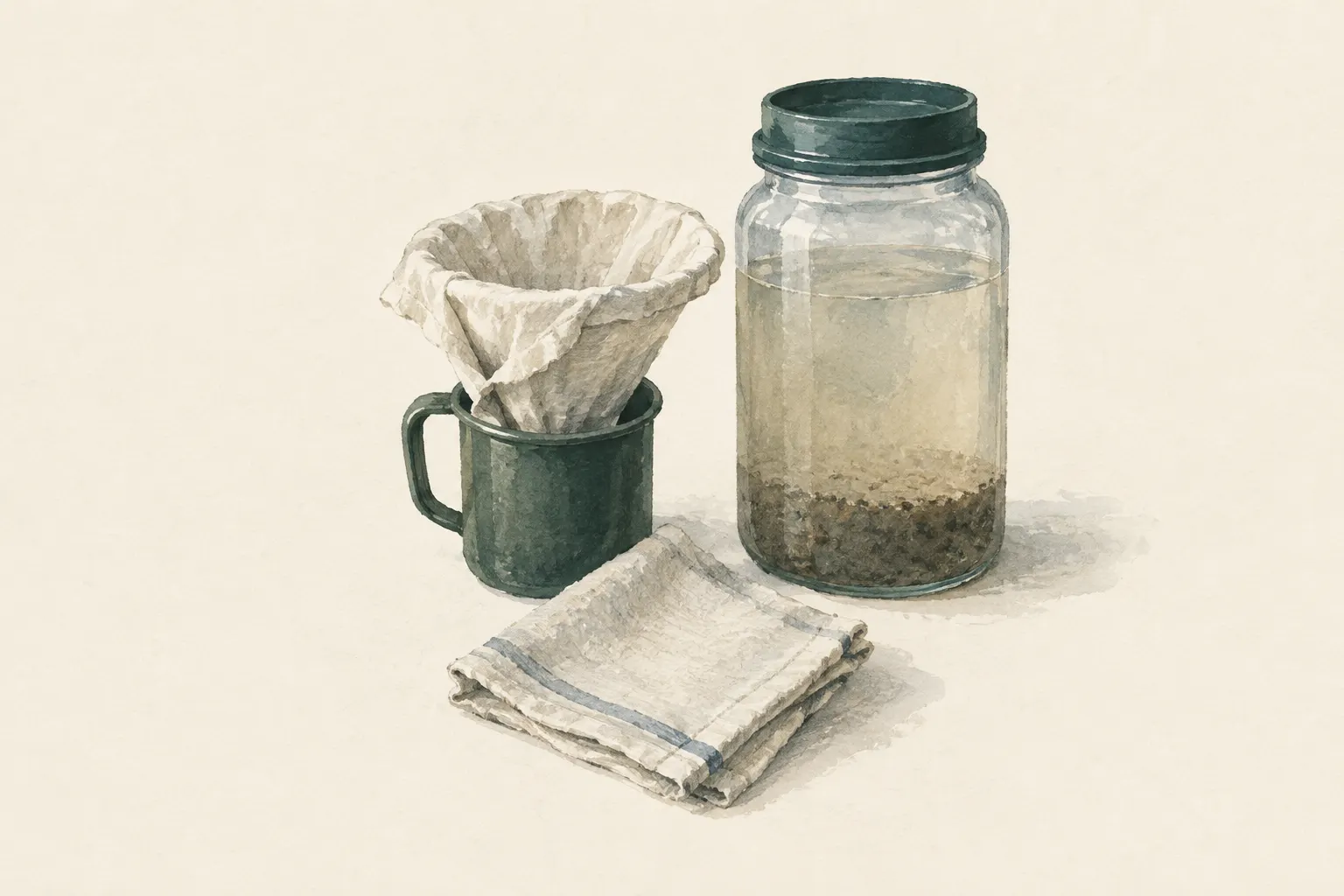
Cloudy water is clarified by letting suspended particles settle and pouring the water through a cloth or coffee filter. This is a pre-treatment, not treatment: the water is clearer afterwards but not safe and must then be disinfected.
- A few minutes of work; settling takes from about an hour to overnight depending on the water
Explained simply
Imagine a glass of water with sand in it. When you stir it, everything goes cloudy. When you leave it to stand, the sand slowly sinks to the bottom and the water at the top becomes clearer. That is exactly what „letting it settle“ means. Afterwards you carefully pour off the clear water and also pour it through a clean cloth or a coffee filter.
That helps a lot: clear water is much easier to make germ-free, and filters do not clog as quickly. But afterwards the water only looks cleaner. The tiny germs are so small that they slip through the cloth.
The most important point: water that has settled or been poured through a cloth is never ready to drink. You still have to disinfect it afterwards, for example by boiling.
How it works
In still water, particles that are heavier than water sink to the bottom by gravity. Coarse sand reaches the bottom in seconds, fine silt takes minutes to hours, and very fine clay particles sometimes stay suspended for days. The stiller the water and the longer you wait, the more settles out.
A cloth or coffee filter works like a very fine sieve: it holds back leaves, insects, grains of sand and coarser suspended matter. Densely woven cotton folded several times holds back more than a single layer. Bacteria and viruses, however, are so tiny that they fit through the gaps in the fabric.
Together, both steps are called pre-treatment or clarification. They change how the water looks and create good conditions for the step that really matters: disinfection.
Why clarifying matters so much
Water treatment follows the multi-barrier principle: several steps one after another, each doing part of the job. First clarify, then disinfect. Experts and authorities therefore recommend letting cloudy water settle or pouring it through a clean cloth, paper towel or coffee filter before disinfection.
Particles are like hiding places for pathogens: behind a speck of dirt, germs are protected from UV light, and chlorine is partly „used up“ by the dirt before it reaches the germs. Solar disinfection and UV devices explicitly need clear water.
Filters benefit too: a hollow-fibre or ceramic filter that you push muddy water through clogs quickly and needs constant cleaning. Letting water settle first saves effort and time and extends the life of your filter.
What really matters
Pour the raw water into a clean container and let it stand without moving it. Depending on the water this takes from about an hour to overnight. Then pour or scoop off the clear water from the top, slowly and evenly, so that the sediment stays at the bottom. Discard the cloudy rest.
Then pour the decanted water through a clean cotton cloth folded several times, or a coffee filter, into a second clean container. A funnel or a cloth stretched over the container makes this easier. The cloth is now a „raw-water cloth“ and must not touch treated water again.
In households, the three-pot method has proved its worth: water is stored in one vessel so that it settles, and transferred daily into a second and third. Longer standing improves clarification – disinfection is still required.
Safety: what to watch out for
The most dangerous mistake is to assume clear water is drinkable. Settling and cloth filters do not reliably hold back bacteria, viruses or most parasites. Without disinfection afterwards – for example boiling or chlorination following the manufacturer's instructions – the water is not safe.
Dissolved substances such as salt, fuel, pesticides or heavy metals stay in the water, however long it stands or however many cloths it runs through. If the water comes from a source where chemicals are suspected, such as flood water or downstream of industry, clarifying does not help – choose another source.
Keep the raw-water container and cloth away from everything meant for finished water. Wash your hands after handling raw water before you touch treated water.
Limits and good to know
Some turbidity barely settles – very fine clay, for example, that makes water milky or muddy. Even waiting a long time helps little here. In such cases boiling is usually the most robust method, because it works even with moderately cloudy water; chlorine and solar disinfection reach their limits.
In development work, flocculants are used that stick the finest particles together into larger flocs, which then sink. This works well but requires tested products and their exact instructions. As an improvisation with household products it is deliberately not described here.
Settling costs nothing but time: no fuel, no chemicals, hardly any material. That is why it is almost always worthwhile when water is cloudy and you are not under great time pressure.
Step by step
Fill and let stand
Pour the raw water into a clean container and let it stand undisturbed until sediment has formed.
- 1
Fill and let stand
Pour the raw water into a clean container and let it stand undisturbed until sediment has formed.
- 2
Decant carefully
Pour or scoop off the clear water from the top without stirring up the sediment. Discard the rest.
- 3
Pour through cloth or filter paper
Pour the decanted water through a clean, folded cotton cloth or a coffee filter into a second clean container.
- 4
Disinfect
Then disinfect the clarified water, e.g. by boiling, chlorination or a suitable filter followed by disinfection.
Without this step the water is not safe.
Common mistakes
- Assuming water is drinkable once it looks clear after settling
- Stirring up the sediment when decanting
- Using the same cloth for raw and treated water
- Settling too briefly and clogging a fine filter straight away
Quick view
Materials
Food-grade water container
Or another clean container for settling
Only use containers that never held chemicals or fuel.
Cotton cloth / T-shirt
Removes coarse particles only – no disinfection.
Coffee filter
Does not disinfect.
Metal pot (stainless steel, aluminium, titanium)
Hot – scalding risk.
Suitable for
- Cloudy river, pond or flood water before disinfection
- Protecting filters from clogging quickly
- Preparing water for chlorination, UV and SODIS, which need clear water
Not suitable for
- As the only treatment
- Removing dissolved chemicals or salt
- Very fine turbidity that does not settle (e.g. some clays)
Prerequisites
- Two clean containers
- A disinfection method to follow
Safety
- Keep the cloth and raw-water container away from treated water.
How it works
Heavy particles sink to the bottom of still water by gravity. A folded cloth or coffee filter also retains coarser suspended matter. Less turbidity improves the effect of the disinfection that follows, because pathogens can no longer shelter behind particles, and it protects filters.
Advantages
- Possible with almost no material
- Improves effect and lifespan of the methods that follow
- No fuel, no chemicals
Disadvantages
- No disinfection
- Time-consuming
- Has little effect on very fine turbidity
Deep knowledge
Background
Water treatment follows the multi-barrier principle: clarify first, then disinfect. Turbidity shields microorganisms from chlorine and UV light and consumes disinfectant. Authorities therefore recommend letting cloudy water settle or pouring it through a clean cloth, paper towel or coffee filter before disinfection.
In development work, flocculants are used that bind fine particles into settling flocs. They require tested products and their instructions and are not described here as an improvisation.
Variants
- Three-pot method
- In households, water is stored in one vessel to settle and transferred daily into a second and third. Longer standing improves clarification; disinfection is still required.
Common mistakes
- Assuming water is drinkable once it looks clear after settling
- Stirring up the sediment when decanting
- Using the same cloth for raw and treated water
- Settling too briefly and clogging a fine filter straight away
Limits and risks
- Reduces turbidity only
- Does not reliably remove pathogens, chemicals or salt
Material alternatives
Derived from material properties: a substitute must have all relevant properties. Observe the notes on the substitute.
- Food-grade water container
- Single-wall stainless steel bottle (Heat only single-wall bottles without paint/plastic; remove the lid before heating.), Double-wall insulated bottle (Never heat directly.), PET bottle (clear, max. 2 litres) (Do not heat or place in a fire.), Airtight food-grade storage container (Fill only when clean and completely dry; never use containers that previously held chemicals.), Collapsible water container or bag (Protect from sharp objects.), Food-grade water bag (Use only for drinking water, never for chemicals or fuel.), Fermentation jar or crock (Use only food-grade containers of glass, food-safe glazed stoneware or food-grade plastic – no metal containers for acidic food.), Resealable food bags (Use only bags intended for food; do not use with boiling water unless the manufacturer explicitly allows it.)
- Coffee filter
- Cotton cloth / T-shirt (Removes coarse particles only – no disinfection.), Gravel, Charcoal from a campfire (Not activated carbon: adsorption capacity is low and unknown.)
- Metal pot (stainless steel, aluminium, titanium)
- Single-wall stainless steel bottle (Heat only single-wall bottles without paint/plastic; remove the lid before heating.)
Results come exclusively from structured entries. No improvised instructions are generated.
Sources
Centers for Disease Control and Prevention: Making Water Safe in an Emergency
Letting cloudy water settle or pouring it through cloth/coffee filter before disinfection
World Health Organization (2022): Guidelines for drinking-water quality, fourth edition incorporating the first and second addenda
Multi-barrier principle and the effect of turbidity on disinfection