Improvised sand and gravel filter (teaching model)
A bottle filter of cloth, sand and gravel clearly demonstrates how layers retain turbidity. It reduces turbidity only: it does not make water safe and does not reliably remove pathogens, chemicals or salt. The filtrate must always be disinfected.
- About 30 minutes to build; flushing and running-in required
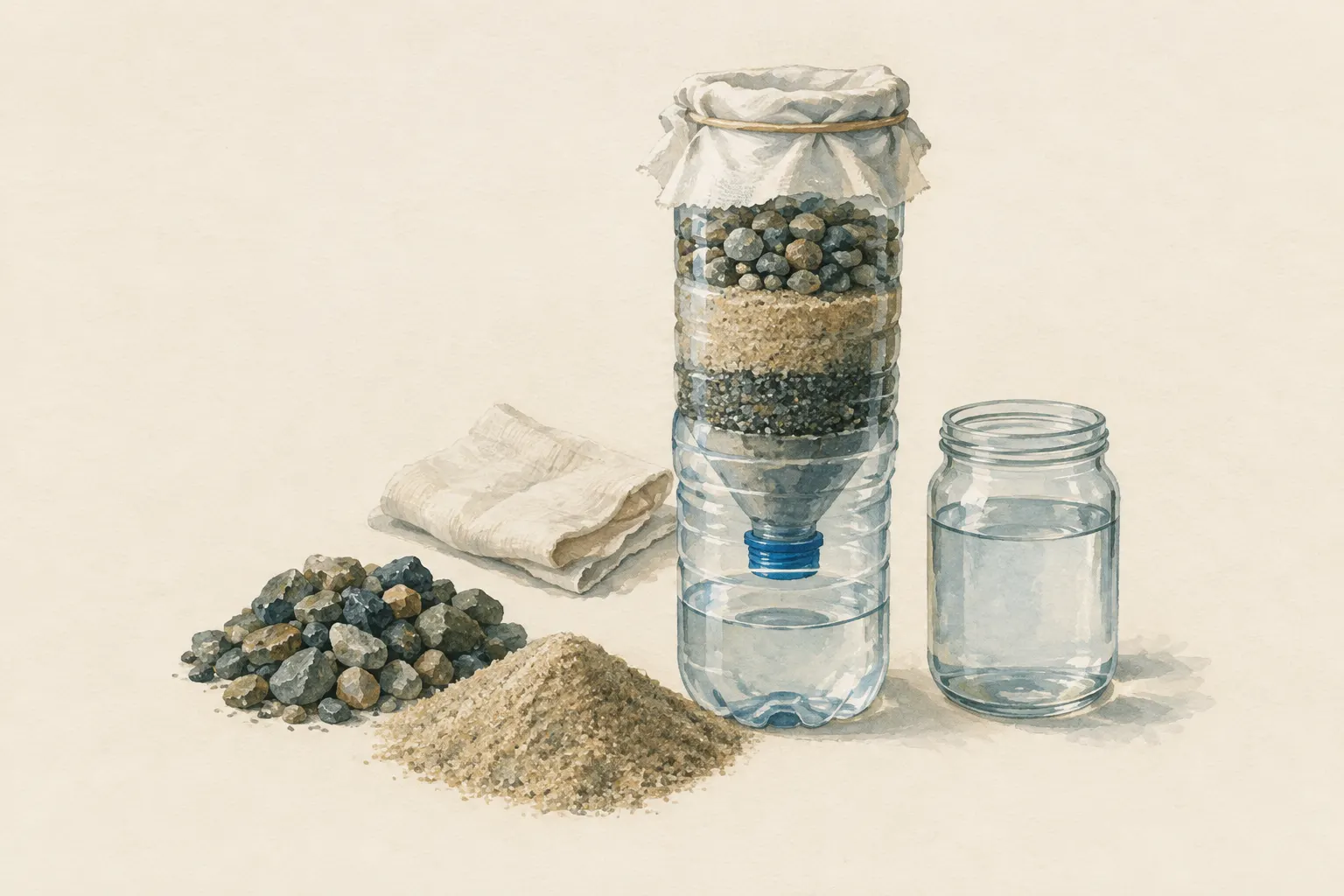
Explained simply
Imagine a stack of sieves: a cloth on top, fine sand beneath, then coarse sand, and gravel at the very bottom. You fill all this into an upside-down plastic bottle with the bottom cut off. When you pour cloudy water in at the top, specks of dirt get caught between the grains of sand, and clearer water drips out at the bottom. It is a great experiment for understanding how filters work.
But careful: clear does not mean safe. Germs are so tiny that many of them simply slide between the grains of sand. Poison and salt get through anyway. This model only makes water look nicer, not drinkable.
So the rule is always: you must disinfect water from this filter afterwards, for example by boiling it. And do not use charcoal from the campfire as a layer – it is not activated carbon and does not help.
How it works
Between grains of sand and gravel there are small gaps through which the water trickles. Coarse layers hold back large particles, fine sand the smaller ones. Suspended matter gets caught in the gaps or attaches to the grains, and the water becomes visibly clearer.
Microorganisms, however, are much smaller than the gaps between grains of sand. Many bacteria, viruses and parasites pass an improvised sand bed unhindered. Dissolved substances such as salt, nitrate or fuel components also simply pass through.
Tested slow sand filters work differently: in them, a biologically active layer forms on the surface over weeks under controlled conditions and breaks down some of the pathogens. This needs a defined sand grading, a particular design and steady operation. A bottle of sand built today and used today does not achieve that.
What the model is good for
In class, in a youth group or when learning at home, the model shows very clearly how layers hold back turbidity – and why clear water still need not be safe. That second part of the lesson is the more important one.
In practice, such a filter can pre-clarify cloudy water before it is boiled or chemically disinfected. Clearer water is easier to disinfect, and filters such as ceramic or hollow-fibre ones clog more slowly.
Often, however, you reach the same goal more simply: let the water settle and pour it through a clean cloth folded several times or a coffee filter. That takes less material and time and does the same job – preparing for disinfection.
What matters when building it
Use clean, ideally washed sand and gravel and a clean PET bottle. The cloth at the outlet stops gravel falling out; the cloth on top spreads the water so that the fine sand is not stirred up when pouring and no channels form.
A freshly built filter first flushes out fine sand and dust. So keep pouring water through until the filtrate is no longer cloudy from washed-out sand, and discard this flushing water. Only then does the actual filtering begin.
Pour slowly. If you fill the filter too fast, the water is pushed through a few large channels and the effect drops. Collect the filtrate in a clean container that you then use directly for disinfection.
Safety: what to watch out for
This filter does not make water drinkable. Clear-looking filtrate can contain bacteria, viruses and parasites. Boil it afterwards or disinfect it chemically according to instructions – without this step the water is not safe.
The filter itself becomes a source of germs: dirt and pathogens collect in the moist sand. Treat sand, gravel, cloths and bottle as contaminated after use, wash your hands afterwards and let none of it come into contact with treated water.
Chemically contaminated water, for example from floods or downstream of industry, and seawater do not get better through the filter. Only another source helps here. Campfire charcoal is deliberately not used in this model, because it does not demonstrably improve the safety of the water.
Myths and facts
Many survival videos and books show the bottle filter as a solution for dirty water, often with a layer of charcoal. That is misleading. Such filters improve the appearance of the water, not its safety – and because the result looks so convincingly clear, they tempt people to leave out disinfection.
In household water treatment there are tested biosand filters. They differ in precisely defined sand grading, design, operation and a biologically active layer that develops over weeks. Even for them, disinfection afterwards is recommended. The bottle model is not such a filter.
The real lesson of the model is: water treatment has several stages. Clarifying is the first, disinfecting the decisive one. Anyone who has understood that has learned more than someone who has merely built a nice-looking filter.
Step by step
Prepare the housing
Cut the bottom off a clean PET bottle, turn it upside down and tie a cloth over the opening as the outlet.
- 1
Prepare the housing
Cut the bottom off a clean PET bottle, turn it upside down and tie a cloth over the opening as the outlet.
- 2
Add the layers
Fill from the bottom up: gravel, coarse sand, fine sand. Place a cloth on top as a pre-filter so the sand is not stirred up when pouring.
- 3
Flush
Pour water through until the filtrate is no longer cloudy from washed-out sand. Discard the flushing water.
- 4
Filter slowly
Pour the raw water in slowly and collect the filtrate in a clean container.
- 5
Disinfect
Boil the filtrate or disinfect it chemically according to instructions.
Without disinfection the water is not safe.
Common mistakes
- Assuming clear filtrate is drinkable
- Adding campfire charcoal as ‘activated carbon’
- Feeding the filter too fast
- Using the filter for chemically contaminated water
Quick view
Materials
PET bottle (clear, max. 2 litres)
Bottom cut off, inverted as housing
Do not heat or place in a fire.
Cotton cloth / T-shirt
At the outlet and as a pre-filter
Removes coarse particles only – no disinfection.
Clean sand
Improvised sand layers do not reliably remove pathogens.
Gravel
Food-grade water container
Clean receiving container
Only use containers that never held chemicals or fuel.
Suitable for
- Teaching and demonstrating the filter principle
- Pre-clarifying cloudy water before boiling or chemical disinfection
Not suitable for
- As drinking-water treatment without disinfection
- Chemically contaminated water or seawater
- A substitute for tested household sand filters
Prerequisites
- Clean sand and gravel
- A disinfection method to follow
Safety
- Campfire charcoal is not activated carbon and does not demonstrably improve water safety; it is deliberately not used in this model.
- The filter itself becomes a source of germs: treat filter material and housing as contaminated after use.
How it works
Coarse layers retain large particles, fine sand the smaller ones. The water gets clearer because suspended matter is caught in the pores. Microorganisms, however, are so small that many of them pass an improvised bed unhindered. Tested slow sand filters only work through a biological layer that develops over weeks under controlled conditions – this model does not achieve that.
Advantages
- Illustrative for teaching
- Made from simple materials
- Reduces turbidity before disinfection
Disadvantages
- No reliable removal of pathogens
- No effect on chemicals and salt
- Performance unknown and not verifiable
- Becomes a source of germs itself
Deep knowledge
Background
Improvised layered filters appear in many survival depictions as a solution for dirty water. This is misleading: they improve the appearance of the water, not its safety. Precisely because the filtrate looks clear, they tempt people to skip disinfection.
In household water treatment there are tested biosand filters. They differ in defined sand grading, design, operation and a biologically active layer that develops over weeks. Disinfection afterwards is recommended for them too. The bottle model is not such a filter.
Common mistakes
- Assuming clear filtrate is drinkable
- Adding campfire charcoal as ‘activated carbon’
- Feeding the filter too fast
- Using the filter for chemically contaminated water
Limits and risks
- Reduces turbidity only
- No reliable effect on bacteria, viruses, protozoa, chemicals or salt
Material alternatives
Derived from material properties: a substitute must have all relevant properties. Observe the notes on the substitute.
- Gravel
- Cotton cloth / T-shirt (Removes coarse particles only – no disinfection.), Coffee filter (Does not disinfect.), Charcoal from a campfire (Not activated carbon: adsorption capacity is low and unknown.)
- Food-grade water container
- Single-wall stainless steel bottle (Heat only single-wall bottles without paint/plastic; remove the lid before heating.), Double-wall insulated bottle (Never heat directly.), PET bottle (clear, max. 2 litres) (Do not heat or place in a fire.), Airtight food-grade storage container (Fill only when clean and completely dry; never use containers that previously held chemicals.), Collapsible water container or bag (Protect from sharp objects.), Food-grade water bag (Use only for drinking water, never for chemicals or fuel.), Fermentation jar or crock (Use only food-grade containers of glass, food-safe glazed stoneware or food-grade plastic – no metal containers for acidic food.), Resealable food bags (Use only bags intended for food; do not use with boiling water unless the manufacturer explicitly allows it.)
Results come exclusively from structured entries. No improvised instructions are generated.
Sources
Centers for Disease Control and Prevention: Making Water Safe in an Emergency
Filtering cloudy water as a preliminary step; disinfection is still required
World Health Organization (2022): Guidelines for drinking-water quality, fourth edition incorporating the first and second addenda
Difference between clarification and disinfection; multi-barrier principle