Disinfection with chlorine
Chlorine tablets or suitable unscented household bleach kill bacteria and viruses and leave residual protection against recontamination. At normal doses chlorine is practically ineffective against Cryptosporidium and only partly effective against Giardia; turbidity and cold weaken the effect.
- A few seconds to dose, then at least 30 minutes contact time, or longer per manufacturer
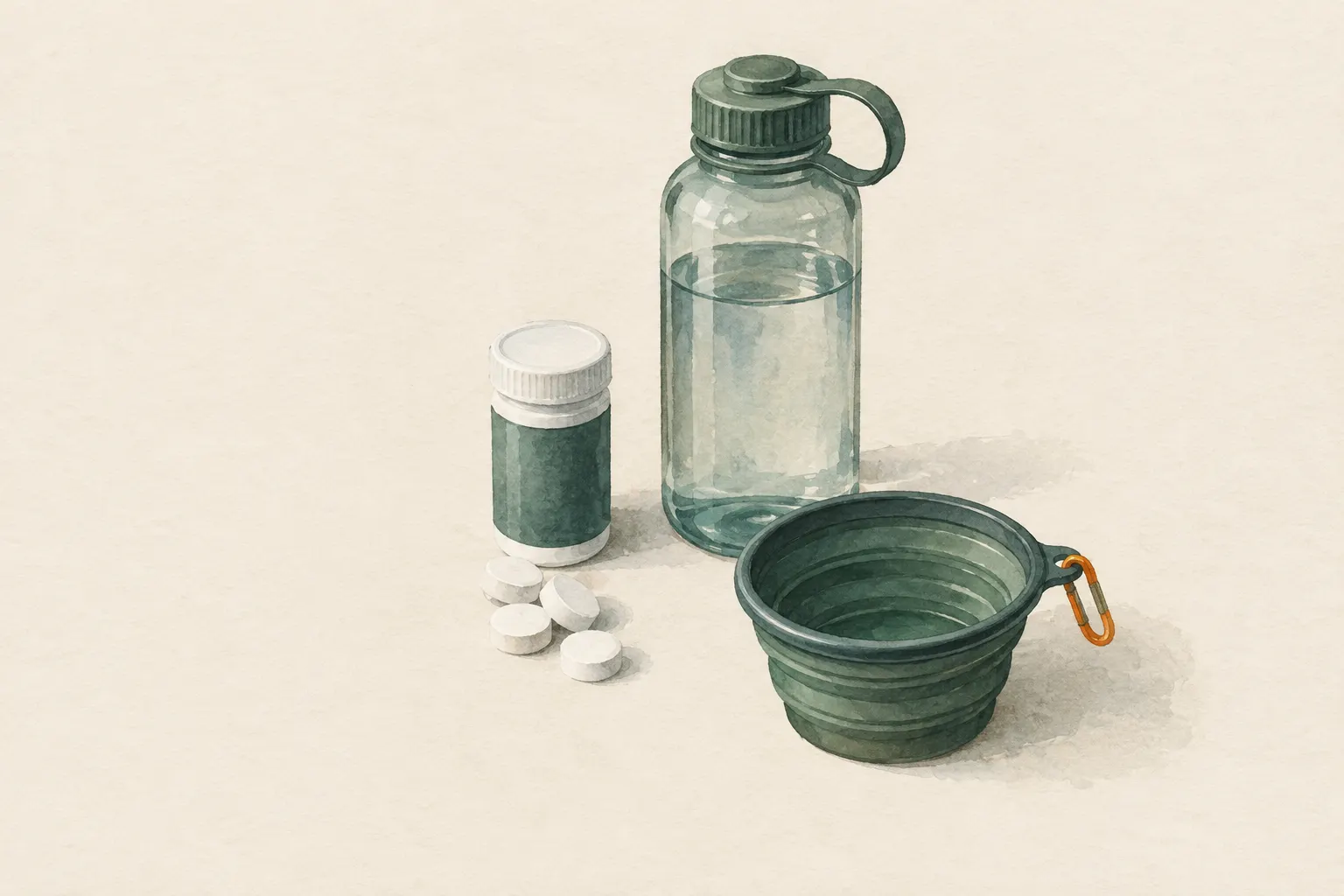
Explained simply
You may know the smell from the swimming pool: that is chlorine. It is a substance that attacks tiny germs and makes them harmless, a bit like a cleaning product, but in a very fine dose. For drinking water there are small tablets. You put one tablet into the right amount of water, shake and wait at least half an hour – or as long as the pack says.
The special thing: chlorine stays in the water for a while and keeps watch, like a guard. If a germ gets in later, it is caught as well. That makes chlorine good for water you want to store. But some parasites have a kind of armour. Against one of them, Cryptosporidium, chlorine practically does not work. If such germs are likely, you are better off boiling the water.
Very important: always dose exactly as instructed and never guess. And never mix bleach with other cleaning products – this can produce poisonous gases. Tablets and bleach must be kept out of children's reach.
How it works
Chlorine is an oxidant: it reacts with components of the cell walls and interior of microorganisms and destroys them. Bacteria and viruses are sensitive to this and are reliably inactivated at the right dose and contact time. Some parasites, so-called protozoa, protect themselves with a resistant shell. For Giardia, chlorine needs considerably longer; against Cryptosporidium it is practically ineffective at normal concentrations.
How well chlorine works depends on several things at once: dose, contact time, temperature, pH and turbidity. Cold water slows the reaction, so it needs more time there. Dirt and organic material „use up“ part of the chlorine before it reaches the germs.
If some free chlorine is left in the water after the contact time, it is called residual chlorine. It protects the water from recontamination for a while – an advantage that boiling, UV light and filters do not offer. A slight smell of chlorine after the contact time is a simple sign that chlorine is still present.
What really matters
The water should be clear. Let cloudy water settle first and pour it through a clean cloth or coffee filter. Then measure the volume exactly, because every dose refers to a particular volume. A container marked in litres or a bottle of known size helps.
Dose exactly according to the manufacturer or – for bleach – according to the official instructions of the public-health authority. Some authorities give a higher dose for cloudy water; then use exactly their figure and nothing estimated. Next, close the container, shake it and let some water run over the threads and the rim of the lid so that no germs survive there either.
Now you wait: at least 30 minutes or the longer time the manufacturer states, longer in cold water. Afterwards a slight chlorine smell should be noticeable. If it is absent, follow the authority's or manufacturer's instructions on re-dosing.
Tablets or household bleach
For trips and emergency stocks, tablets for drinking-water disinfection are the simplest choice. Many contain sodium dichloroisocyanurate (NaDCC). They are precisely dosed, light and keep for a long time; each tablet is intended for a specific volume of water stated on the pack.
Public-health authorities also describe disinfection with household bleach, i.e. a sodium hypochlorite solution, for emergencies. The bleach must be unscented, contain no additives, and its concentration must be known. The dose depends on that concentration and is taken exclusively from the authority's official table. This text deliberately gives no dose figures of its own.
Bleach loses strength over time, especially when stored warm or in the light. Expired or poorly stored products are unreliable. Store tablets and bleach cool, dark, dry and out of children's reach, and check the expiry date.
Safety: what to watch out for
Chlorine's biggest gap is resistant parasites. With surface water near grazing livestock or where people live, Cryptosporidium and Giardia must be expected. Then boil the water, or use a suitable filter that retains protozoa before chlorinating.
Never mix bleach with other cleaners, for example acidic products or those containing ammonia – this can produce toxic gases. If someone has swallowed undiluted bleach or tablets or has difficulty breathing, call the local emergency number (112 in the EU) or a poison control centre.
Chlorine does not work against chemicals, heavy metals or salt. Water suspected of such contamination, and seawater too, does not become drinkable through chlorination.
Good to know
Chlorination is the most widely used method of drinking-water disinfection worldwide. Many public water suppliers use it too, precisely because of the residual protection in long pipes. WHO, the CDC and the US Environmental Protection Agency (EPA) describe it explicitly for households and emergencies.
Many people dislike the chlorine taste. Add drink powders or flavourings only after the full contact time, because some additives bind the chlorine. If you leave the water standing open or pour it back and forth after the contact time, the taste becomes weaker – but part of the residual protection is lost as well.
For larger volumes at home or in camp, chlorine is often more practical than boiling: no fuel, little weight and many litres at once. Combining chlorine with a filter for protozoa covers bacteria, viruses and parasites together.
Step by step
Clarify the water
Let cloudy water settle and pour it through a clean cloth or coffee filter.
- 1
Clarify the water
Let cloudy water settle and pour it through a clean cloth or coffee filter.
- 2
Measure the volume
Determine the volume of water precisely – the dose depends on the volume.
- 3
Dose according to instructions
Dose exactly according to the manufacturer or, for bleach, the official public-health instructions. Some authorities give a higher dose for cloudy water – use only their figure.
Do not guess or improvise doses.
- 4
Mix and wet the threads
Close the container, shake it and let some water run over the threads and the rim of the lid so they are disinfected too.
- 5
Wait for the contact time
Wait at least 30 minutes or the longer time stated by the manufacturer. Cold water requires a longer contact time.
- 6
Check the smell
After the contact time a slight chlorine smell should be noticeable. If it is absent, follow the authority's or manufacturer's instructions on re-dosing.
Common mistakes
- Shortening the contact time
- Using scented bleach or products with additives
- Treating cloudy water without clarifying it
- Assuming chlorine works against Cryptosporidium
- Using expired or improperly stored products
- Guessing the volume instead of measuring it
Quick view
Materials
Chlorine tablets (NaDCC) for drinking water
Product approved for drinking water
Follow the manufacturer's dose and contact time.
Unscented household bleach (sodium hypochlorite)
Only following official public-health instructions
Only unscented, without additives, with known concentration.
Dose depends on concentration – use only following official public-health instructions.
Never mix with other cleaners.
Food-grade water container
Only use containers that never held chemicals or fuel.
PET bottle (clear, max. 2 litres)
Do not heat or place in a fire.
Cotton cloth / T-shirt
For pre-clarification
Removes coarse particles only – no disinfection.
Suitable for
- Larger volumes at home or in camp
- Situations without fuel
- Water that is to be stored for longer (residual protection)
Not suitable for
- Water suspected of carrying Cryptosporidium without an additional method
- Very cloudy water without pre-treatment
- Chemically contaminated water or seawater
Prerequisites
- Known volume of water
- Approved product with instructions
- Clear or pre-clarified water
Safety
- Store tablets and bleach out of children's reach, cool and dark; observe the expiry date – old bleach loses strength.
How it works
Chlorine oxidises cell components of microorganisms. Bacteria and viruses are sensitive; the resistant walls of some protozoa largely protect them. The effect depends on dose, contact time, temperature, pH and turbidity; residual chlorine then protects the water against recontamination.
Advantages
- No fuel needed
- Residual protection against recontamination
- Light, cheap, treats large volumes
- Effective against bacteria and viruses
Disadvantages
- Insufficient against Cryptosporidium, limited against Giardia
- Effect reduced by turbidity and cold
- Waiting time
- Chlorine taste
Deep knowledge
Background
Chlorination is the most widely used method of drinking-water disinfection worldwide and is described by WHO, CDC and EPA for households and emergencies. Its particular advantage is residual protection: as long as free chlorine remains in the water, newly introduced germs continue to be inactivated.
Its weakness is protozoa. Cryptosporidium oocysts are highly resistant to chlorine at household concentrations; Giardia cysts require considerably longer contact times than bacteria, especially in cold water. Where these pathogens are expected, chlorine is combined with boiling or a filter of suitable pore size.
Organic material and turbidity consume chlorine and shelter pathogens. Pre-clarification is therefore part of the method, not an option.
Variants
- Tablets (NaDCC)
- Tablets containing sodium dichloroisocyanurate are precisely dosed, keep for a long time and are light. Each tablet is designed for a specific volume of water.
- Household bleach
- Unscented sodium hypochlorite solution is described by public-health authorities for emergencies. The dose depends on the concentration and must be taken from the official table.
Common mistakes
- Shortening the contact time
- Using scented bleach or products with additives
- Treating cloudy water without clarifying it
- Assuming chlorine works against Cryptosporidium
- Using expired or improperly stored products
- Guessing the volume instead of measuring it
Limits and risks
- No effect on chemicals and salt
- Cryptosporidium is not reliably inactivated
- Effect depends on correct dose and contact time
Material alternatives
Derived from material properties: a substitute must have all relevant properties. Observe the notes on the substitute.
- Chlorine tablets (NaDCC) for drinking water
- Chlorine dioxide tablets or drops (Only approved drinking-water products; follow manufacturer instructions.), Unscented household bleach (sodium hypochlorite) (Only unscented, without additives, with known concentration.), Iodine water purification tablets (Not in pregnancy, thyroid disease or iodine allergy without medical advice.)
- Unscented household bleach (sodium hypochlorite)
- Chlorine tablets (NaDCC) for drinking water (Follow the manufacturer's dose and contact time.), Chlorine dioxide tablets or drops (Only approved drinking-water products; follow manufacturer instructions.), Iodine water purification tablets (Not in pregnancy, thyroid disease or iodine allergy without medical advice.)
- Food-grade water container
- Single-wall stainless steel bottle (Heat only single-wall bottles without paint/plastic; remove the lid before heating.), Double-wall insulated bottle (Never heat directly.), PET bottle (clear, max. 2 litres) (Do not heat or place in a fire.), Airtight food-grade storage container (Fill only when clean and completely dry; never use containers that previously held chemicals.), Collapsible water container or bag (Protect from sharp objects.), Food-grade water bag (Use only for drinking water, never for chemicals or fuel.), Fermentation jar or crock (Use only food-grade containers of glass, food-safe glazed stoneware or food-grade plastic – no metal containers for acidic food.), Resealable food bags (Use only bags intended for food; do not use with boiling water unless the manufacturer explicitly allows it.)
Results come exclusively from structured entries. No improvised instructions are generated.
Sources
United States Environmental Protection Agency: Emergency Disinfection of Drinking Water
Emergency disinfection with household bleach, contact time and notes on cloudy water
Centers for Disease Control and Prevention: CDC Yellow Book: Health Information for International Travel – Water Disinfection
Effectiveness of chlorine against bacteria, viruses, Giardia and Cryptosporidium
World Health Organization (2022): Guidelines for drinking-water quality, fourth edition incorporating the first and second addenda
Chlorination, residual chlorine and the effect of turbidity
Centers for Disease Control and Prevention: Making Water Safe in an Emergency
Disinfecting water with bleach in an emergency