Disinfection with chlorine dioxide
Chlorine dioxide tablets or drops act against bacteria and viruses and – given a long enough contact time – also against Giardia and Cryptosporidium. For Cryptosporidium, manufacturers often state contact times of several hours; cold and turbidity extend them.
- Dosing takes seconds; contact time per manufacturer, often several hours for Cryptosporidium
Explained simply
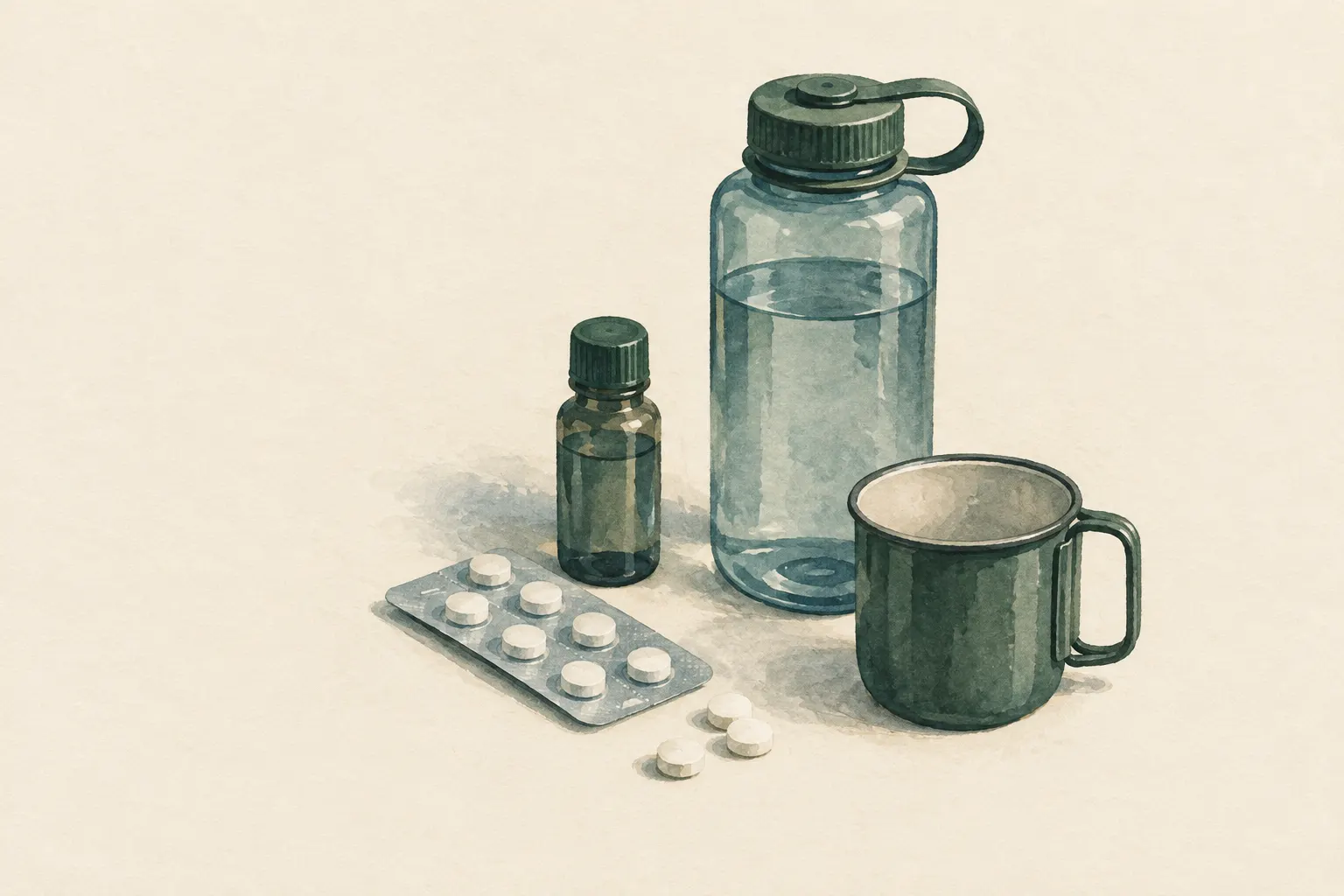
Chlorine dioxide is a relative of chlorine, but stronger in one respect: it can also crack the armoured parasites that ordinary chlorine can hardly touch. It comes as small tablets or as drops from two little bottles that you mix first.
The catch is patience. Bacteria and viruses are dealt with quickly, but the toughest parasites often need several hours. Exactly how long is written on the pack. With cold or cloudy water it takes even longer. Only when the full time is up is the water ready.
Important: use only products that are explicitly approved for drinking water. There are chlorine dioxide preparations promoted as a „remedy“ to drink. They are dangerous and have nothing to do with water treatment.
How it works
Chlorine dioxide is a strong oxidant. It attacks cell components of microorganisms and also penetrates the resistant shells of protozoa such as Giardia and Cryptosporidium. That distinguishes it from chlorine and iodine at normal concentrations, which can hardly touch Cryptosporidium.
Its effect, however, is not a yes-or-no matter but a question of time. Bacteria and viruses are inactivated quickly. Giardia takes longer, and Cryptosporidium oocysts – the resistant resting forms of this parasite – only after a long contact time. Manufacturers often state several hours for this.
As with chlorine: cold slows the reaction, and turbidity shelters pathogens and uses up the active ingredient. Clear, not too cold water and the full contact time are therefore the basis for a safe result.
Contact time is everything
Many packs show several times: a shorter one for bacteria and viruses and a much longer one for protozoa. The most common mistake is drinking after the short time even though parasites are a concern. For surface water with livestock, wild animals or people nearby, the longest stated time always applies.
If the water is cold or slightly cloudy, use the manufacturer's longer figure, if one is given. It helps to treat water in the evening and drink it in the morning, or to work with two bottles in turn: one is drunk while the other is still working.
If you have no time, chlorine dioxide alone is not the right choice when Cryptosporidium is suspected. Then boiling, or a filter that retains protozoa combined with a short contact time against viruses, is the better solution.
Tablets or drops
Tablets are usually individually packed and designed for a fixed volume of water, such as a certain number of litres. They are light, easy to dose and easy to carry. Do not split them to treat smaller amounts, and do not estimate the water volume – otherwise the concentration is no longer right.
With two-part drops, two solutions are mixed. They react with each other for a set time before the mixture goes into the water. This is more flexible, because the amount can be adjusted, but also more error-prone: a wrong mixing ratio, too short an activation time or mixed-up bottles change the result.
Moisture, heat and light harm both forms. Damp or expired tablets lose strength. Store them dry, cool, protected from light and out of children's reach.
Safety: what to watch out for
Use only products approved for drinking-water disinfection and follow their instructions exactly. Chlorine dioxide preparations promoted as a „remedy“ to be ingested are hazardous to health. They are not water treatment, and nothing in this text recommends drinking such products.
Drink only after the full contact time has passed. After dosing, wet the threads and the rim of the lid with the treated water so that no untreated drops remain there. If larger amounts of the concentrate are swallowed by accident, or if symptoms occur, call the local emergency number (112 in the EU) or a poison control centre.
Chlorine dioxide does not remove chemicals, heavy metals, salt or turbidity. Water from contaminated sources or seawater does not become drinkable with it.
Typical situations
On trips without fuel, chlorine dioxide is a light and compact solution, especially when there is enough time, for example overnight or during a long break. Many people find the aftertaste milder than with chlorine.
A very common combination is with a hollow-fibre filter. The filter retains bacteria and protozoa immediately but lets viruses through. The chlorine dioxide then covers the viruses, for which a comparatively short contact time per the manufacturer is enough. That way you quickly get water treated against all three groups of pathogens.
In winter, chlorine dioxide is an alternative to boiling meltwater when fuel is short. Because of the cold, however, waiting times become considerably longer – plan for them deliberately and keep the water as close to your body as possible.
Step by step
Clarify the water
Let cloudy water settle and pour it through a cloth or coffee filter.
- 1
Clarify the water
Let cloudy water settle and pour it through a cloth or coffee filter.
- 2
Dose exactly
Add the tablet or activated drops to the matching volume of water exactly as the manufacturer specifies.
- 3
Mix and wet the threads
Close the container, shake it and wet the threads and the rim of the lid with the treated water.
- 4
Wait for the full contact time
Wait for the contact time specified by the manufacturer. If Cryptosporidium is a concern, the longest stated time applies; cold extends it further.
Common mistakes
- Drinking after the bacteria contact time even though protozoa are a concern
- Splitting tablets and guessing the volume
- Using damp or expired tablets
- Dosing cloudy water without pre-treatment
Quick view
Materials
Chlorine dioxide tablets or drops
Approved drinking-water product
Only approved drinking-water products; follow manufacturer instructions.
PET bottle (clear, max. 2 litres)
Do not heat or place in a fire.
Food-grade water container
Only use containers that never held chemicals or fuel.
Cotton cloth / T-shirt
For pre-clarification
Removes coarse particles only – no disinfection.
Suitable for
- Trips without fuel
- Surface water suspected of carrying protozoa, when there is enough time
- Supplementing filters that do not retain viruses
Not suitable for
- Water that must be drunk immediately when Cryptosporidium is a concern
- Very cloudy water without pre-treatment
- Chemically contaminated water or seawater
Prerequisites
- Approved product with instructions
- Known volume of water
- Clear or pre-clarified water
- Time for the contact period
Safety
- Store tablets dry, cool, protected from light and out of children's reach; activate two-part drops only as instructed.
How it works
Chlorine dioxide is a strong oxidant that also attacks the resistant walls of protozoa. Its effect depends strongly on contact time, temperature and turbidity: bacteria and viruses are inactivated quickly, Cryptosporidium oocysts only after a long time.
Advantages
- No fuel, very light
- Effective against bacteria and viruses
- With sufficient contact time also against Giardia and Cryptosporidium
- Usually less aftertaste than chlorine
Disadvantages
- Long waiting time for Cryptosporidium
- Effect reduced by cold and turbidity
- More expensive than chlorine
- No effect on chemicals and salt
Deep knowledge
Background
The CDC describes chlorine dioxide as a method that, given an adequate contact time, can also inactivate Cryptosporidium – unlike chlorine and iodine at normal concentrations. The required times differ by product; the instructions of the specific approved product are authoritative.
In practice chlorine dioxide is often combined with a hollow-fibre filter: the filter retains protozoa and bacteria immediately, while the chlorine dioxide covers viruses, for which a short contact time suffices.
Variants
- Tablets
- Individually packed tablets are light and easy to dose; they are usually designed for a fixed volume of water.
- Two-part drops
- Two solutions are mixed and react for a set time before being added to the water. Dosing is more flexible but more error-prone.
Common mistakes
- Drinking after the bacteria contact time even though protozoa are a concern
- Splitting tablets and guessing the volume
- Using damp or expired tablets
- Dosing cloudy water without pre-treatment
Limits and risks
- Does not remove chemicals, salt or turbidity
- Effect depends on contact time, temperature and turbidity
Material alternatives
Derived from material properties: a substitute must have all relevant properties. Observe the notes on the substitute.
- Chlorine dioxide tablets or drops
- Chlorine tablets (NaDCC) for drinking water (Follow the manufacturer's dose and contact time.), Unscented household bleach (sodium hypochlorite) (Only unscented, without additives, with known concentration.), Iodine water purification tablets (Not in pregnancy, thyroid disease or iodine allergy without medical advice.)
- Food-grade water container
- Single-wall stainless steel bottle (Heat only single-wall bottles without paint/plastic; remove the lid before heating.), Double-wall insulated bottle (Never heat directly.), PET bottle (clear, max. 2 litres) (Do not heat or place in a fire.), Airtight food-grade storage container (Fill only when clean and completely dry; never use containers that previously held chemicals.), Collapsible water container or bag (Protect from sharp objects.), Food-grade water bag (Use only for drinking water, never for chemicals or fuel.), Fermentation jar or crock (Use only food-grade containers of glass, food-safe glazed stoneware or food-grade plastic – no metal containers for acidic food.), Resealable food bags (Use only bags intended for food; do not use with boiling water unless the manufacturer explicitly allows it.)
Results come exclusively from structured entries. No improvised instructions are generated.
Sources
Centers for Disease Control and Prevention: CDC Yellow Book: Health Information for International Travel – Water Disinfection
Chlorine dioxide and its effectiveness against protozoa with longer contact times
Centers for Disease Control and Prevention: Making Water Safe in an Emergency
Chemical disinfection with chlorine dioxide per manufacturer instructions