Hollow-fibre and membrane filters
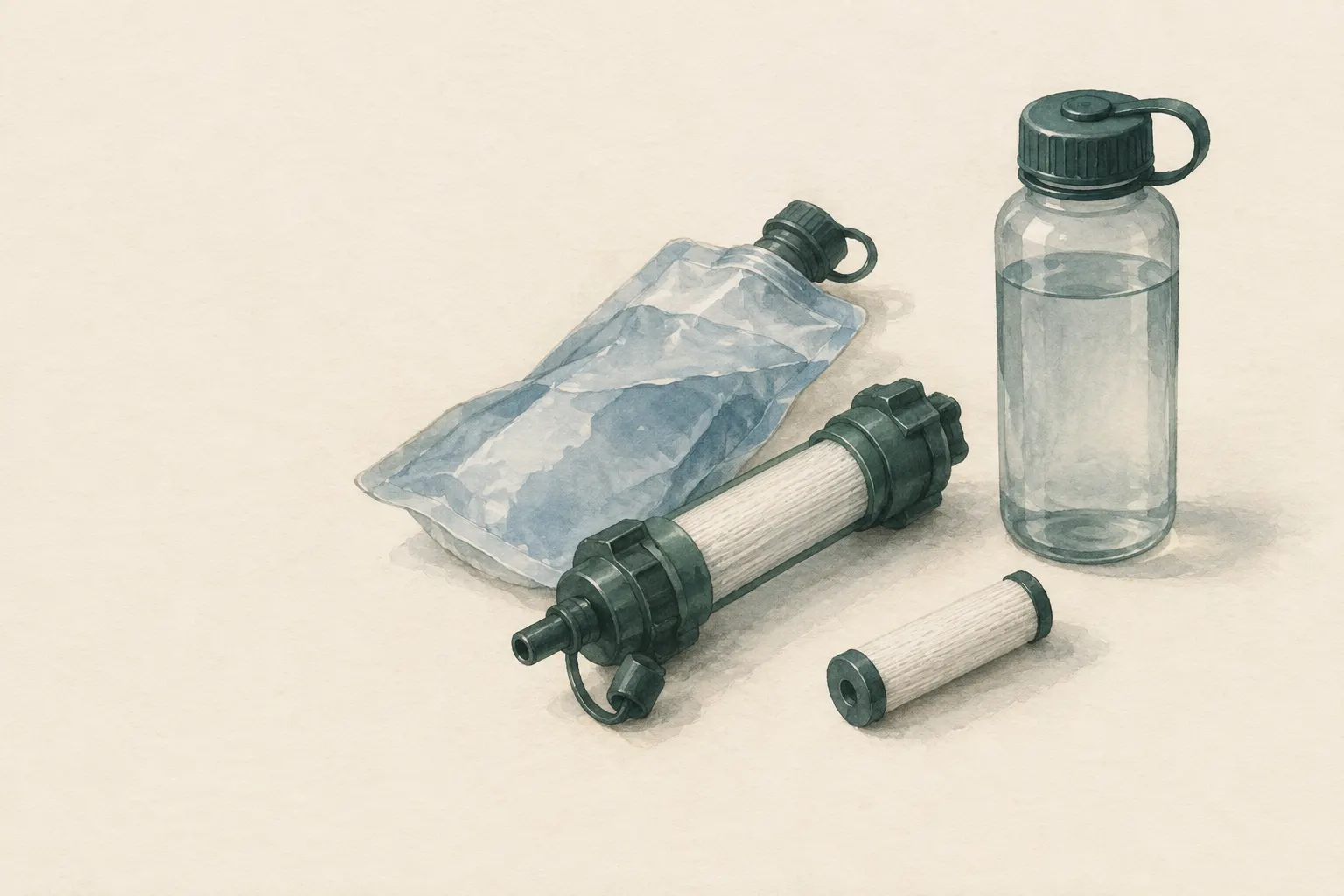
Portable hollow-fibre filters with a typical pore size of 0.1–0.2 µm retain bacteria and protozoa including Giardia and Cryptosporidium. Viruses pass through such filters; chemicals and salt are not removed. Where viruses are expected, follow up with chemical disinfection or boiling.
- Usable immediately; flow depends on model and fouling
Explained simply
Imagine a bundle of lots of very thin drinking straws. Their walls have tiny holes, much smaller than you can see. When you push water through, the water fits through the holes, but bacteria and parasites are too big and get stuck. That is how a hollow-fibre filter works.
However, there are even smaller germs: viruses. Most of them are so tiny that they slip through the holes. And poison or salt dissolved in the water passes straight through too. That is why filtered water is not automatically safe. If people live nearby, if sewage or flood water is involved – or if you are simply not sure – you also make the water germ-free afterwards, for example with tablets or by boiling.
One important rule: the filter must not freeze. Ice can tear the fine fibres without anyone seeing it. In frost you therefore carry it close to your body.
How it works
Inside the filter are many fine, hollow plastic fibres. Their walls are a membrane with pores that, in typical outdoor filters, measure around 0.1 to 0.2 micrometres. A micrometre is a thousandth of a millimetre. The water is pushed or sucked through these walls from outside to inside or the other way round.
Everything larger than the pores is held back. Single-celled parasites such as Giardia and Cryptosporidium are large enough for this, and so are bacteria. Most viruses, however, are much smaller and can pass through the membrane. Dissolved substances – salts, many chemicals, heavy metals – are smaller still and pass straight through.
What matters is the absolute pore size, the largest opening allowed to occur. A single crack in a fibre or a leaking spot in the housing acts like a big hole through which raw water flows past the membrane. That is why an intact filter is so important.
What the filter can do – and what not
Hollow-fibre filters fill exactly the gap that chlorine leaves with parasites: they retain protozoa including Cryptosporidium immediately, with no waiting, no taste and no fuel. Bacteria also stay caught in the membrane.
Pores of this size are not enough for viruses. Where people live, sewage is discharged or there has been flooding, viruses must be expected. Then additionally disinfect the filtered water with chlorine or chlorine dioxide, or boil it. In remote areas with little human impact, viruses are considered a lower risk – but that is an assessment of the surroundings, not a property of the filter. In an emergency, and whenever you are unsure, additional disinfection is the safe way.
Some manufacturers offer models with much smaller pores or combined systems that are explicitly rated for viruses as well. Rely only on claims documented for your exact model. No hollow-fibre filter helps against chemicals and salt – if you suspect them, choose another source.
What really matters
Before use, check the housing, seals and connections for cracks and make sure the filter has never frozen. Collect the clearest water possible; let cloudy water settle first or pour it through a cloth. Mud clogs the membrane quickly, and the flow becomes laborious.
Keep the raw side and the clean side strictly separate. The outlet must not come into contact with raw water or dirty hands. Even one drop from the dirty-water bag running down to the outlet makes the filtrate unsafe again. Fill into a clean container that is meant only for treated water.
Backflush the filter regularly, using clean, already treated water, never raw water. This loosens deposits from the membrane and restores the flow. Storage and drying follow the manufacturer's instructions – some models should be stored moist, others dry.
Safety: what to watch out for
Frost is the invisible enemy. If water freezes in the fibres, it expands and can make them crack. From the outside you see nothing, but pathogens can slip through the cracks. In frost, carry the filter close to your body and take it into your sleeping bag at night. After it has frozen through, do not trust it any more unless the manufacturer provides a test.
Falls and knocks can also damage the membrane or housing without it being noticeable. A sudden, unusually fast flow can be a warning sign. If in doubt, additionally disinfect the filtrate or switch to another method.
Remember: the filter makes water clearer and holds back many pathogens, but it does not make it safe to drink in every case. Viruses, chemicals and salt remain possible. Whenever the authorities issue advice, such as boil-water notices, always follow it.
Designs and typical situations
Squeeze and straw filters are small and light: water is pressed from a soft bag through the filter or sucked directly. They suit individuals on trips where water is plentiful and weight matters.
Gravity filters consist of a hanging raw-water bag from which the water runs on its own through the filter into a clean container. That is practical for groups and in camp, because you can do other things meanwhile. Pump filters are another design, in which you push the water through the membrane by muscle power.
Hollow-fibre filters are strongest in combination: first settle or pre-filter, then filter, then – where viruses are possible – disinfect chemically. That way each step covers the weaknesses of the others, in keeping with the multi-barrier principle.
Step by step
Inspect the filter
Check the housing, seals and connections for cracks and make sure the filter has never frozen.
- 1
Inspect the filter
Check the housing, seals and connections for cracks and make sure the filter has never frozen.
- 2
Pre-clarify raw water
Collect the clearest water possible and pour cloudy water through a cloth or let it settle first.
- 3
Filter
Filter according to the manufacturer's instructions (squeeze, suction, gravity or pump) into a clean container. Keep the outlet away from raw water.
- 4
Post-treat if viruses are a risk
If viruses are likely, additionally disinfect the filtrate with chlorine or chlorine dioxide or boil it.
- 5
Backflush and dry
Backflush the filter regularly with clean water and store it according to the manufacturer's instructions.
Common mistakes
- Assuming the filter protects against viruses
- Letting the filter freeze
- Backflushing with raw water
- Touching the outlet with dirty hands or raw water
- Filtering very cloudy water until the filter clogs
Quick view
Materials
Portable water filter (hollow fibre / membrane)
Do not let it freeze – fibres can be damaged without visible signs.
PET bottle (clear, max. 2 litres)
As a raw-water container where compatible
Do not heat or place in a fire.
Cotton cloth / T-shirt
Pre-filter against fast clogging
Removes coarse particles only – no disinfection.
Suitable for
- Clear to slightly cloudy water on trips
- Areas with little human impact, where bacteria and protozoa are the main risk
- Drinking immediately without waiting
Not suitable for
- Water with a virus risk (settlements, sewage or flooding) without additional disinfection
- Chemically contaminated water or seawater
- Freezing temperatures if the filter cannot be kept frost-free
Prerequisites
- Intact, never-frozen filter
- Knowledge of the manufacturer's data on pore size and cleaning
Safety
- Keep the raw and clean sides strictly separate; drips from the dirty-water bag on the outlet make the filtrate unsafe again.
How it works
Water is pushed or sucked through the walls of many fine hollow fibres. Particles larger than the pores are held back: protozoa and bacteria are large enough, most viruses are much smaller. Dissolved substances such as salts and many chemicals pass through the membrane unhindered.
Advantages
- Drinkable immediately, no waiting
- No fuel, no chemicals, no taste
- Retains protozoa including Cryptosporidium
- Light
Disadvantages
- No virus retention at typical pore sizes
- Sensitive to frost, damage invisible
- Clogs with cloudy water
- No effect on chemicals and salt
Deep knowledge
Background
A filter's effectiveness depends on its absolute pore size. The CDC associates filters of about 1 µm with protozoa removal and filters in the range of 0.1–0.2 µm additionally with bacteria; such pores are not sufficient for viruses. Hollow-fibre filters thus fill exactly the gap that chemical methods leave for protozoa – and leave the gap for viruses open.
This is the reason for the common combination of filter plus chemical disinfection. In remote areas with little human impact, viruses are considered a lower risk, but that is an assessment of the surroundings, not a property of the filter.
Variants
- Squeeze and straw filters
- Small and light; water is squeezed from a bag through the filter or sucked directly.
- Gravity filters
- A hanging raw-water bag lets water run through the filter on its own – practical for groups.
- Models with a virus claim
- Some membranes with much smaller pores or combined systems are rated by the manufacturer for viruses as well. Rely only on claims explicitly documented for the specific model.
Common mistakes
- Assuming the filter protects against viruses
- Letting the filter freeze
- Backflushing with raw water
- Touching the outlet with dirty hands or raw water
- Filtering very cloudy water until the filter clogs
Limits and risks
- No reliable virus retention at 0.1–0.2 µm
- Does not remove chemicals and salt
- Invisible damage from frost or impacts possible
Sources
Centers for Disease Control and Prevention: CDC Yellow Book: Health Information for International Travel – Water Disinfection
Filter pore sizes and which pathogen groups they retain
World Health Organization (2016): Results of Round I of the WHO International Scheme to Evaluate Household Water Treatment Technologies
Evaluation of household methods separately for bacteria, viruses and protozoa