Communication when networks fail
During power outages and disasters, landlines, internet and mobile networks often fail gradually or become overloaded. A battery or crank radio remains the most reliable source of information. Short text messages often get through more easily than calls, and a plan agreed beforehand replaces many phone calls.
- About 1 hour of planning
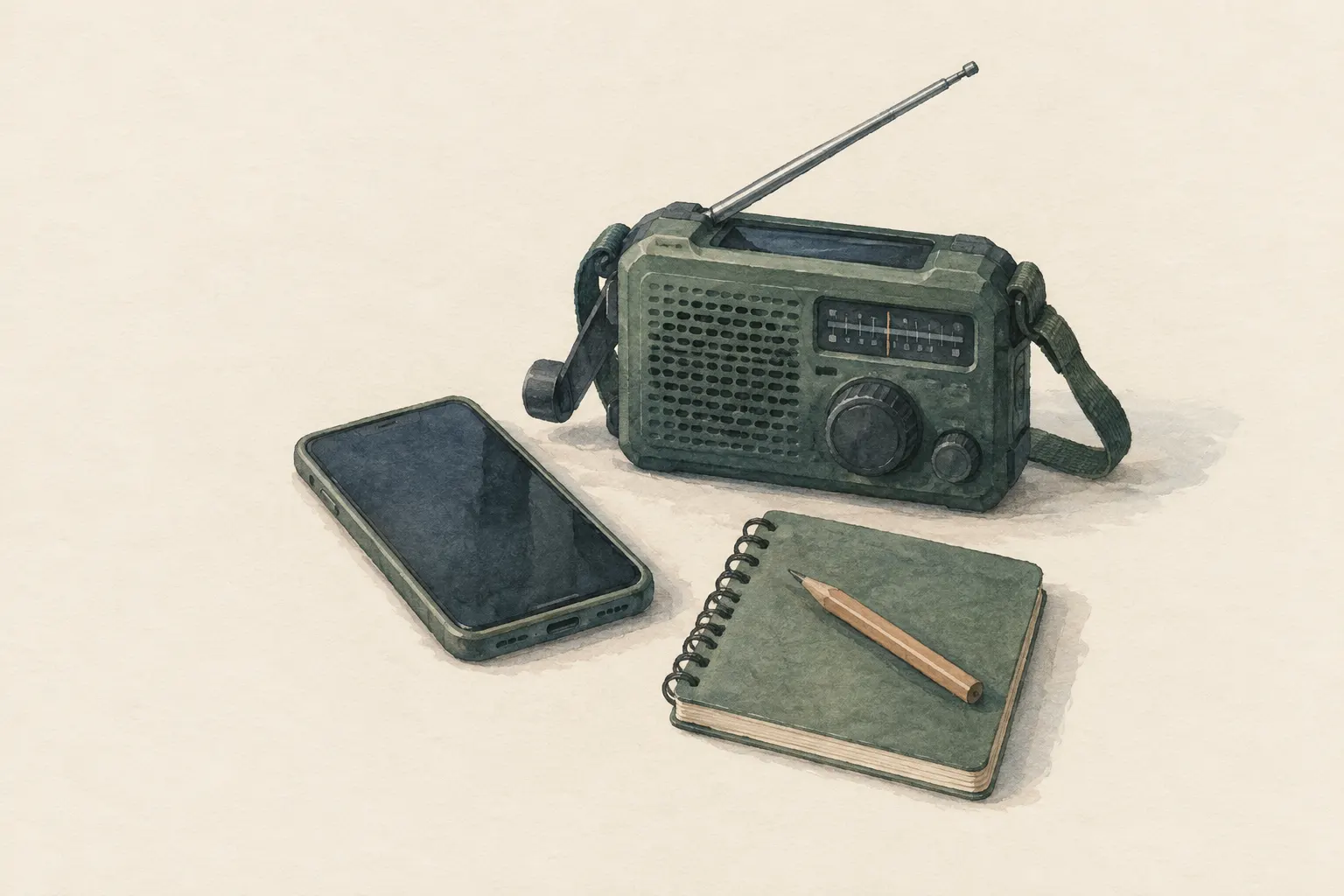
Explained simply
Telephone and internet need power in many places: in the router at home, in large equipment rooms and at the mobile masts. If the power is out for a long time, these networks fail one after another. And when everyone wants to phone at once, the network gets clogged – like a road in a traffic jam.
A radio with batteries or a crank works quite differently. One single transmitter can reach any number of radios, and your radio needs no network for it. That is why it is the best source of official news during a power outage.
Important: in a life-threatening situation, always try the emergency number first (112 in the EU). If the phone does not work, get help from neighbours, a fire station, the police or a municipal contact point.
How it works
A phone call needs a whole chain: your device, a mast or router, cables and switching equipment – and every link needs power. Many installations have backup power from batteries or generators, but it usually lasts only for a limited time. If one link fails, the chain breaks. Also, every network is built only for a certain number of simultaneous calls. In a crisis, very many people suddenly want to phone, and the network is overloaded even if it is still technically running.
Broadcasting is a one-way street: a transmitter sends, and every radio within range receives, no matter how many there are. That is why authorities use radio to inform people in emergencies. A battery, crank or solar radio therefore stays useful long after the internet and mobile networks have gone silent.
What really matters
Short text messages need far less network capacity than calls and are often delivered as soon as there is a brief connection. Agree simple standard messages in the family, such as “Safe, at home”. Keep calls short so emergency calls can get through.
An out-of-area contact is a clever trick. Calls to another region often get through more easily than connections within the affected area. Everyone checks in with this person, who passes on who is where. Add an agreed meeting point in case nobody can be reached.
Write the most important numbers and addresses on a card for your wallet and go bag. Also note the frequencies of your regional radio stations. Save your phone battery: power-saving mode, lower brightness, close unnecessary apps and switch the phone off at times when there is no network anyway.
Safety: what to watch out for
The emergency call always takes priority. Try it even when the network is poor. If it does not work, go to neighbours, the nearest fire or police station, or a contact point the municipality may set up during longer outages. Find out beforehand whether there is such a place near you and where.
In a crisis, rumours spread quickly. Do not pass on anything that does not come from a reliable source, such as the radio or official bodies. False reports can put people in danger or frighten them unnecessarily.
Radio transceivers are subject to different rules and sometimes licensing requirements depending on the country. Check local rules before you buy or use one.
How to practise it
Find out how your region issues warnings: sirens, radio, warning apps, alerts sent directly to phones (cell broadcast where available) or loudspeaker vans. Set up warning apps while the network is working. Many regions have regular warning test days – a good opportunity to check whether the warning reaches you.
Hold a small family test once: everyone sends the agreed standard message to the contact person, and you check whether everyone has the numbers on paper and knows the meeting point. Also switch on your radio and find the regional station – without searching online.
Good to know
The BBK and Ready.gov both recommend a battery or crank radio as part of emergency equipment. Ready.gov also advises text messages instead of calls and an out-of-area contact.
In longer outages, the neighbourhood is often the fastest help. A notice in the stairwell with the latest information from the radio, or knowing who in the building lives alone, sometimes replaces many phone calls.
Step by step
Keep a radio ready
Keep a battery, crank or solar radio with spare batteries and note the frequencies of the regional stations used for official information.
- 1
Keep a radio ready
Keep a battery, crank or solar radio with spare batteries and note the frequencies of the regional stations used for official information.
- 2
Know the warning channels
Find out how your region issues warnings: sirens, radio, warning apps, mobile alerts (cell broadcast where available), loudspeaker vans. Set up warning apps while the network is still working.
- 3
Numbers on paper
Write the most important numbers and addresses on a card for your wallet and go bag.
- 4
Messages instead of calls
Short text messages need less network capacity and are often delivered as soon as there is a brief connection. Agree on short standard messages such as "Safe, at home".
- 5
Out-of-area contact
A contact person in another region is often easier to reach than relatives in the affected area. Everyone checks in with that person and learns how the others are.
- 6
Save battery
Turn on power-saving mode, lower brightness, close apps you do not need and switch the phone off at times when there is no network.
- 7
Local contact points
Some municipalities set up contact points during longer outages where information and emergency calls are available. Find out in advance whether your municipality has such places.
Common mistakes
- Relying only on the internet and social media
- Phone numbers only in the phone
- Overloading networks with long calls
- Forwarding unverified rumours
- No meeting point agreed
Quick view
Materials
Battery or crank radio
Check batteries regularly and keep spares.
Power bank
Do not use damaged or swollen batteries; do not charge while covered.
Spare batteries
Store cool and dry, observe the expiry date; keep button cells out of children's reach.
Suitable for
- Power outages, severe weather, major incidents
- Families who are in different places during the day
Not suitable for
- A substitute for the emergency call – in an emergency always try the emergency number first
Prerequisites
- Important numbers and addresses on paper
- An agreed meeting point and a contact person outside the region
Safety
- Do not overload networks unnecessarily in emergencies: keep calls short, use messages instead of calls so emergency calls can get through.
- Radio transceivers are subject to different rules and licensing requirements depending on the country. Check local rules before buying and using them.
How it works
Communication networks need power at many points: in the home router, in exchanges and at mobile masts. Backup power there usually lasts only for a limited time, and in a crisis very many people try to call at once. Broadcasting works differently: one transmitter reaches any number of receivers, and a battery radio needs no network. So: receive information by radio, make arrangements beforehand, use networks sparingly.
Advantages
- Radio works independently of networks
- Arrangements reduce worry and unnecessary journeys
- Hardly any cost
Disadvantages
- Radio is a receive-only channel
- Arrangements need regular refreshing
Deep knowledge
Background
The BBK and Ready.gov recommend a battery-powered or crank radio as part of emergency equipment. Ready.gov also advises using text messages instead of calls in emergencies and naming an out-of-area contact, because long-distance calls often get through more easily than connections within the affected area.
How warnings are distributed and which radio transceivers may be used without a licence differs from country to country. The guidance of local authorities applies.
Variants
- Neighbourhood
- In longer outages, the neighbourhood is often the fastest help. Know who in the building lives alone or needs support, and pass information on – for example with a notice in the stairwell.
Common mistakes
- Relying only on the internet and social media
- Phone numbers only in the phone
- Overloading networks with long calls
- Forwarding unverified rumours
- No meeting point agreed
Limits and risks
- No radio-equipment or amateur-radio guidance
- Warning systems and radio rules vary by region
Sources
Bundesamt für Bevölkerungsschutz und Katastrophenhilfe (BBK), Deutschland: Ratgeber für Notfallvorsorge und richtiges Handeln in Notsituationen
Battery radio as a source of information in emergency preparedness
Ready.gov – U.S. Federal Emergency Management Agency (FEMA): Make A Plan
Text messages instead of calls, out-of-area contact
European Commission: 112 – the European emergency number
European emergency number 112