Evacuation: following official instructions
When the authorities call for evacuation, acting immediately is right – delay puts people and rescuers at risk. Take your go bag, documents, medication and pets, use the designated routes, inform your contact person and return only when the authorities allow it. Good preparation turns minutes into enough time.
- A few hours of preparation; execution depending on the situation
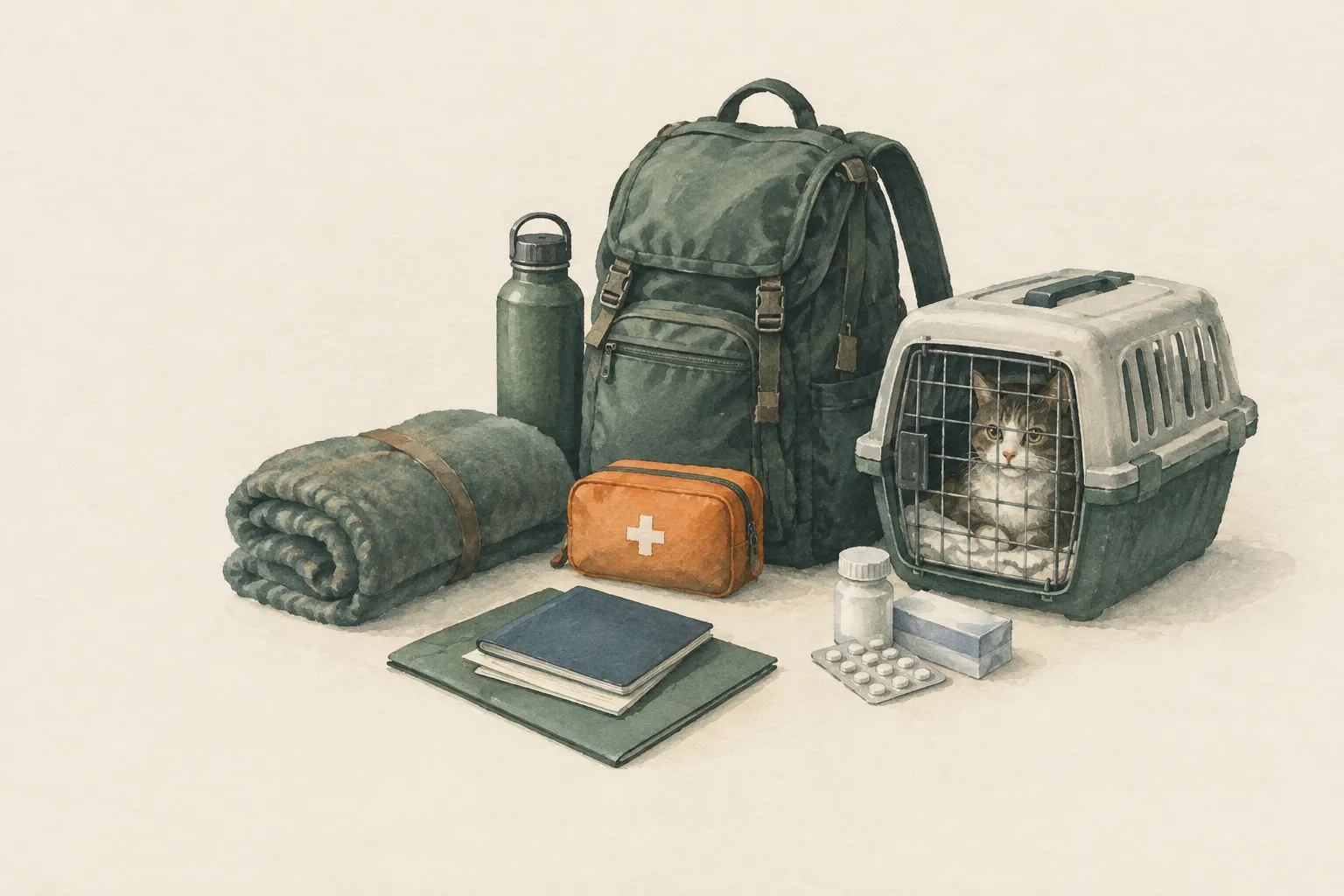
Explained simply
Evacuation means: everyone in an area should go somewhere else for a while, because it is dangerous there right now or could soon become dangerous. This can happen in a flood, in a wildfire, when gas leaks or when an old bomb from the war is found.
The authorities – for example the fire service, the police and the municipality – often see more than you can from your window. They know how high the water will rise or where the wind is blowing the smoke. That is why: when they say “Please leave”, you go at once and do not wait and see.
It is easiest when everything is prepared, like a school bag packed the evening before. A go bag, important papers, medication and the pets – then leaving takes only a few minutes. And only come back when the authorities allow it.
How it works
An evacuation is ordered when the authorities believe that staying is more dangerous than leaving. They rely on information that individuals on site usually do not have: water-level forecasts, wind direction, the spread of a fire or the type of substance released. Sometimes evacuation is precautionary, meaning before the danger is visible – and that is exactly when the temptation to wait is strongest.
Depending on the region, an evacuation is announced via radio, warning apps, sirens, loudspeaker vans or in person at the front door. There are often designated routes, assembly points for people without a car and emergency shelters. Exactly how this is organised differs between countries and municipalities; the local authorities' instructions are always what counts.
The earlier people leave, the better everything works. Leaving early means clear roads, less crowding and no dangerous rescue operations for stragglers. Anyone who stays may later be impossible to reach and, in the worst case, also puts rescuers at risk.
What really matters
Good preparation turns minutes into enough time. Pack a go bag and keep a document folder with copies of important papers ready. Write a short “last-moment list”: things you cannot pack in advance, such as medication from the fridge, charging cables, glasses or the child's cuddly toy. With a list like this you will not forget anything important, even under stress.
A family emergency plan sets out where you will meet if you are separated and who your contact person outside the area is. Also think about where you can go: to relatives, friends or an official emergency shelter. If a hazard is forecast and you have a car, do not let the tank run low.
When the order comes, take the go bag, documents, medication and pets and go. If there is time and the authorities recommend it, close windows and doors and switch off appliances; shut off utilities such as gas or water only if the authorities instruct you to. Tell your contact person where you are, and register at the emergency shelter's registration point if there is one – that way relatives can find you.
Safety: what to watch out for
Use only the designated or cleared routes and follow the instructions of emergency services. Shortcuts through closed areas are dangerous, because closures usually have a reason that you cannot see from outside. Never drive through flooded roads and never through smoke – you do not know how deep the water is or what lies behind the wall of smoke.
Not every hazard means: leave. In a chemical or industrial accident the instruction may be the exact opposite – stay indoors, close windows and doors, switch off the ventilation. Anyone who drives off then may end up in the middle of the hazardous cloud. That is why what matters is not a general rule but always the specific instruction from the authorities.
Return only when the authorities have cleared the area. Even then, buildings may be damaged, power lines may be hanging down or gas may be leaking. Watch for gas smells and drinking-water notices, and do not enter anything that looks as if it could collapse.
Typical situations
Anyone without a car should find out in advance whether the municipality, neighbours or relatives offer transport and where the evacuation assembly points are. This applies especially to people who cannot walk or drive themselves. They should agree with the municipality, care service or neighbours how support will be organised, and in a real event request help early – not at the last minute.
Pets are part of the family and come along. Many people delay an evacuation or return too early because they do not want to leave their animal behind. So plan a carrier, lead, food and papers in advance and ask which shelters accept animals.
A typical situation in Germany is the defusing of a World War bomb: a whole neighbourhood has to be cleared for a few hours, often at short notice. Here too, the packed bag helps. And even if an evacuation turns out afterwards to have been “unnecessary”, the decision to leave was right – no one can know for certain in advance how a situation will develop.
Step by step
Prepare beforehand
Pack a go bag, make a family plan, know the evacuation routes and possible places to stay (relatives, friends, official emergency shelters). For households with a car: do not let the tank run low when a hazard is forecast.
- 1
Prepare beforehand
Pack a go bag, make a family plan, know the evacuation routes and possible places to stay (relatives, friends, official emergency shelters). For households with a car: do not let the tank run low when a hazard is forecast.
- 2
Follow information
When hazards are forecast, follow radio, warning apps and announcements. Listen for loudspeaker announcements and sirens.
- 3
Leave immediately when told
Take the go bag, documents, medication, pets and the last-moment list. Do not wait for stragglers or better conditions.
- 4
Secure your home
If there is time and the authorities recommend it: close windows and doors, switch off appliances, shut off utilities only when instructed by the authorities. Leave a note saying where you are going if that is recommended.
- 5
Use the designated route
Follow the designated routes and instructions from emergency services. No shortcuts; do not drive through water or smoke.
Never drive through flooded roads.
- 6
Let people know
Tell your contact person where you are. Register at the emergency shelter's registration point if one exists, so relatives can find you.
- 7
Return only when cleared
Return only when the authorities have cleared the area. Watch for damage, power lines, gas smells and drinking-water notices.
Common mistakes
- Ignoring or waiting out an evacuation order
- Only starting to pack after the order
- Leaving pets behind
- Shortcuts through closed areas
- Returning too early
- Telling no one where you are
Quick view
Materials
Backpack
Pre-packed go bag
Document folder (waterproof)
Store securely – contains sensitive personal data.
Medication supply
Agree any stock of prescription medication with a doctor or pharmacist; observe storage instructions and expiry dates.
Battery or crank radio
Check batteries regularly and keep spares.
Pet emergency supplies
Suitable for
- Floods, wildfires, storms, gas leaks, bomb disposal, industrial accidents
- All households
Not suitable for
- Situations in which the authorities explicitly instruct people to stay indoors (e.g. hazardous substance release)
Prerequisites
- A family emergency plan with meeting points and a contact person
- Knowing the warning channels and, where they exist, designated evacuation routes
Safety
- Not every hazard requires evacuation. With hazardous substances the instruction may be: stay inside, close windows and doors, switch off ventilation. The authorities' instruction is what counts.
- Anyone who cannot walk or drive themselves should clarify in advance with the municipality, care service or neighbours how support will be organised, and request help early in a real event.
How it works
Evacuations are ordered when the authorities believe that staying is more dangerous than leaving. They often know more about the situation – water levels, wind direction, fire spread – than individuals on site. The earlier people leave, the less congestion, crowding and dangerous rescue operations. Good preparation reduces the effort of leaving to a few actions.
Advantages
- Saves lives and relieves rescue services
- Quick and orderly with preparation
Disadvantages
- Uncertainty and stress about what happens to your home
- Evacuations may turn out to have been precautionary
Deep knowledge
Background
FEMA (Ready.gov) recommends following evacuation orders immediately, using designated routes, taking pets and returning only once cleared. The BBK advises keeping an emergency bag and document folder ready in case of evacuation.
How evacuations are ordered, announced and organised differs between countries and municipalities. The local authorities are always what counts.
Variants
- Without a car
- Anyone without a car should find out in advance whether the municipality, neighbours or relatives offer transport and where the evacuation assembly points are.
Common mistakes
- Ignoring or waiting out an evacuation order
- Only starting to pack after the order
- Leaving pets behind
- Shortcuts through closed areas
- Returning too early
- Telling no one where you are
Limits and risks
- No statements on regional legal bases for evacuations
- No guidance on hazardous-substance releases beyond "follow instructions"
Material alternatives
Derived from material properties: a substitute must have all relevant properties. Observe the notes on the substitute.
- Backpack
- Sleeping pad, Dry leaves, grass or conifer boughs (Collect only where allowed; no protected plants. Check for ticks and insects.), Dry spare clothing (Carry it in waterproof packaging – wet clothing barely insulates.), Wool blanket / duvet (Keep away from candles, stoves and heaters.), Insulated cool box (Keeps cold only for a limited time; without ice packs or ice it is not a fridge.), Sleeping bag (Do not store compressed long-term; do not pack away damp.), Newspaper and cardboard (Flammable – keep away from candles, stoves, heaters and embers.), Insulated cooking box (hay box, thermal cooker) (Never put open flame or embers inside – only the hot, closed pot.)
- Document folder (waterproof)
- Tarp, Plastic sheet / large bin bag (Tears easily; never pull over the head (suffocation risk).), Emergency blanket (Tears easily once punctured; short-term shelter only.), Rain poncho (When used as a shelter, it no longer protects your body from rain.), Bivy bag (Never fully close off the face.), Tent (Do not cook or heat inside the tent (fire and carbon monoxide danger).), Heavy-duty bin bag (large) (Suffocation risk: never pull plastic bags over the head or face and keep them away from small children.), Group shelter bag (Airtight – ventilate regularly.)
Results come exclusively from structured entries. No improvised instructions are generated.
Sources
Ready.gov – U.S. Federal Emergency Management Agency (FEMA): Evacuation
Follow immediately, designated routes, take pets, return only when cleared
Bundesamt für Bevölkerungsschutz und Katastrophenhilfe (BBK), Deutschland: Ratgeber für Notfallvorsorge und richtiges Handeln in Notsituationen
Emergency bag and document folder for evacuation