Packing a go bag (grab bag)
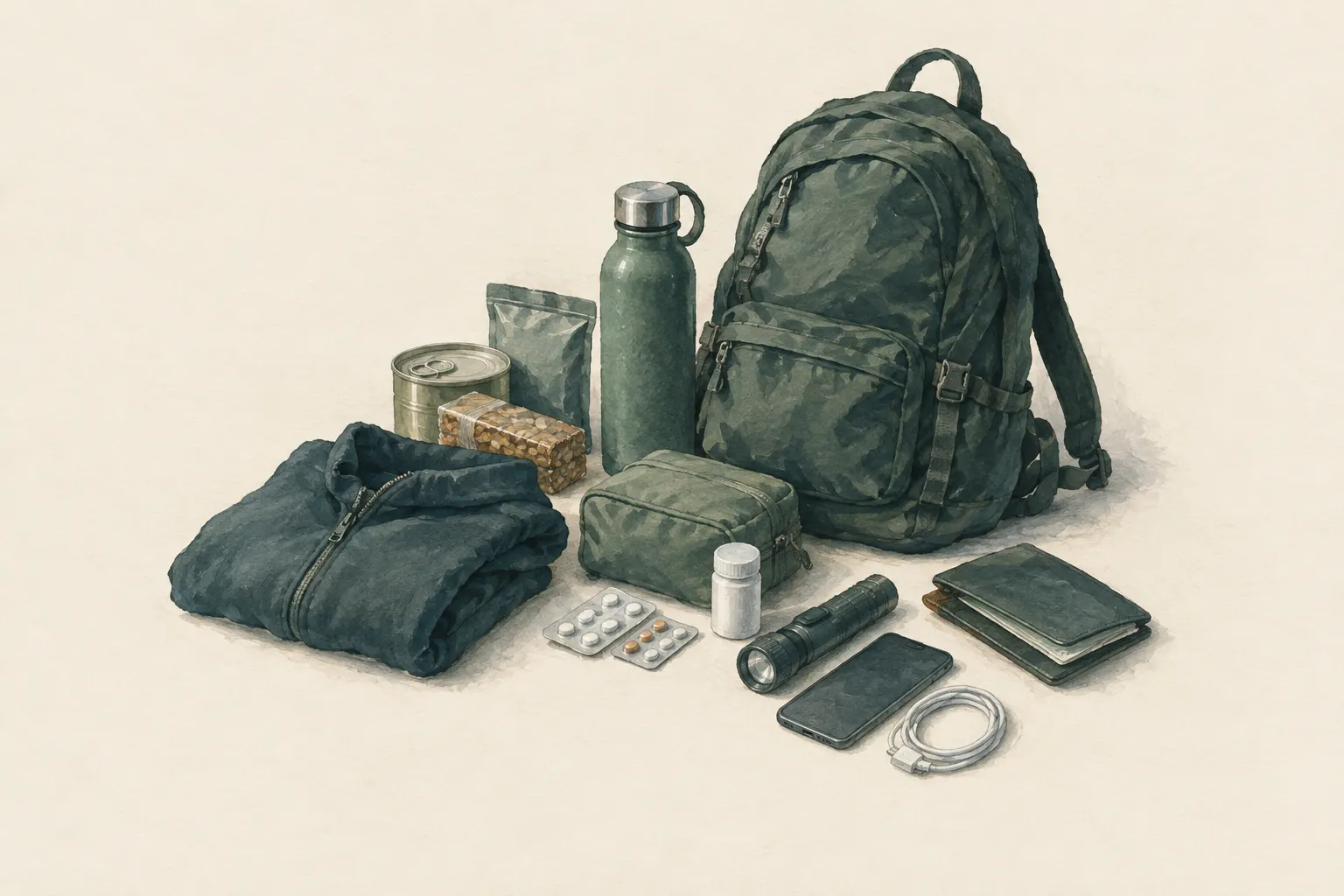
If you have to leave home at short notice – because of a flood, fire, gas leak or official evacuation – you often have only minutes. A prepared go bag per person contains the essentials for a few days: documents, medication, water, food, light, clothing and a charger. It must stay portable.
- About 1 hour to pack; check once or twice a year
Explained simply
Sometimes you have to leave home quickly, for example because a river bursts its banks or the fire service says everyone must leave the building. Then there is no time to search for things. A go bag is a packed backpack that is already waiting in its place – like the school bag you pack the evening before.
It holds the most important things for a few days: water, something to eat, a light, warm clothing, medication, copies of important papers and a list of phone numbers. Every person has their own bag, and it may only be as heavy as they can comfortably carry.
The most important thing: if there is a fire, you do not pack anything. You go out at once and leave the bag where it is. People matter more than any object.
How it works
In an evacuation there is often little time, and under stress hardly anyone thinks clearly. That is exactly when you forget the charging cable, your glasses or the tablets you need every day. The go bag moves these decisions into a calm moment: you think through today, at leisure, what you need, and in an emergency you only have to grab it.
The bag is meant for situations you can see coming or that happen in an orderly way: an announced flood warning, an official evacuation, a gas leak in the neighbourhood. Emergency shelters and relief services then take care of basics such as a place to sleep and food. What they cannot replace are your personal medication, your documents and your contacts – these are what matter most in the bag.
What really matters
Light beats complete. A bag you can no longer carry after ten minutes does not help. So pack less but the right things: copies of documents in waterproof packaging, a contact list on paper, some cash, medication for a few days with a list of doses, spare glasses, drinking water, non-perishable snacks, a headlamp or torch, a power bank with cable, a weatherproof jacket, a warm layer, a change of underwear, sturdy shoes and hygiene items. A small radio is useful if the weight allows.
Some things cannot live in the bag permanently because you need them daily: phone, keys, wallet, regular medication, perhaps medication from the fridge. That is what the last-moment list is for. It lies right at the top of the bag so you see it the moment you open it. Pets are on it too.
Where you keep the bag matters as well. It should be quick to reach, for example in the hallway or a bedroom cupboard, but not in plain sight, because the document copies contain sensitive data. The basement is a poor place: in a flood it fills up first.
For children, older people and animals
From a certain age, children can carry a small bag of their own. Let them help with packing and choose a cuddly toy, a book or a small game. That gives them security because they know what is inside. For babies and small children the necessities go into an adult's bag, along with a baby carrier, because with a pram it is often hard to get up stairs or through crowds.
Older people or people with impairments need lighter luggage, and their aids such as hearing-aid batteries, spare glasses or chargers belong in it. For pets, pack food, water, a bowl, a lead, medication and the vaccination record, and keep the carrier nearby.
Safety: what to watch out for
In a fire or other immediate danger there is one simple rule: do not gather anything, get out at once, then call the local emergency number (112 in the EU) from outside. The bag is no reason to stay in the building even one minute longer. And if the authorities order an evacuation, follow their instructions – even if you could not pack everything.
Heat can affect water and medication. That is especially important if you also keep a small basic kit in the car. Check it more often there, and keep sensitive medication in the house instead.
How to keep it up to date
Once or twice a year, unpack the bag completely. Check the expiry dates of water, snacks and medication, test the light and batteries and charge the power bank. With children the most important point is often clothing size: last year's trousers may no longer fit.
A good exercise is to walk a longer distance once with the packed bag. You quickly notice whether it pinches, is too heavy or whether something is missing. Then adjust it – that is how a packing list becomes a bag that really suits you.
Step by step
One bag per person
Each person gets a bag they can carry themselves. For infants and pets, the necessities go into an adult's bag.
- 1
One bag per person
Each person gets a bag they can carry themselves. For infants and pets, the necessities go into an adult's bag.
- 2
Documents and money
Copies of documents in waterproof packaging, a contact list on paper, some cash.
- 3
Health
Medication for a few days, a medication list with doses, spare glasses, a small first-aid kit, hygiene supplies.
- 4
Water, food, light
Drinking water, non-perishable snacks, a torch or headlamp, a power bank with cable and, if possible, a small radio.
- 5
Clothing
Weatherproof jacket, warm layer, change of underwear, sturdy shoes, and if needed a blanket or emergency blanket.
- 6
Last-moment list
Put a list on top of the bag: phone and charger, keys, wallet, refrigerated medication, pets.
- 7
Check regularly
Once or twice a year check water, food, medication, batteries and children's clothing sizes.
Common mistakes
- Packing the bag so heavy that it cannot be carried
- Packing original documents unprotected
- Forgetting medication or letting it expire
- Storing the bag in the basement, which floods first
- Not thinking of the children
Quick view
Materials
Backpack
One backpack per person that they can carry themselves
Document folder (waterproof)
Store securely – contains sensitive personal data.
Medication supply
Supply for a few days plus a medication list
Agree any stock of prescription medication with a doctor or pharmacist; observe storage instructions and expiry dates.
PET bottle (clear, max. 2 litres)
Drinking water
Do not heat or place in a fire.
Non-perishable food
Prefer food that can be eaten without cooking; consider allergies and dietary needs; do not forget a can opener.
Headlamp / flashlight
Power bank
Do not use damaged or swollen batteries; do not charge while covered.
Battery or crank radio
Check batteries regularly and keep spares.
First-aid kit (household)
Does not replace a first-aid course; check contents and expiry dates regularly.
Dry spare clothing
Carry it in waterproof packaging – wet clothing barely insulates.
Hygiene supplies
Cash reserve
Store securely and discreetly.
Suitable for
- Evacuations, floods, fire, gas leaks
- Short-notice stays with relatives or in emergency shelters
Not suitable for
- A heavy bag that the person cannot carry
- A fire – then do not pack, get out immediately
Prerequisites
- A fixed, quickly reachable place for the bag
- A list of items that only go in at the last moment (e.g. phone, keys, regular medication)
Safety
- The bag must remain carryable, even over longer distances. Pack correspondingly lighter for children and older people.
- Copies of documents contain sensitive data. Keep the bag out of plain sight but quickly reachable.
How it works
In an evacuation there is no time to think. A packed bag moves the decisions into a calm moment: what is really needed is ready; what goes in at the last moment is on a list. Lightness matters more than completeness – emergency shelters and relief services provide basic needs, but not documents and personal medication.
Advantages
- Saves crucial minutes in an evacuation
- Prevents important things being forgotten
- Gives children and adults a sense of security
Disadvantages
- Needs maintaining
- Cost of duplicate equipment
Deep knowledge
Background
In its emergency preparedness guide the BBK recommends an emergency bag for every person, and Ready.gov's "Build A Kit" describes an emergency kit you can take along in an evacuation. Both name documents, medication, water, food, light and a radio as core components.
In practice small things often make the difference: glasses, a charging cable, a list of phone numbers. These are exactly what gets forgotten in a hurry if they were not set out beforehand.
Variants
- Supplement in the car
- If you travel a lot by car, you can keep a small basic kit in the vehicle: water, blanket, light, snacks, charging cable. Heat in the vehicle can affect water and medication.
Common mistakes
- Packing the bag so heavy that it cannot be carried
- Packing original documents unprotected
- Forgetting medication or letting it expire
- Storing the bag in the basement, which floods first
- Not thinking of the children
Limits and risks
- No universal packing list – needs depend on household, climate and region
- No substitute for official evacuation instructions
Material alternatives
Derived from material properties: a substitute must have all relevant properties. Observe the notes on the substitute.
- Backpack
- Sleeping pad, Dry leaves, grass or conifer boughs (Collect only where allowed; no protected plants. Check for ticks and insects.), Dry spare clothing (Carry it in waterproof packaging – wet clothing barely insulates.), Wool blanket / duvet (Keep away from candles, stoves and heaters.), Insulated cool box (Keeps cold only for a limited time; without ice packs or ice it is not a fridge.), Sleeping bag (Do not store compressed long-term; do not pack away damp.), Newspaper and cardboard (Flammable – keep away from candles, stoves, heaters and embers.), Insulated cooking box (hay box, thermal cooker) (Never put open flame or embers inside – only the hot, closed pot.)
- Document folder (waterproof)
- Tarp, Plastic sheet / large bin bag (Tears easily; never pull over the head (suffocation risk).), Emergency blanket (Tears easily once punctured; short-term shelter only.), Rain poncho (When used as a shelter, it no longer protects your body from rain.), Bivy bag (Never fully close off the face.), Tent (Do not cook or heat inside the tent (fire and carbon monoxide danger).), Heavy-duty bin bag (large) (Suffocation risk: never pull plastic bags over the head or face and keep them away from small children.), Group shelter bag (Airtight – ventilate regularly.)
- Headlamp / flashlight
- Mobile phone (The battery drains quickly in cold and with continuous screen and GPS use.), Battery lantern / LED light
- Dry spare clothing
- Sleeping pad, Dry leaves, grass or conifer boughs (Collect only where allowed; no protected plants. Check for ticks and insects.), Backpack, Wool blanket / duvet (Keep away from candles, stoves and heaters.), Insulated cool box (Keeps cold only for a limited time; without ice packs or ice it is not a fridge.), Sleeping bag (Do not store compressed long-term; do not pack away damp.), Newspaper and cardboard (Flammable – keep away from candles, stoves, heaters and embers.), Insulated cooking box (hay box, thermal cooker) (Never put open flame or embers inside – only the hot, closed pot.)
Results come exclusively from structured entries. No improvised instructions are generated.
Sources
Bundesamt für Bevölkerungsschutz und Katastrophenhilfe (BBK), Deutschland: Ratgeber für Notfallvorsorge und richtiges Handeln in Notsituationen
Emergency bag and document folder
Ready.gov – U.S. Federal Emergency Management Agency (FEMA): Build A Kit
Components of an emergency kit to take along