Household emergency supplies: the basics
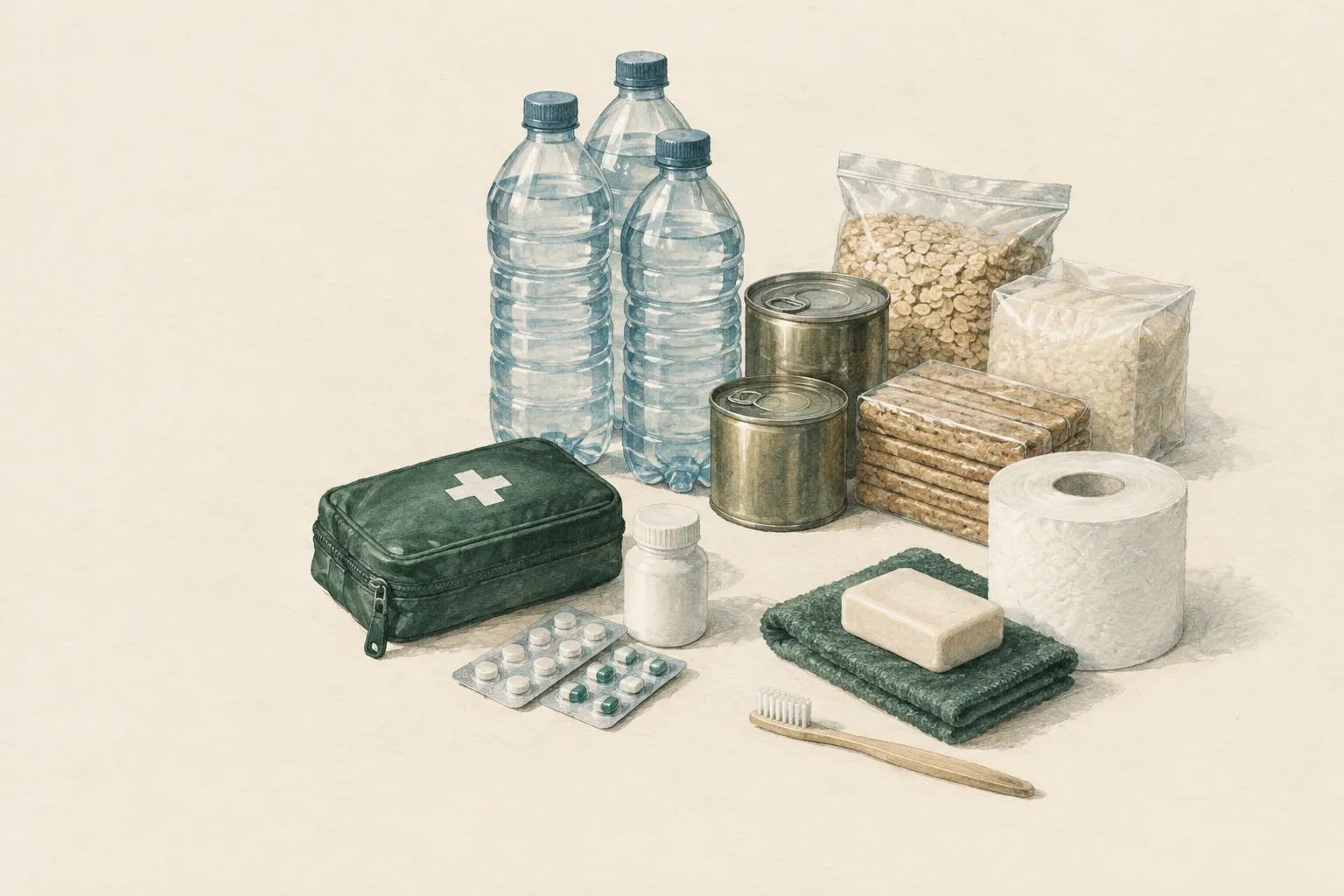
An emergency stock of drinking water, non-perishable food, medication and hygiene supplies helps you bridge several days without shopping, power or water supply. National agencies say how much makes sense – for example the BBK in Germany or FEMA/Ready.gov in the USA. What matters is a stock that suits your own household and is renewed regularly.
- Build up gradually over a few weeks; then regular checks
Explained simply
Imagine the supermarket is closed for a few days, the power is off and nothing comes out of the tap. An emergency stock is like a cushion: it catches you until everything works again. It holds drinking water, food that keeps for a long time, medication and things for washing and for the toilet.
The trick is not to buy anything special, but simply a bit more of what you eat anyway. Whatever gets old is eaten and bought again – so the stock stays fresh, like a shelf that slowly moves from back to front.
Very important: stoves, grills and gas bottles never belong inside the home. They make an invisible gas called carbon monoxide. You cannot smell it, but it can badly poison people. That is why food you can eat cold is best.
How it works
In a major emergency – a long power cut, a severe storm or a flood – rescue services and authorities cannot be everywhere at once. Shops close because tills, refrigeration and deliveries do not work, and tap water may fail or temporarily be unsafe to drink. A stock means your household does not have to go out to get things during this time. That is safer for you and relieves the helpers, who can then look after people who urgently need help.
National agencies say how big the stock should be. Germany's Federal Office of Civil Protection and Disaster Assistance (BBK) recommends a stock for ten days and works with around two litres of fluid per person per day. Ready.gov in the USA gives one gallon, about 3.8 litres, of water per person per day for several days – that already includes water for hygiene. Other countries use other figures. What counts is always the recommendation of the agency in your own country.
What really matters
The best stock is made of things your household knows and likes. In a crisis it helps nobody to have tins in the cupboard that nobody wants to eat. Good choices are foods that can be eaten without cooking and without a fridge: tinned food, ready meals in jars, nuts, crispbread, dried fruit, muesli. A can opener that works without power is a must.
The easiest way to store water is bought bottled water. If you fill water yourself, use only clean, food-grade containers, keep them cool and dark, and renew the water regularly. Besides drinking water, plan water for brushing teeth, washing hands and doing dishes. If the toilet cannot be flushed, sturdy rubbish bags help as a makeshift solution.
Think of every person and animal in the household: babies need their usual food and nappies, people with allergies or special diets need suitable food, pets need their food. Add light (a headlamp or torch with spare batteries), a battery or wind-up radio, a first-aid kit, hygiene items and some cash, because card payments often do not work without power.
Safety: what to watch out for
The biggest danger in a power cut is not hunger but unsafe cooking and heating. Camping stoves, gas cartridges, charcoal grills and generators produce carbon monoxide. This gas has no colour and no smell and can quickly become life-threatening in enclosed spaces. So never use such devices in the home, basement, garage or tent. Anyone who gets a headache, dizziness or nausea while such a device is running must get into fresh air at once, and someone calls the local emergency number (112 in the EU).
Medication is a topic of its own. How much prescription medication it makes sense to keep in stock is something to discuss with your doctor or pharmacy. Medication that has to be kept cold needs its own solution for a power cut – that, too, is best clarified there. Keep medication out of children's reach, including in the emergency stock.
How to build it and keep it fresh
Nobody has to buy everything at once. The most relaxed way is to take one or two extra items with every shop. After a few weeks the stock is there without it being expensive or hectic. A list helps, for example the BBK checklist, on which you tick off what you already have.
So that nothing goes off, the rule is “new to the back, old to the front”. Whatever expires first is eaten first and then replaced. Set fixed dates for checking expiry dates, batteries and water – for example when the clocks change in spring and autumn. That way the stock never turns into a forgotten store full of expired items.
Little space is no obstacle. Spread the stock over several places: cupboard floors, under the bed, behind books. A cool, dry, dark place is ideal; right next to a radiator or in full sun, food and water deteriorate faster.
Good to know
A stock is not the same as hoarding. Hoarding happens in a panic once a crisis has already arrived – then shelves empty quickly and others get nothing. A stock, by contrast, is built up calmly long before anything happens. If many households have prepared, fewer people need to shop at the same time in a crisis, and shortages are smaller.
A stock does not only help in disasters, by the way. It is also handy when the whole family is ill in bed, when snow blocks the roads or when you simply cannot leave the house for a few days. Many people only then notice how reassuring it is not to have to go shopping straight away.
Step by step
Look up your agency's recommendation
Look up what your national agency recommends. Germany's BBK recommends a stock for ten days and around two litres of fluid per person per day. Ready.gov (USA) gives one gallon (about 3.8 litres) of water per person per day for several days, including sanitation.
- 1
Look up your agency's recommendation
Look up what your national agency recommends. Germany's BBK recommends a stock for ten days and around two litres of fluid per person per day. Ready.gov (USA) gives one gallon (about 3.8 litres) of water per person per day for several days, including sanitation.
- 2
Map your household
Note who needs to be supplied: infants, children, older people, people with allergies, special diets or chronic illnesses, pets.
- 3
Water
Store drinking water in bought bottles or clean, food-grade containers, cool and dark. Plan extra water for hygiene.
- 4
Food
Choose non-perishable food that can be eaten without cooking or refrigeration and that the household likes: tins, ready meals, nuts, crispbread, dried fruit. Do not forget a can opener.
- 5
Medication and first aid
Keep regular medication, a first-aid kit and aids such as glasses or hearing-aid batteries ready.
- 6
Hygiene
Toilet paper, soap, hand sanitiser, rubbish bags, nappies and menstrual products. Rubbish bags also help if the toilet cannot be flushed.
- 7
Use and renew
Use older stock first and replace it. Check expiry dates at fixed intervals.
Common mistakes
- Storing food that can only be eaten cooked without a safe way to cook
- Building a stock and forgetting it for years
- Forgetting medication and hygiene supplies
- Not planning for pets
- Buying everything only once the crisis begins
Quick view
Materials
Food-grade water container
Food-grade water container
Only use containers that never held chemicals or fuel.
PET bottle (clear, max. 2 litres)
Bought bottled water
Do not heat or place in a fire.
Non-perishable food
Prefer food that can be eaten without cooking; consider allergies and dietary needs; do not forget a can opener.
Medication supply
Agree any stock of prescription medication with a doctor or pharmacist; observe storage instructions and expiry dates.
First-aid kit (household)
Does not replace a first-aid course; check contents and expiry dates regularly.
Hygiene supplies
Headlamp / flashlight
Battery or crank radio
Check batteries regularly and keep spares.
Suitable for
- All households
- Preparing for power outages, severe weather, illness or quarantine
Not suitable for
- Panic buying shortly before or during a crisis – it worsens shortages
Prerequisites
- An overview of the people, dietary needs and medication in the household
- A cool, dry, dark storage place
Safety
- Agree any stock of prescription medication with your doctor or pharmacist. Medication that must be refrigerated needs its own solution during a power outage.
- Store water only in clean, food-grade containers; renew self-filled water regularly.
How it works
In major emergencies help cannot reach everyone straight away; shops close, supply chains stall, tap water may fail. A stock buys time without dangerous journeys or improvisation. A good stock consists of things the household eats and uses anyway and is constantly renewed by using it up and buying more.
Advantages
- Buys time and calm in an emergency
- Also helps during illness or quarantine
- Relieves the burden on emergency services
Disadvantages
- Takes space and some money at first
- Needs regular upkeep
Deep knowledge
Background
In its emergency preparedness guide the BBK publishes a checklist for a ten-day stock; on Ready.gov, FEMA's "Build A Kit" lists a basic supply of water, food, light, radio, first-aid supplies and medication. Other countries' recommendations differ in duration and quantity; your own country's agency is what counts.
A stock is not hoarding: it is built up calmly before a crisis occurs and precisely because of that helps prevent shortages when many people want to shop at once.
Variants
- Small flat
- Little space? Spread the stock over several places (cupboard floors, under the bed) and combine it with everyday stock: simply buy a little more of what you eat anyway.
Common mistakes
- Storing food that can only be eaten cooked without a safe way to cook
- Building a stock and forgetting it for years
- Forgetting medication and hygiene supplies
- Not planning for pets
- Buying everything only once the crisis begins
Limits and risks
- Quantities only as quoted agency recommendations – check national guidance
- No nutritional advice for special diets
- No advice on stocking prescription medication without a doctor
Material alternatives
Derived from material properties: a substitute must have all relevant properties. Observe the notes on the substitute.
- Food-grade water container
- Single-wall stainless steel bottle (Heat only single-wall bottles without paint/plastic; remove the lid before heating.), Double-wall insulated bottle (Never heat directly.), PET bottle (clear, max. 2 litres) (Do not heat or place in a fire.), Airtight food-grade storage container (Fill only when clean and completely dry; never use containers that previously held chemicals.), Collapsible water container or bag (Protect from sharp objects.), Food-grade water bag (Use only for drinking water, never for chemicals or fuel.), Fermentation jar or crock (Use only food-grade containers of glass, food-safe glazed stoneware or food-grade plastic – no metal containers for acidic food.), Resealable food bags (Use only bags intended for food; do not use with boiling water unless the manufacturer explicitly allows it.)
- Headlamp / flashlight
- Mobile phone (The battery drains quickly in cold and with continuous screen and GPS use.), Battery lantern / LED light
Results come exclusively from structured entries. No improvised instructions are generated.
Sources
Bundesamt für Bevölkerungsschutz und Katastrophenhilfe (BBK), Deutschland: Ratgeber für Notfallvorsorge und richtiges Handeln in Notsituationen
Ten-day stock, around two litres of fluid per person per day, checklist
Ready.gov – U.S. Federal Emergency Management Agency (FEMA): Build A Kit
Basic kit; one gallon of water per person per day for several days