Preparing for a power outage
A longer power outage knocks out light, refrigeration, often heating, card payments and, after a while, mobile networks. If you have prepared light without candles, a battery or crank radio, charged power banks, some cash and a simple communication plan, you can bridge the first days much more calmly.
- About 1–2 hours once; then regular short checks
Explained simply
Electricity is like invisible water in a pipe: you only notice how much depends on it when it suddenly stops flowing. In a power outage it is not just the lights that go out. The fridge warms up, the heating often stops working, card payments at the till fail, and after a while even the mobile network can go down.
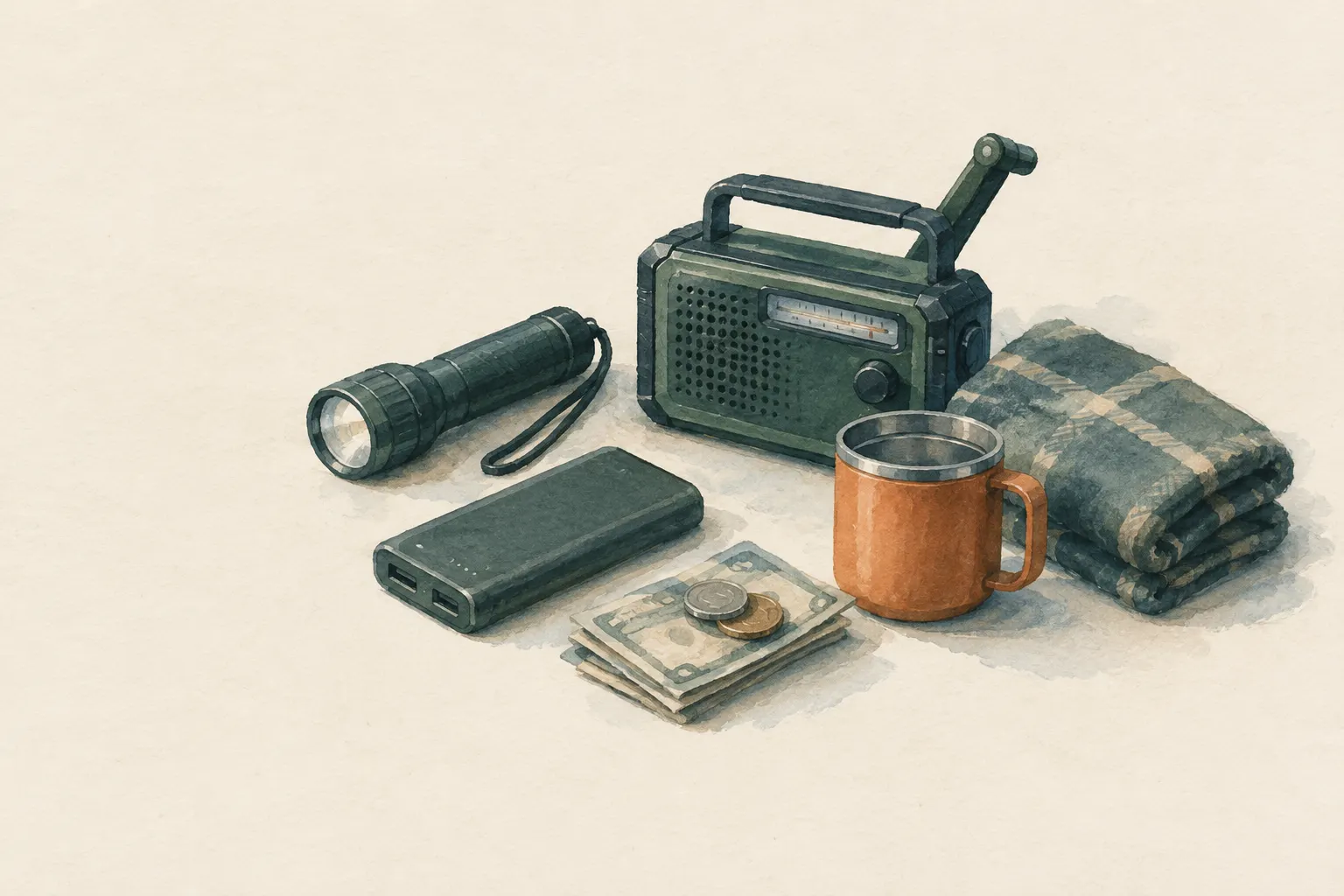
Preparing means thinking calmly beforehand about what you will need then. A torch for each person, a radio with batteries or a crank, a charged power bank, some cash and a list of important phone numbers on paper. It costs little and makes the first days much more relaxed.
The most important safety point: grills, camping stoves and generators never belong indoors – not even when it is cold. They produce carbon monoxide, a gas you can neither see nor smell and which is very dangerous.
How it works
Almost everything in modern daily life depends on electricity, often including things you would not expect. A gas or oil boiler needs power for its controls and pump, a high-rise building needs pumps to push water upwards, and cash machines, tills and petrol pumps are electric. Mobile masts and exchanges often have backup power, but it usually lasts only for a limited time.
A power outage therefore acts like a row of dominoes: one failure brings down several others. Preparedness starts right there. You secure the five most important functions independently of the grid in advance: light, information, communication, payment and warmth. Add water, food that needs no cooking and medication according to your authority's recommendations.
What really matters
The most important step is an honest inventory. Walk once through your flat or house and ask for each device: what happens if this fails? Electric shutters, the garage door, the door intercom, the heating pump, a stairlift or a medical device quickly end up on the list. For each item, note whether you need a substitute or can simply do without it.
It is just as important that things can be found and are ready when it matters. A torch lying somewhere in a box in the cellar is of little help in the dark. Keep lights in a fixed place everyone knows. Keep power banks charged rather than empty in a cupboard, and write phone numbers on paper, because a flat battery makes every stored number unreachable.
Cash in small notes and coins is an often-forgotten point. When tills and card terminals fail, some shops can still sell for cash – but change is often scarce then.
Safety: what to watch out for
Many accidents during an outage are caused not by the outage itself but by dangerous improvised solutions. Candles are a common cause of fires; battery or rechargeable lights are the safer choice. Grills, charcoal, camping stoves, patio heaters and generators produce carbon monoxide and never belong indoors, not in a garage or cellar either, and not with a window open.
Anyone who depends on electrically powered medical devices, such as ventilation, an oxygen concentrator or home dialysis, must clarify in advance with their doctor, care service or device supplier what to do in an outage. A general supplies list does not replace this conversation. In danger, always call the local emergency number (112 in the EU).
Unplug or switch off sensitive devices and leave one single lamp switched on. That way you notice when the power returns and protect your devices from surges when the power comes back.
How to practise it
Hold a small “power-cut evening” once: deliberately switch off the lights for an hour or two and use only your emergency equipment. You quickly notice whether everyone can find a light, whether the radio works and whether you know the frequency of your regional station. Children often find such an exercise exciting, and it helps them lose their fear of the dark.
Also set a fixed check date, for example when the clocks change in spring and autumn. Then you test batteries, recharge power banks, look at the expiry dates of supplies and medication and update the phone list.
Good to know
Most power outages are short and over within minutes or a few hours. Preparedness is still worth it because it makes the difference in long, widespread outages. Then many people need help at once, and authorities and rescue services have to concentrate on the most urgent cases.
How much water and food you should keep is deliberately not stated here. Your own authority's recommendations apply, for example those of the BBK in Germany or Ready.gov in the USA. Backup-power systems that are permanently connected to household wiring belong exclusively in the hands of a qualified electrician.
Step by step
List your dependencies
Walk through your home: what stops working without power? Heating, cooker, fridge, phone, router, electric shutters, garage door, water pump, medical devices. Note what you need a substitute for.
- 1
List your dependencies
Walk through your home: what stops working without power? Heating, cooker, fridge, phone, router, electric shutters, garage door, water pump, medical devices. Note what you need a substitute for.
- 2
Light without a flame
Keep a torch or headlamp for every person in a fixed place you can find in the dark, plus spare batteries or a charged rechargeable light.
- 3
Secure a source of information
A battery, crank or solar radio receives official announcements even when the internet and mobile networks fail. Note the frequencies of your regional stations.
- 4
Power for the phone
Keep at least one power bank charged and charging cables ready. A car charging adapter is a supplement – only run the vehicle for this outdoors, never in a garage.
Never run an engine in an enclosed space.
- 5
Keep cash at hand
Card payments and cash machines usually do not work without power. A small cash reserve in small notes helps when shopping in stores that may still open.
- 6
Contact plan on paper
Write important phone numbers, the address of a meeting point and a contact person outside the region on paper. The phone may be flat, and stored numbers are then out of reach.
- 7
Check supplies
Keep drinking water, food that can be eaten without cooking, medication and warm blankets in stock – according to your authority's guidance.
- 8
Check regularly
Check batteries, power-bank charge and expiry dates at fixed intervals, for example when the clocks change.
Common mistakes
- Relying only on candles for light
- Storing power banks empty in a cupboard
- Having all phone numbers stored only in the phone
- No radio – relying only on internet and apps
- No cash at home
- Running a generator or grill indoors
Quick view
Materials
Headlamp / flashlight
One light per person
Battery lantern / LED light
To light a room
Battery or crank radio
For official announcements
Check batteries regularly and keep spares.
Spare batteries
Store cool and dry, observe the expiry date; keep button cells out of children's reach.
Power bank
Keep charged
Do not use damaged or swollen batteries; do not charge while covered.
Cash reserve
Small notes and coins
Store securely and discreetly.
Wool blanket / duvet
In case the heating fails too
Keep away from candles, stoves and heaters.
Suitable for
- All households as basic preparedness
- Regions with severe weather, heat or cold waves
- Households with children, older people or people in need of care
Not suitable for
- A substitute for a backup-power solution agreed with a doctor or supplier for life-sustaining medical devices
Prerequisites
- An overview of which household devices need power (including heating, pumps, door openers)
- Knowing where the fuse box and main switch are
Safety
- Candles are a common cause of fires. Battery or rechargeable lights are the safer choice.
- Unplug or switch off sensitive devices and leave one lamp switched on so you notice when the power returns.
How it works
A power outage hits many systems at once that people do not think of as power-dependent in daily life: heating pumps, water supply in high-rise buildings, tills, cash machines, petrol stations, routers and, with a delay, mobile phone masts. Preparedness therefore means securing the most important functions – light, information, communication, payment, warmth – independently of the grid in advance.
Advantages
- Low cost
- Helps in other emergencies too
- Reduces the temptation of dangerous improvisation
Disadvantages
- Requires regular maintenance
- Does not replace a heat or cooling source in long outages
Deep knowledge
Background
Authorities such as Germany's BBK and the US emergency management agency FEMA (Ready.gov) consistently recommend torches instead of candles, a battery-powered radio, spare batteries, supplies and a plan for people who depend on power. Ready.gov also advises unplugging appliances to avoid damage from power surges when the power returns.
Most power outages are short. For long, widespread outages preparedness is valuable because many people need help at the same time and authorities must concentrate on the most urgent cases.
Variants
- High-rise and rented flat
- In high-rise buildings lifts and often water pressure pumps fail. A water stock in the flat and a plan for people who cannot use stairs are especially important here.
Common mistakes
- Relying only on candles for light
- Storing power banks empty in a cupboard
- Having all phone numbers stored only in the phone
- No radio – relying only on internet and apps
- No cash at home
- Running a generator or grill indoors
Limits and risks
- No quantities – your own authority's recommendations apply
- No guidance on backup-power systems in household wiring (qualified electrician)
Material alternatives
Derived from material properties: a substitute must have all relevant properties. Observe the notes on the substitute.
- Headlamp / flashlight
- Mobile phone (The battery drains quickly in cold and with continuous screen and GPS use.), Battery lantern / LED light
- Battery lantern / LED light
- Headlamp / flashlight, Mobile phone (The battery drains quickly in cold and with continuous screen and GPS use.)
- Wool blanket / duvet
- Sleeping pad, Dry leaves, grass or conifer boughs (Collect only where allowed; no protected plants. Check for ticks and insects.), Backpack, Dry spare clothing (Carry it in waterproof packaging – wet clothing barely insulates.), Insulated cool box (Keeps cold only for a limited time; without ice packs or ice it is not a fridge.), Sleeping bag (Do not store compressed long-term; do not pack away damp.), Newspaper and cardboard (Flammable – keep away from candles, stoves, heaters and embers.), Insulated cooking box (hay box, thermal cooker) (Never put open flame or embers inside – only the hot, closed pot.)
Results come exclusively from structured entries. No improvised instructions are generated.
Sources
Bundesamt für Bevölkerungsschutz und Katastrophenhilfe (BBK), Deutschland: Ratgeber für Notfallvorsorge und richtiges Handeln in Notsituationen
Power-outage preparedness: light without candles, radio, batteries, supplies
Ready.gov – U.S. Federal Emergency Management Agency (FEMA): Power Outages
Preparation, unplugging appliances, planning for powered medical devices