Safe lighting without candles
During a power outage many people reach for candles – and that is exactly when house fires often happen. Battery and rechargeable lights are safer, more practical and last longer. If you do use candles, you need firm rules: never unattended, stable, far from anything flammable and from children.
- About 15 minutes of preparation
Explained simply
When the power goes out, it is suddenly dark – and many people then light candles. That feels cosy but is dangerous: house fires often happen precisely during outages, because a candle falls over, a curtain catches fire or someone falls asleep with a candle burning.
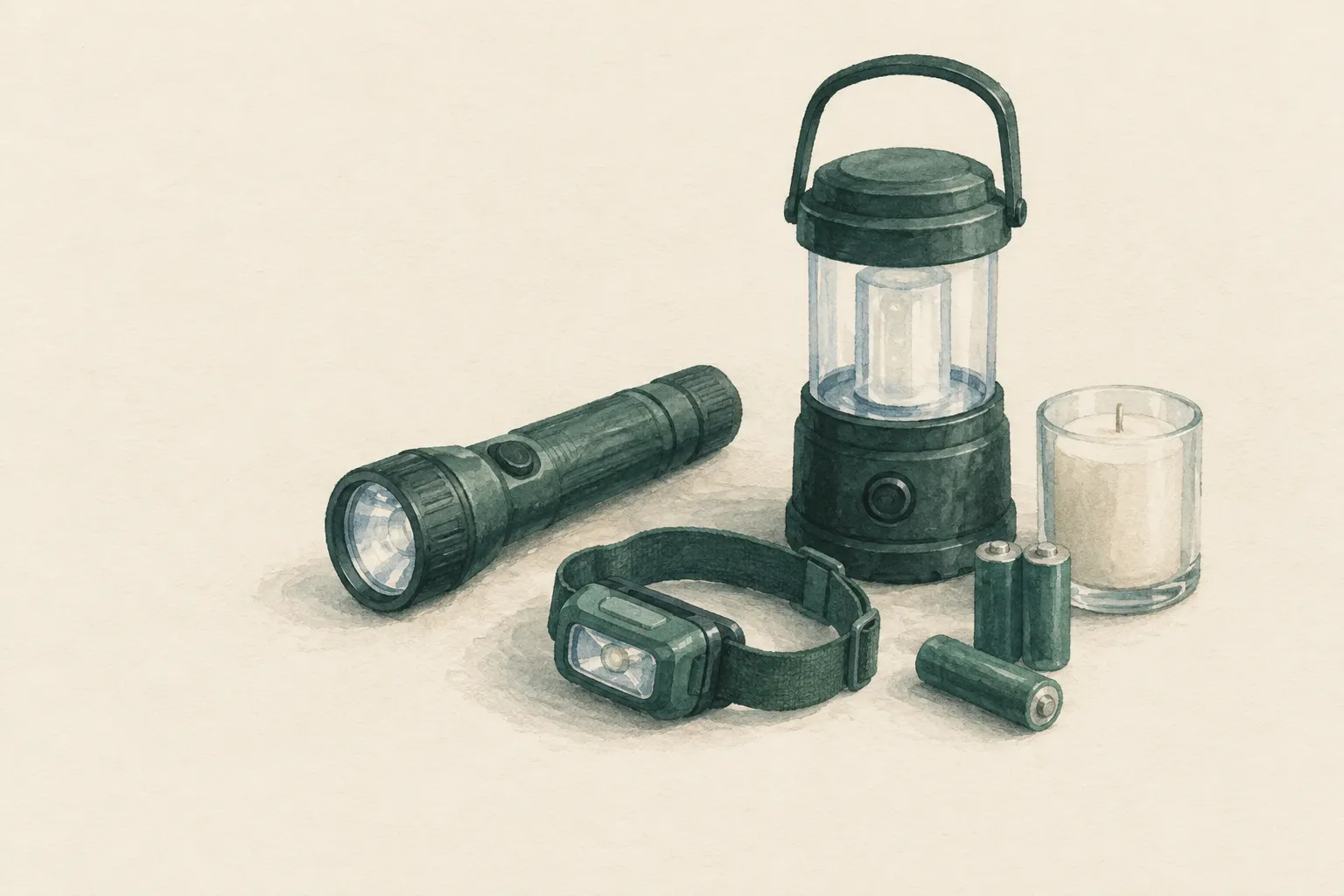
Lights with batteries or rechargeable cells are much safer, ideally with LEDs. An LED is a small light that hardly gets warm and uses very little electricity. If such a light falls over, nothing happens. Ideally everyone has their own torch or headlamp, and there is a lantern for the living room.
Very important: if you smell gas, you must not light a flame or press a light switch. Then everyone leaves the building straight away and calls the emergency number from outside (112 in the EU).
How it works
An LED converts electrical current into light very efficiently. An old incandescent bulb, by contrast, mainly made heat and only light on the side. That is why LED lights run much longer on a set of batteries and barely get hot. A candle flame is the opposite: it is an open fire that can ignite flammable things nearby, and it uses oxygen from the room air as it burns.
During an outage there is something else that is easy to underestimate: the situation is unfamiliar. It is dark, everyone is a bit restless, children and pets move around, people search for things and knock things over more easily. In such a situation a naked flame is a constant risk. A battery light, on the other hand, can fall or tip over without anything happening.
What really matters
Light is only useful if you can find it in the dark. So keep lights in a fixed, known place, for example in a drawer in the hallway or next to the bed. Headlamps are especially practical because both hands stay free – on the stairs, when cooking or when carrying a child.
One lantern is often enough for the shared room. A simple trick: point a headlamp so it shines into a clear bottle filled with water. The water scatters the light, and the bottle works like a small room lamp.
Save energy so the light lasts. Use low brightness settings, switch lights off when nobody is in the room, and keep spare batteries ready, sorted by type. Solar or crank lights are a good supplement but deliver only limited light depending on weather and model.
Safety: what to watch out for
If you do use candles, you need firm rules. Only in a stable, non-flammable holder on a fire-resistant base. Well away from curtains, blankets, paper and anything that can burn. Out of reach of children and pets. Never unattended, and always put them out before leaving the room or going to bed. Never place tealights directly on plastic or wood.
Oil, kerosene and gas lanterns are not a good long-term solution indoors. They can start fires and produce carbon monoxide. If used at all, then strictly according to the manufacturer's instructions – battery light is almost always the better choice.
Keep a fire extinguisher or fire blanket within reach as soon as naked flames are involved. If a fire cannot be put out immediately: everyone out, close the doors behind you and call the emergency number. Smoke alarms usually run on batteries and protect during an outage too – provided they are tested regularly.
Gear and materials
A sensible basic kit is manageable: one torch or headlamp per person, one lantern for the living area and spare batteries in the right sizes. If you use USB-rechargeable lights, you can top them up from a charged power bank. Try to have as many devices as possible use the same battery size – then you need to store fewer different kinds.
Batteries slowly lose charge even when unused, and old batteries can leak. Remove them from devices for long-term storage or check them regularly, for example when the clocks change.
Good to know
Authorities such as the BBK in Germany and Ready.gov in the USA consistently recommend torches rather than candles. The reason is simple: candles cause fires again and again, and the risk rises when many people use them at the same time in an unfamiliar situation.
Candlelight is still not “forbidden” – it depends on how you handle it. For basic lighting in an emergency, however, battery-powered light is the calmer, safer solution, especially in households with children, pets or older people.
Step by step
One light per person
Give every person a torch or headlamp. Headlamps keep the hands free, for example on stairs or when cooking.
- 1
One light per person
Give every person a torch or headlamp. Headlamps keep the hands free, for example on stairs or when cooking.
- 2
One room, one lantern
Use one lantern for the shared living room. A headlamp shining into a bottle filled with water also spreads light around the room.
- 3
Save energy
Use low brightness settings and switch lights off when not needed. Keep batteries and rechargeables ready, sorted by type.
- 4
If candles are used: firm rules
Only in stable, non-flammable holders on a fire-resistant base, with distance to anything flammable, never unattended. Put them out before leaving the room or going to sleep.
Keep candles out of reach of children and pets.
- 5
Extinguishing means at hand
Keep a fire extinguisher or fire blanket within reach if naked flames are used. If a fire is not out immediately: get out, close doors, call the emergency number.
Common mistakes
- Letting candles burn while falling asleep
- Placing tealights directly on plastic or wood
- Candles on windowsills with curtains
- No spare batteries
- Having to search for lights in the dark
Quick view
Materials
Headlamp / flashlight
Keeps hands free
Battery lantern / LED light
To light a room
Spare batteries
Store cool and dry, observe the expiry date; keep button cells out of children's reach.
Power bank
To charge USB-rechargeable lights
Do not use damaged or swollen batteries; do not charge while covered.
Suitable for
- Any power outage at home
- Households with children or pets
Not suitable for
- Naked flames in rooms where gas can be smelled – leave immediately and call the emergency number
Prerequisites
- Lights kept in a fixed, known place
- Working smoke alarms
Safety
- Oil, kerosene and gas lanterns create fire and carbon monoxide hazards. Use them only according to the manufacturer's instructions and not as permanent light in enclosed rooms; prefer battery light.
- Smoke alarms usually run on batteries and protect during a power outage too – provided they are maintained.
How it works
Light during a power outage should be reliable, long-lasting and safe. LED lights use little energy, produce hardly any heat and can be knocked over without igniting anything. A naked flame, on the other hand, remains a constant fire risk in a darkened, unfamiliar situation – with restlessness, children and pets.
Advantages
- No fire risk from battery lights
- Long run time with LED
- Safe with children and pets
Disadvantages
- Requires a stock of batteries or rechargeables
- Does not recharge itself without power
Deep knowledge
Background
In its emergency preparedness guide the BBK recommends torches and battery-powered lights; Ready.gov also explicitly advises using flashlights rather than candles during power outages because candles can cause fires.
Fuel-burning lanterns are a grey area: they give plenty of light but consume oxygen and produce exhaust and heat. For everyday life during an outage they are unnecessary if there is enough battery light.
Variants
- Solar and crank lights
- Lights with a solar panel or crank are independent of battery stocks but deliver limited light depending on weather and model. Useful as a supplement.
Common mistakes
- Letting candles burn while falling asleep
- Placing tealights directly on plastic or wood
- Candles on windowsills with curtains
- No spare batteries
- Having to search for lights in the dark
Limits and risks
- No product recommendations
- No fire-safety guidance beyond simple basic rules
Material alternatives
Derived from material properties: a substitute must have all relevant properties. Observe the notes on the substitute.
- Headlamp / flashlight
- Mobile phone (The battery drains quickly in cold and with continuous screen and GPS use.), Battery lantern / LED light
- Battery lantern / LED light
- Headlamp / flashlight, Mobile phone (The battery drains quickly in cold and with continuous screen and GPS use.)
Results come exclusively from structured entries. No improvised instructions are generated.
Sources
Bundesamt für Bevölkerungsschutz und Katastrophenhilfe (BBK), Deutschland: Ratgeber für Notfallvorsorge und richtiges Handeln in Notsituationen
Torches and battery lights in emergency preparedness
Ready.gov – U.S. Federal Emergency Management Agency (FEMA): Power Outages
Flashlights rather than candles during power outages