Food safety when the fridge and freezer fail
During a power outage the rule is: keep fridge and freezer doors closed – that keeps the cold in longest. The US food safety authority USDA gives guide values for this. Perishable food that has been too warm for too long is thrown away. And: when in doubt, throw it out – appearance and smell do not tell you whether food is safe.
- A few minutes; checking after the outage ends
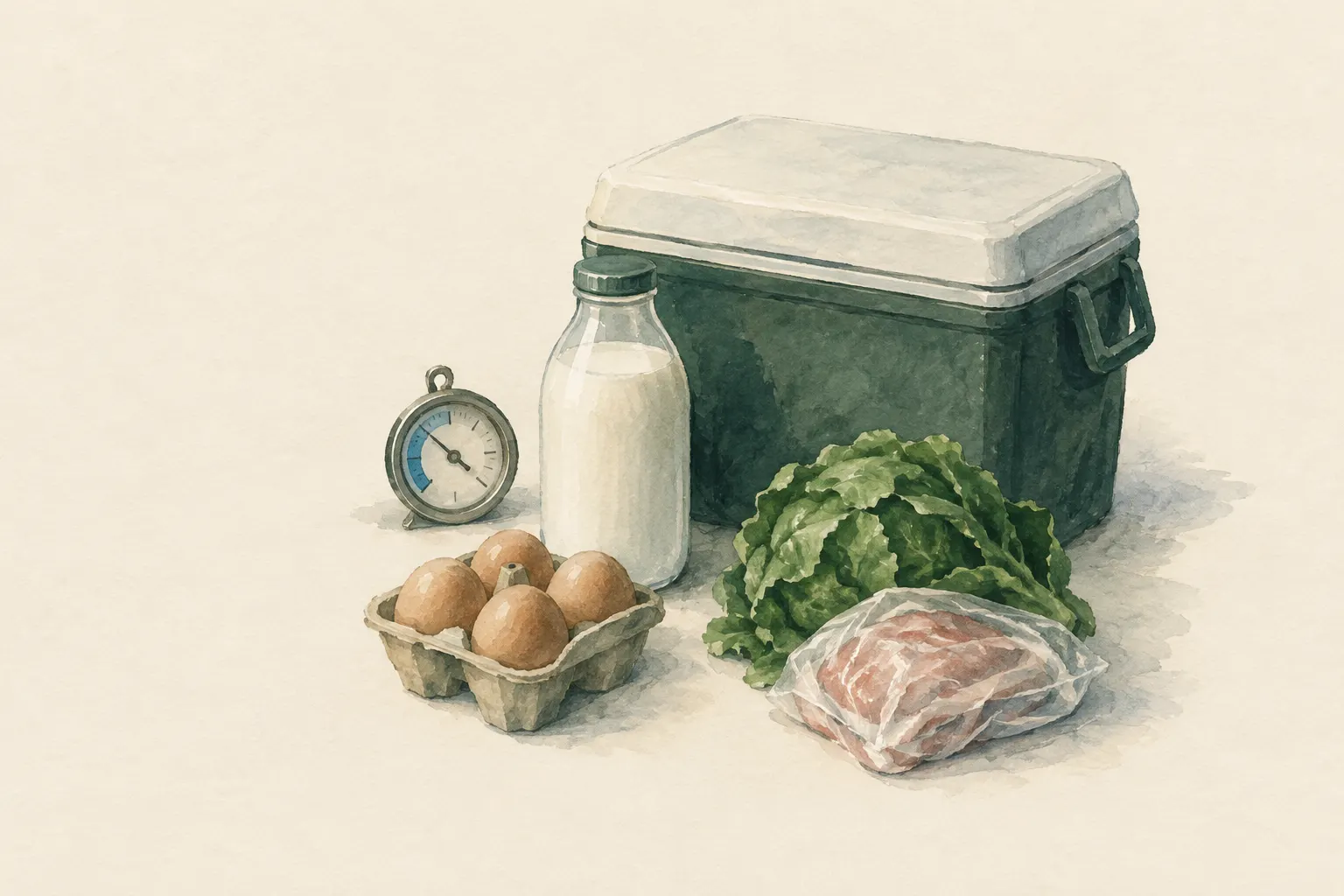
Explained simply
A fridge is really a well-insulated box. When the power goes, it does not get warm inside straight away but only slowly – like a cool bag that stays cold for a while. The cold lasts longest if you keep the door shut. Every opening lets cold air out and warm air in.
Some foods quickly become dangerous if they are too warm for too long: meat, fish, eggs, dairy products and leftovers. Bacteria can multiply in them – tiny living things that make you ill. The tricky part: you often cannot see, smell or taste it.
That is why the most important rule is: when in doubt, throw it out. Never taste something to check whether it is still good. And never cook with a grill or charcoal indoors – it produces an invisible, poisonous gas.
How it works
Fridges and freezers keep the cold because their walls are insulated. Without power, heat still slowly flows in from the room. How fast that happens depends on room temperature, the appliance, the door seals and how full it is. A full freezer stays cold longer than a half-empty one because the frozen mass itself acts like a big ice pack.
Bacteria multiply fastest in a middle temperature range, between “fridge-cold” and “piping hot”. If perishable food spends a long time in this range, it can contain pathogens or their toxins, which later heating does not always make harmless.
What really matters
The US food safety authority USDA gives guide values: an unopened fridge keeps food safely cold for about 4 hours, a full freezer for about 48 hours and a half-full one for about 24 hours. These are reference points, not a guarantee – a warm room or a poor seal shortens the time.
That is why a thermometer in the fridge and in the freezer is so valuable. After the outage it shows you how warm it really got. According to the USDA, perishable foods such as meat, poultry, fish, eggs, dairy and leftovers should be thrown away if they were above 4 °C (40 °F) for more than 2 hours. Frozen food that still contains ice crystals or is at 4 °C (40 °F) or below may be refrozen according to the USDA; quality may suffer, though.
During the outage a simple order helps: eat food that keeps without refrigeration first, so the fridge and freezer can stay closed. If a storm is forecast, you can put frozen water containers or ice packs in beforehand as an extra cold reserve.
Safety: what to watch out for
Smell, appearance and taste are not a safety test. Many pathogens do not noticeably change food. If you do not know how long or how warm something was, throw it away. It hurts, but it is far better than food poisoning, especially when doctors and pharmacies are harder to reach during an outage.
Do not eat food that has been in contact with flood water unless it was in undamaged, waterproof packaging; the authorities' guidance applies here. Refrigerated medication such as insulin, or infant formula, is not judged by food rules – ask a pharmacist or doctor or read the package leaflet.
For cooking: use grills, charcoal and camping stoves only outdoors and according to the manufacturer's instructions. Indoors they produce carbon monoxide, which you cannot notice and which can be fatal.
Typical mistakes and misunderstandings
The most common mistake is constantly checking. Each opening feels harmless but costs cold every time. Better: think once about what you need, open briefly, take everything out and close again quickly.
Another misunderstanding is simply putting food outside. Outdoors the temperature varies, the sun can heat up containers and animals can get at the food. So even in winter the balcony is not a reliable fridge.
Good to know
The figures in this entry come from guidance by the US Department of Agriculture (USDA FSIS). Other countries have their own authorities whose figures may differ in detail. The basic rules – keep closed, measure the temperature, discard when in doubt – are widely shared, though.
An appliance thermometer costs little and turns guessing into a decision. Ideally put it in before an outage, so you also know how cold your appliance is in normal operation.
Step by step
Beforehand: thermometers and cold
Put thermometers in the fridge and freezer. When severe weather is forecast, frozen water containers or ice packs help as an extra cold reserve.
- 1
Beforehand: thermometers and cold
Put thermometers in the fridge and freezer. When severe weather is forecast, frozen water containers or ice packs help as an extra cold reserve.
- 2
Keep the doors closed
Open the fridge and freezer as rarely as possible. According to the USDA, an unopened fridge keeps food safely cold for about 4 hours, a full freezer for about 48 hours (about 24 hours if half full).
- 3
Use non-perishable food
Eat food that keeps without refrigeration first, so the appliances can stay closed.
- 4
Check after the outage
Read the thermometers. The USDA advises discarding perishable food such as meat, poultry, fish, eggs, dairy and leftovers if it has been above 4 °C (40 °F) for more than 2 hours.
- 5
Assess frozen food
According to USDA guidance, frozen food that still contains ice crystals or is at 4 °C (40 °F) or below can be refrozen; quality may suffer. Judge everything else by the rules for chilled food.
- 6
When in doubt, throw it out
If you do not know how long or how warm something was, throw it away. Never taste it.
Common mistakes
- Repeatedly checking whether everything is still cold
- Using smell or taste as a safety test
- Putting food outside to cool where sun and animals can reach it
- Cooking with charcoal indoors
Quick view
Materials
Fridge and freezer thermometer
Shows how warm it got after the outage
Suitable for
- Power outages from a few hours to a few days
- Households with frozen stocks
Not suitable for
- Infant formula, medication and insulin – follow the manufacturer's, doctor's or pharmacy's instructions
- Food that has come into contact with flood water
Prerequisites
- Thermometers in the fridge and freezer, ideally before the outage
- Knowing which foods are highly perishable
Safety
- Do not judge refrigerated medication (e.g. insulin) by food rules – ask a pharmacist, doctor or check the package leaflet.
How it works
Fridges and freezers are insulated boxes: without power their contents warm up only slowly – especially while the doors stay closed. A full freezer holds the cold longer than a half-empty one because the frozen mass acts as a cold store. It becomes dangerous when perishable food spends longer in a temperature range where bacteria multiply.
Advantages
- Simple and needs no equipment
- Reduces food losses
- Protects against foodborne illness
Disadvantages
- In long outages losses are unavoidable
- Without a thermometer the assessment remains uncertain
Deep knowledge
Background
The food safety agency of the US Department of Agriculture (USDA FSIS) publishes guidance on food in emergencies, including the guide values for fridges and freezers and the principle "When in doubt, throw it out". Other countries have their own authorities whose guidance may differ in detail; the basic rules – keep closed, check the temperature, discard when in doubt – are widely shared.
The times given are guide values and depend on the appliance, how full it is, room temperature and door seals. A thermometer therefore provides a better basis for decisions than the clock.
Common mistakes
- Repeatedly checking whether everything is still cold
- Using smell or taste as a safety test
- Putting food outside to cool where sun and animals can reach it
- Cooking with charcoal indoors
Limits and risks
- Guide values from US agency guidance; national authorities may differ
- No detailed guidance on the shelf life of individual foods
- No guidance on medication
Sources
United States Department of Agriculture – Food Safety and Inspection Service (USDA FSIS): Keeping Food Safe During an Emergency
Guide values 4 h fridge / 48 h or 24 h freezer, 40 °F (4 °C) and 2 hours, refreezing, "when in doubt, throw it out"
Ready.gov – U.S. Federal Emergency Management Agency (FEMA): Power Outages
Keeping fridge and freezer closed during power outages