Preparing with children and pets
Children and pets depend on others in emergencies. Children should know, in an age-appropriate way, what happens in an emergency, how to call the emergency number and where to meet. For pets, preparedness includes food, water, a carrier, a leash, identification and vaccination records – and the question of where they can stay during an evacuation.
- A few conversations and about 1 hour of preparation
Explained simply
Children and pets cannot manage everything on their own in an emergency. They need adults who have thought about them beforehand. For you as a child that means: you are allowed to know what happens in an emergency, where your family meets and how to call the emergency number (112 in the EU).
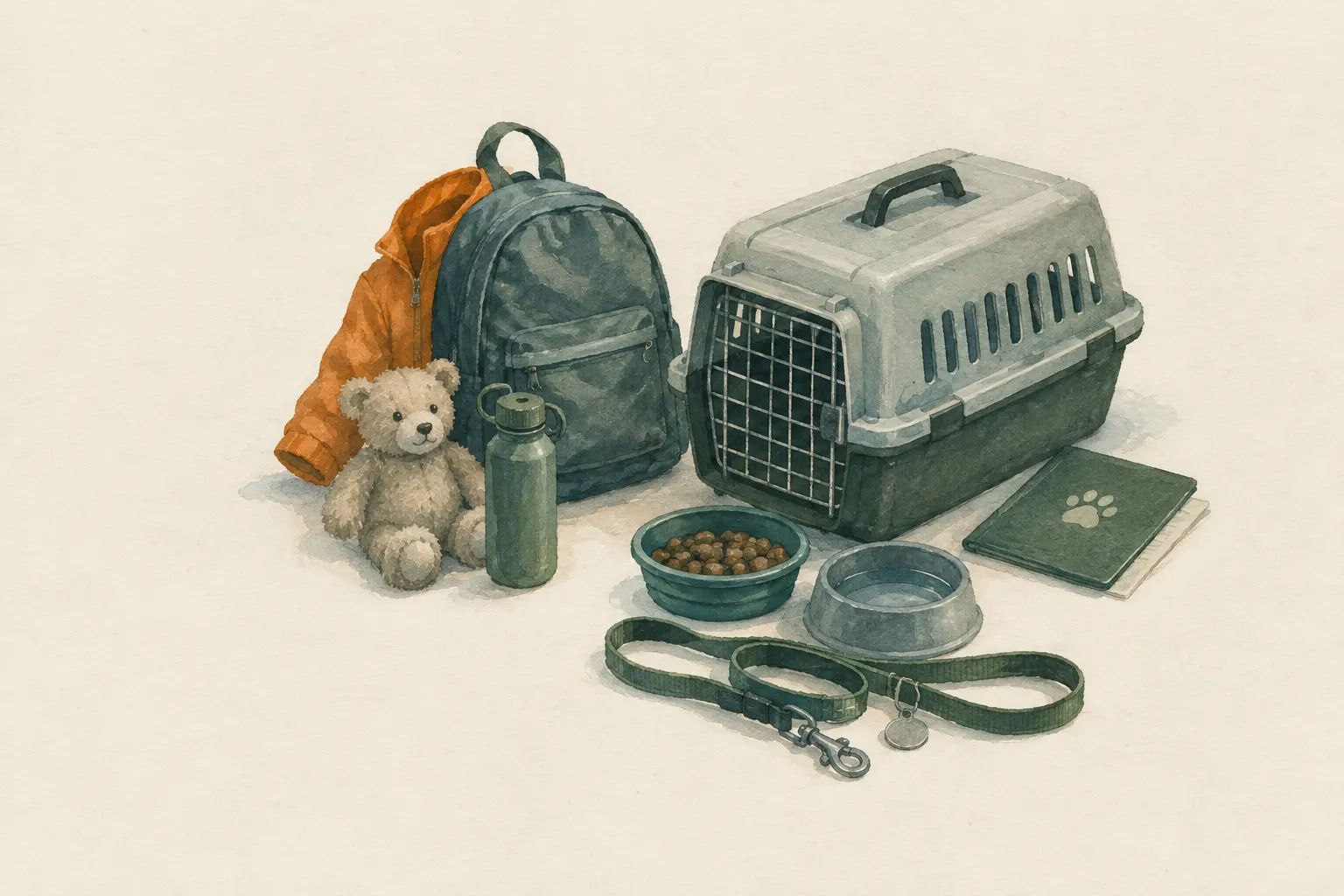
Pets get their own small emergency box with food, water, a lead or carrier and their vaccination record. After all, your dog or cat has to come too if the family must leave home.
The most important thing: nobody goes back into danger to fetch an animal. It is better to leave early with the animal – and if it does get left behind, you tell the rescue services. And children or animals are never left alone in a parked car, because it can get dangerously hot in there very quickly.
How it works
Children cope better with difficult situations when they are prepared. Anyone who knows what will happen, has a small task and carries something familiar feels less helpless. Calm, honest explanations help more than silence – children sense anyway when adults are worried, and otherwise fill the gaps with their own, often worse, ideas.
Pets are often forgotten in emergency plans. That is dangerous because people put themselves at risk for them: they stay in the house too long because the cat is hiding, or return to a closed area to fetch the dog. A solution for the animals therefore belongs in the family plan from the start.
Talking and practising with children
Talk at a calm moment and in words that suit the child's age. For small children this is often enough: “Sometimes something happens and you have to leave the house quickly. We have a plan, and you know where we meet.” Older children can understand more and take on more, such as packing their own bag or writing their own contact card.
Teach children early how to call the emergency number and what to say: who they are, where they are and what has happened. Practise it as a role play with a switched-off phone, not with a real call. Every child should carry a card with the parents' names, phone numbers, the contact person and the meeting point – ideally tucked away so that strangers cannot read it at a glance.
Find out how the school and childcare proceed in an emergency and who is allowed to pick up the children. Register additional trusted people there in case you cannot get through yourself, and tell your child who might come.
Gear and materials
For children, the supplies and go bag get things that give them comfort: a cuddly toy, a book, a small game, familiar snacks and spare clothes that fit. For babies, food, bottles, nappies and warmth belong in it. Which food and which medication suit your child is something to discuss with your paediatrician or midwife.
For pets you pack a separate kit: food and water for several days, bowls, a lead or carrier, any medication, the vaccination record and a current photo of the animal. A collar with contact details and, where this is usual, a microchip with up-to-date registration help reunite you with a lost animal. Important: the chip itself only carries a number – whether it helps depends on your contact details in the registration being correct.
Safety: what to watch out for
Children and animals are never left alone in a parked car. Even in mild weather the sun can make the inside very hot very quickly, even with a window open a crack. For children and animals that can be life-threatening.
Never go back into a danger zone to fetch an animal. Take pets along early when an evacuation is looming, and tell the rescue services if an animal did have to stay behind. Stressed animals may bite or run off; keep them on a lead or in the carrier in unfamiliar surroundings, and do not leave children alone with an agitated animal.
Good to know
Not all emergency shelters accept animals, and the rules differ by country and municipality. So find out beforehand where your animal could stay: with relatives or friends outside the region, in pet-friendly accommodation or at a boarding kennel or cattery. Your municipality and local animal welfare organisations can give information.
Livestock and large animals such as horses need their own preparedness plans and official guidance. They require far more lead time, transport and destinations than can be organised in an acute situation.
Step by step
Talk in an age-appropriate way
Explain calmly what an emergency is and that the family has a plan. Involve children in packing their own bag.
- 1
Talk in an age-appropriate way
Explain calmly what an emergency is and that the family has a plan. Involve children in packing their own bag.
- 2
Contact card for children
Give children a card with their name, address, the parents' and contact person's phone numbers and the meeting point.
- 3
School and childcare
Find out how the school and childcare proceed in an emergency and who may pick up the children. Register additional authorised people there.
- 4
Pack familiar things
A cuddly toy, book or game and familiar snacks help children in an emergency shelter. For infants: food, bottles and nappies for several days.
- 5
Emergency kit for pets
Food and water for several days, bowls, a leash or carrier, medication, vaccination records and a current photo of the animal.
- 6
Identify animals
A collar with contact details and, where common, a microchip with current registration help reunite lost animals.
- 7
Arrange somewhere for pets to stay
Not all emergency shelters accept animals. Find out beforehand whether relatives, friends, pet-friendly accommodation or boarding facilities outside the region are an option.
Common mistakes
- Not letting children in on the plan
- Not knowing the school's pick-up arrangements
- Forgetting pets in the planning
- Animals without identification
- Only looking for somewhere for pets to stay during the evacuation
Quick view
Materials
Pet emergency supplies
Non-perishable food
Including baby food and familiar snacks
Prefer food that can be eaten without cooking; consider allergies and dietary needs; do not forget a can opener.
Hygiene supplies
Nappies, wet wipes
Suitable for
- Families with infants and children
- Households with dogs, cats and small animals
Not suitable for
- Livestock and large animals – these need their own preparedness plans and official guidance
Prerequisites
- A family emergency plan
- Knowing the emergency arrangements of school and childcare
Safety
- Teach children early how to call the emergency number (112 in the EU) and give their address.
- Do not return into danger areas to fetch animals. Take pets early when an evacuation is foreseeable, and tell rescue services about animals left behind.
How it works
Children cope better with emergencies when they are prepared, have tasks and carry familiar things. Calm, honest explanations help more than keeping quiet. Pets are often forgotten in planning, even though people put themselves in danger because of them; a solution for them therefore belongs in the plan from the start.
Advantages
- Children feel safer
- Fewer risky returns because of animals
- Faster family reunification
Disadvantages
- Extra supplies and planning effort
- Conversations may briefly unsettle children if not handled calmly
Deep knowledge
Background
Ready.gov recommends including the specific needs of children and pets in the family plan, and advises taking pets along in an evacuation and arranging somewhere for them to stay in advance. The BBK also recommends taking pets and children into account in household supplies.
Rules on animals in emergency shelters, identification requirements and registration differ by country and municipality. Local authorities and animal welfare organisations can provide information.
Variants
- Infants
- For infants, think of food, safe water for preparation, bottles, nappies and warmth. Clarify questions about feeding and health with a paediatrician or midwife.
Common mistakes
- Not letting children in on the plan
- Not knowing the school's pick-up arrangements
- Forgetting pets in the planning
- Animals without identification
- Only looking for somewhere for pets to stay during the evacuation
Limits and risks
- No paediatric or veterinary advice
- Rules on animals in emergency shelters vary by region
Sources
Ready.gov – U.S. Federal Emergency Management Agency (FEMA): Make A Plan
Specific needs of children and pets in the family plan
Ready.gov – U.S. Federal Emergency Management Agency (FEMA): Pets and animals – disaster preparedness guidance
Emergency kit, identification and accommodation for pets
Bundesamt für Bevölkerungsschutz und Katastrophenhilfe (BBK), Deutschland: Ratgeber für Notfallvorsorge und richtiges Handeln in Notsituationen
Children and pets in supply planning