Securing important documents and copies
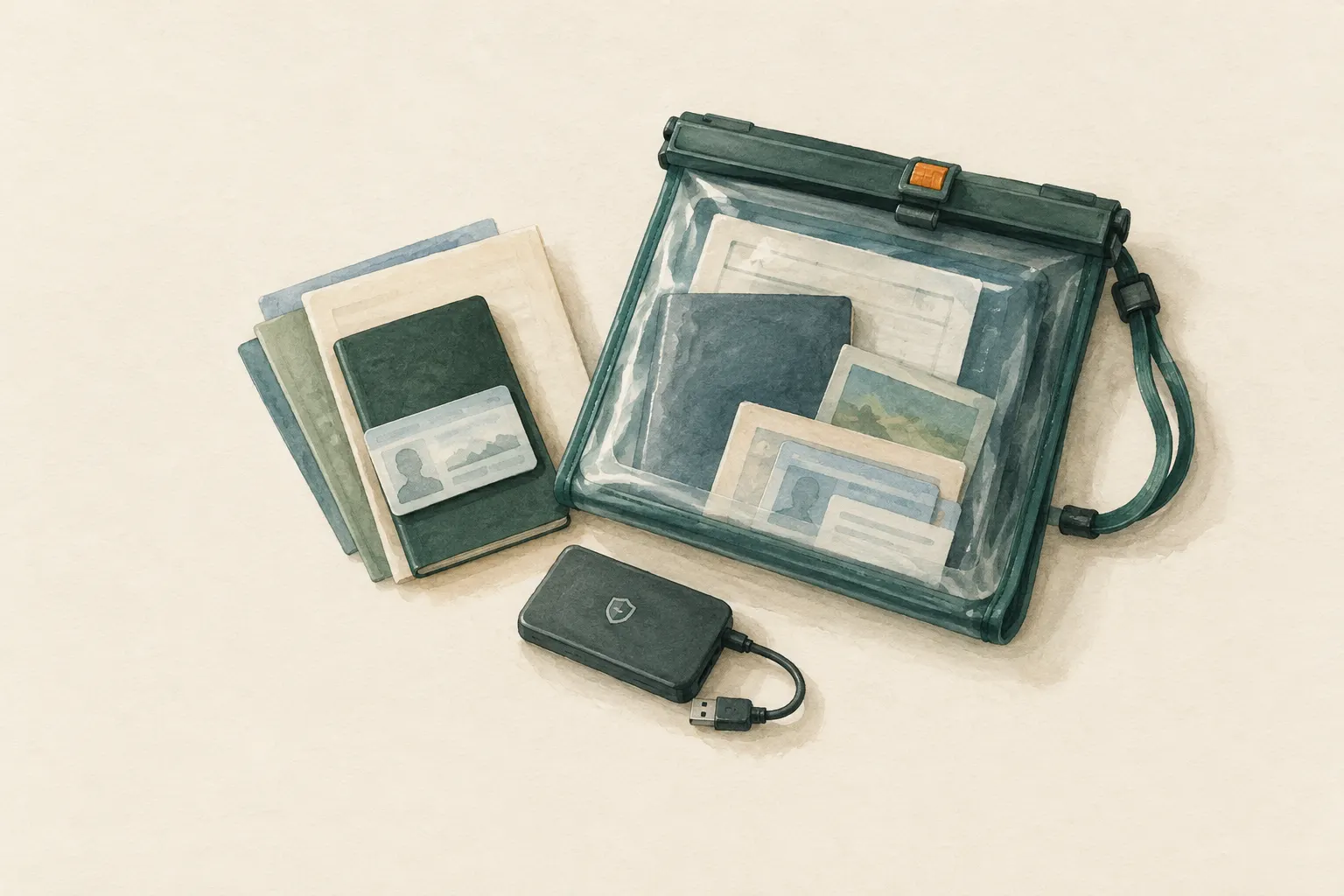
After a flood, fire or evacuation you need ID, insurance and bank papers, medical information and proof of ownership. A waterproof document folder with copies that is ready to grab in an emergency, plus a securely encrypted digital copy, makes starting over much easier.
- About 2 hours to assemble; annual update
Explained simply
When a lot is destroyed after a flood or fire, you need papers to start again: ID, insurance documents, proof of who owns the flat or the car. Without these papers everything takes much longer – like a missing key when you are standing at your own front door.
That is why you copy the most important documents and put them in a waterproof folder you can take quickly. A second backup is kept somewhere else, for example with relatives or well encrypted on a storage device.
The most important thing: if there is a fire, you do not look for papers. You go out at once. Documents can be applied for again; people cannot be replaced.
How it works
After a disaster a long path through authorities, banks and insurers often begins. Everywhere you are asked who you are, what you own and which contracts you have. Copies speed this up because you have numbers, dates and contacts to hand at once, instead of piecing them together laboriously. For medical care it also helps to have the medication plan, allergies and vaccinations in writing.
The second idea is keeping things in separate places. If originals and copies are in the same cupboard, a single fire can destroy both. A second backup somewhere else – with a trusted person in another region or digitally encrypted – protects against losing everything at the same time.
What goes into the folder
These groups are a good guide: ID cards and passports; birth and marriage certificates; insurance policies; bank and account information; tenancy or ownership documents; certificates and diplomas; vehicle papers; vaccination records and medication plans; powers of attorney and advance directives. Add a list of important phone numbers, doctors, insurance numbers and allergies. Which documents are especially important in your country may differ – the list is a starting point, not a complete enumeration.
An often forgotten part is the household contents. If you walk through your home once and photograph or film every room and valuable items, you will later have evidence for the insurer. It may take half an hour and can save a lot of dispute and uncertainty.
The folder itself should be waterproof, for example a sealable document pouch or simple, well-closed freezer bags inside a sturdy binder. Originals you rarely need can also go in it or be kept in another safe place.
Safety: what to watch out for
Copies of ID and bank papers are valuable to fraudsters, because they could be used to sign contracts or open accounts in someone else's name. So keep the folder securely and out of plain sight. Store digital copies only encrypted and with a strong password – never unencrypted in an email inbox or on a plain USB stick.
In a fire or other immediate danger: do not look for documents, get out at once, call the local emergency number (112 in the EU). The folder is meant for orderly evacuations, not for situations in which every second counts.
Where to keep it and how to maintain it
The folder must be quick to grab so you can take it in an evacuation – for example next to the go bag or inside it. The basement is unsuitable because it is affected first in a flood. A place on an upper floor, dry and not right against an outside wall, is usually better.
Once a year you look inside: have any IDs expired? Are there new contracts, new insurance, a new family member? Have phone numbers or medication changed? A fixed date, for instance together with checking the go bag, keeps the folder from going out of date.
Good to know
Each country decides whether and for what copies are accepted. In many cases you will still need originals or newly issued documents in the end. The copy does not replace them, but it speeds up the process, because the authority immediately knows which document is involved. Some authorities also recommend certified copies; if in doubt, ask the responsible office.
An extra copy with relatives in another region is a simple and effective addition. If your whole home area is affected, a complete set of papers is still waiting there.
Step by step
Make a list
Gather: ID cards and passports, birth and marriage certificates, insurance policies, bank and account information, tenancy or ownership documents, certificates, vehicle papers, vaccination records, medication plans, powers of attorney and advance directives.
- 1
Make a list
Gather: ID cards and passports, birth and marriage certificates, insurance policies, bank and account information, tenancy or ownership documents, certificates, vehicle papers, vaccination records, medication plans, powers of attorney and advance directives.
- 2
Make copies
Copy the documents and put them in a waterproof folder. Originals that are rarely needed can also go in it or be kept in a safe place.
- 3
Contacts and medical information
Add a list of important phone numbers, doctors, insurance numbers, allergies and medication.
- 4
Document household contents
Photograph or film rooms and valuable items; this helps with insurance claims.
- 5
Digital backup
Scan the documents and store them encrypted, for example on an encrypted USB stick or in secured cloud storage.
- 6
Keep it within reach
Keep the folder where it can be taken quickly in an evacuation – not in the basement if flooding is a risk.
- 7
Update
Once a year check whether documents have expired or new ones have been added.
Common mistakes
- Storing the folder in the basement
- Storing digital copies unencrypted
- Forgetting medical information
- Never updating the folder
Quick view
Materials
Document folder (waterproof)
Store securely – contains sensitive personal data.
Suitable for
- All households
- Regions at risk of flood, fire or storms
Not suitable for
- Unencrypted storage of sensitive data on unsecured devices or services
Prerequisites
- Access to a copier or scanner
- A secure storage place
Safety
- Copies of ID and bank papers are valuable to fraudsters. Store the folder securely, and keep digital copies only encrypted and with a strong password.
- Each country decides whether and for what copies are accepted. Originals usually remain necessary; ask the authorities if in doubt.
How it works
Without proof, replacement documents, insurance payouts and assistance take longer. Copies speed up these processes, and a second, separately stored backup (digital or with a trusted person) protects against losing originals and copies at the same time.
Advantages
- Speeds up replacement documents and insurance payouts
- Important medical information is immediately available
Disadvantages
- Sensitive data in one place – protection against theft needed
- Needs upkeep
Deep knowledge
Background
In its emergency preparedness guide the BBK recommends a document folder with important papers or certified copies that can be taken quickly in an emergency. Ready.gov lists copies of important family documents in a waterproof container as part of the emergency kit.
Which documents are important and whether copies are accepted depends on the country. The list in this entry is a guide, not an exhaustive enumeration.
Variants
- Copy with a trusted person
- An extra copy with relatives in another region protects you if your own home area is entirely affected.
Common mistakes
- Storing the folder in the basement
- Storing digital copies unencrypted
- Forgetting medical information
- Never updating the folder
Limits and risks
- No legal advice on the acceptance of copies
- No recommendation of specific storage services
Material alternatives
Derived from material properties: a substitute must have all relevant properties. Observe the notes on the substitute.
- Document folder (waterproof)
- Tarp, Plastic sheet / large bin bag (Tears easily; never pull over the head (suffocation risk).), Emergency blanket (Tears easily once punctured; short-term shelter only.), Rain poncho (When used as a shelter, it no longer protects your body from rain.), Bivy bag (Never fully close off the face.), Tent (Do not cook or heat inside the tent (fire and carbon monoxide danger).), Heavy-duty bin bag (large) (Suffocation risk: never pull plastic bags over the head or face and keep them away from small children.), Group shelter bag (Airtight – ventilate regularly.)
Results come exclusively from structured entries. No improvised instructions are generated.
Sources
Bundesamt für Bevölkerungsschutz und Katastrophenhilfe (BBK), Deutschland: Ratgeber für Notfallvorsorge und richtiges Handeln in Notsituationen
Document folder with important papers
Ready.gov – U.S. Federal Emergency Management Agency (FEMA): Build A Kit
Copies of important documents in a waterproof container