Choosing and breaking in footwear
Good hiking footwear suits the foot, the terrain and the load. Try it on in the afternoon with hiking socks; the toes must not hit the front going downhill. New footwear is broken in gradually before a long trip. Blisters come from friction – react early instead of pushing through.
- Fitting 1 hour, breaking in over a few weeks
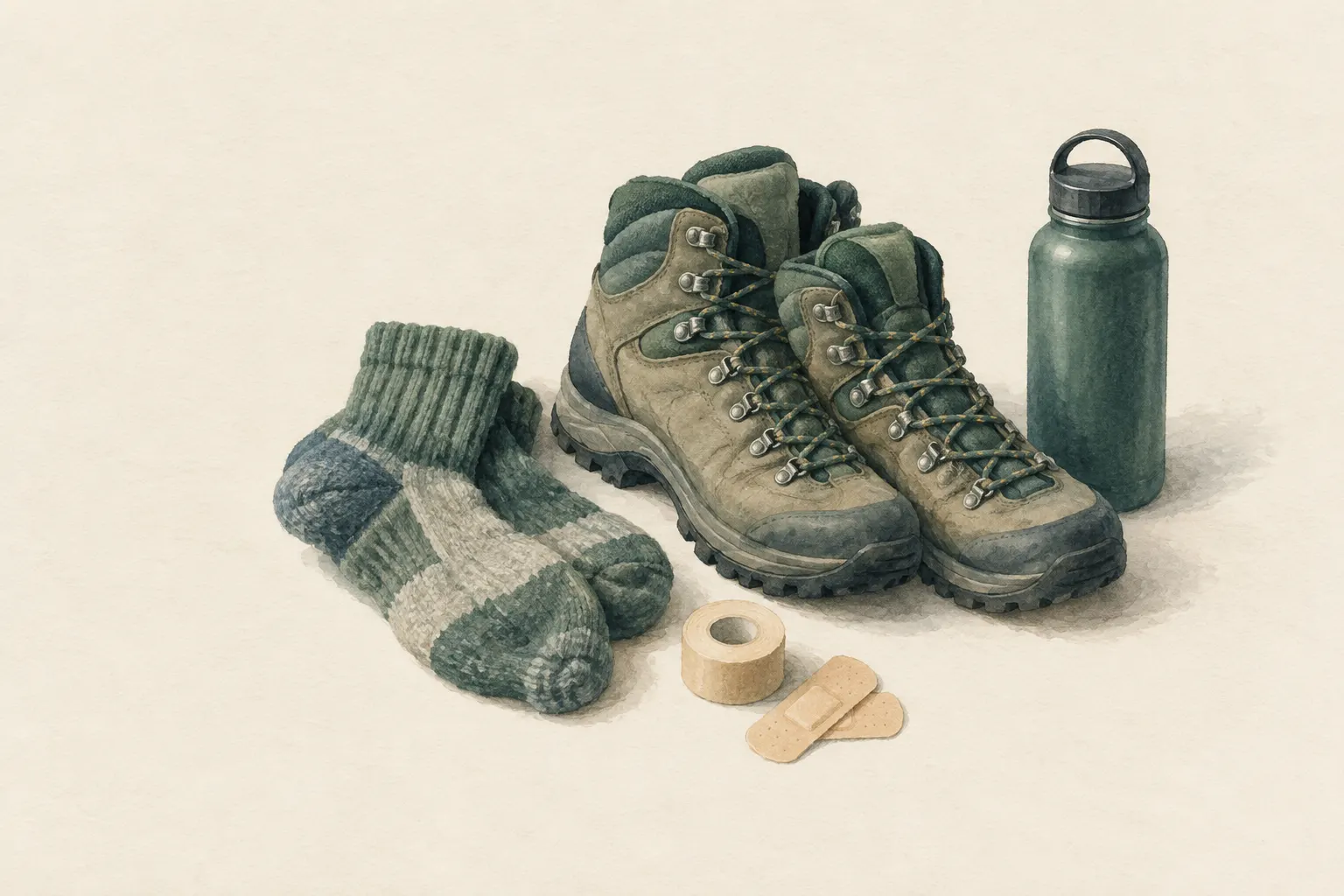
Explained simply
Your feet carry you all day. Good footwear suits your foot, the path and the weight you carry. Try shoes on in the afternoon, because feet get a little bigger during the day. Wear the socks you will wear on the trip. When you walk downhill, your toes must not hit the front, and your heel should not slip.
New footwear is like a new backpack: it has to get used to you, and you to it. That is why you wear it in daily life and on short walks first, before going on a long trip.
Blisters form when skin rubs again and again. Just before, you feel a warm, burning spot. That is like a smoke alarm for your feet: stop at once, straighten your socks and protect the spot with a plaster or tape.
How blisters form
A blister forms when skin keeps rubbing against the sock or shoe. The upper layers of skin shift against the deeper ones until they separate and the space between fills with fluid. Moisture makes the skin softer and more vulnerable, heat strengthens the effect. That is why blisters appear especially on long, warm days and with wet feet.
Before the blister there is almost always a warning sign: a warm, burning or reddened spot, often called a “hot spot”. If you stop and react now, you can usually still prevent the blister. If you keep going and “tough it out”, you often have a painful blister a few hours later that spoils the rest of the trip.
What helps against friction is a shoe whose shape suits your foot, a firm heel hold, well-fitting socks without wrinkles and feet that are as dry as possible. Breaking in reveals pressure points before they become a problem on a long trip.
Finding the right footwear
First comes the type: light hiking shoes are enough for good paths. Ankle-high boots with stiffer soles are meant for uneven terrain and heavy loads. Crampon-compatible mountain boots with very stiff soles are only needed for alpine routes. Light trail shoes dry quickly but offer less protection and support under heavy loads.
When trying footwear on, the details count. Try in the afternoon, with your trip socks, and always both feet – many people have two feet of different sizes, and the larger one decides. In the shop, walk downhill on a ramp: your toes must not hit the front. Walk uphill: your heel should not lift noticeably. Pay attention to width too: if it presses at the side of the ball of the foot or the little toe, that will not get better over long distances.
Every manufacturer builds its footwear over its own form, called the last. That is why the same size can fit very differently from brand to brand. Take your time, try several models and do not buy footwear too small – one of the most common causes of bruised toenails and pain when walking downhill.
Breaking in and lacing
Wear new footwear in daily life first, then on short walks and finally on longer trips, also with a pack. Increase duration and load step by step. Modern footwear often needs less break-in time than the all-leather boots of the past, but it too only shows where it presses once you walk in it. A long trip in brand-new boots is an unnecessary risk.
Lacing is an underrated tool. Over the instep – the top of the foot – it should be firm enough that the foot does not slide forward downhill. If it presses at a certain spot, you can skip a hook or eyelet there to reduce the pressure. Before a long descent it is worth tightening the laces again; uphill they can be a little looser.
Socks are part of the system too. They should fit well, not wrinkle and move moisture away from the skin. Cotton socks soak up water and stay wet, which encourages blisters on long trips. A spare pair packed dry in the pack is worth its weight in gold.
Foot care on the way
Care on the trip is just as important as the footwear itself. Trim your toenails a few days before the trip so they do not hit the front downhill. During longer breaks take off shoes and socks so your feet can dry and cool. Swap wet socks for dry ones as soon as you can.
At the first hot spot, stop immediately, even if the moment is inconvenient. Straighten your socks, remove grit or sand from the shoe and protect the spot with tape or a blister plaster. That takes a few minutes and often saves you days of pain.
Safety: what to watch out for
Keep open or burst blisters clean and covered. If they become red, swollen, warm, ooze pus or you develop a fever, it may be an infection – then seek medical help. Anyone with foot problems or a condition that reduces feeling in the feet should check their feet especially carefully and get advice from a doctor or foot specialist.
Sturdy, ankle-high boots give more support and protection on rough ground but do not replace careful footing. On slippery or steep ground, walking slowly helps more than any shoe. In cold and wet conditions, dry, warm feet also protect against cold injuries: change wet socks and do not let your feet cool for hours in wet shoes.
Step by step
Choose a type
Light hiking shoes for trails, ankle-high boots with stiffer soles for rough terrain and loads, crampon-compatible boots only for alpine routes.
- 1
Choose a type
Light hiking shoes for trails, ankle-high boots with stiffer soles for rough terrain and loads, crampon-compatible boots only for alpine routes.
- 2
Try on
In the afternoon, with hiking socks, both feet. Walk downhill on a ramp: toes must not hit the front, and the heel should not lift.
- 3
Lace
Firm enough over the instep that the foot does not slide forward; relieve pressure points by skipping hooks.
- 4
Break in
Wear them in daily life and on short walks, gradually increasing duration and load.
- 5
Watch for hot spots
At the first hot spot stop at once, straighten socks and protect the spot with tape or a blister plaster.
Common mistakes
- New boots straight on a long trip
- Buying footwear too small
- Cotton socks on long trips
- Ignoring hot spots
Quick view
Materials
Sturdy closed shoes
Suitable for
- Buying new
- Moving to rougher terrain
- Recurring blisters
Not suitable for
- Medical foot problems – have them checked by a doctor or specialist
Prerequisites
- The socks you will wear on the trip
- Time before the planned trip
Safety
- Keep open, inflamed blisters clean; with redness, swelling or fever seek medical help.
How it works
Blisters form when skin repeatedly rubs against sock and shoe. A suitable last, a firm heel hold and dry socks reduce this friction. Breaking in lets material and foot adapt to each other, and pressure points show up before they become a problem on the trip.
Advantages
- Fewer blisters and injuries
- Better footing
Disadvantages
- A good fit takes time when buying
Deep knowledge
Background
Mountaineering handbooks stress fit, terrain and weight as criteria for footwear and recommend breaking boots in before trips. Modern footwear often needs less break-in time than the all-leather boots of the past.
Foot care on the trip – dry socks, reacting early – is as important as the shoe itself.
Variants
- Light trail shoes
- Light and quick-drying but less protection and stability under heavy loads.
Common mistakes
- New boots straight on a long trip
- Buying footwear too small
- Cotton socks on long trips
- Ignoring hot spots
Limits and risks
- No product recommendations
- No treatment of foot injuries
Sources
The Mountaineers Books (2017): Mountaineering: The Freedom of the Hills, 9th edition
Footwear choice, fit, breaking in and foot care