Layering clothing system
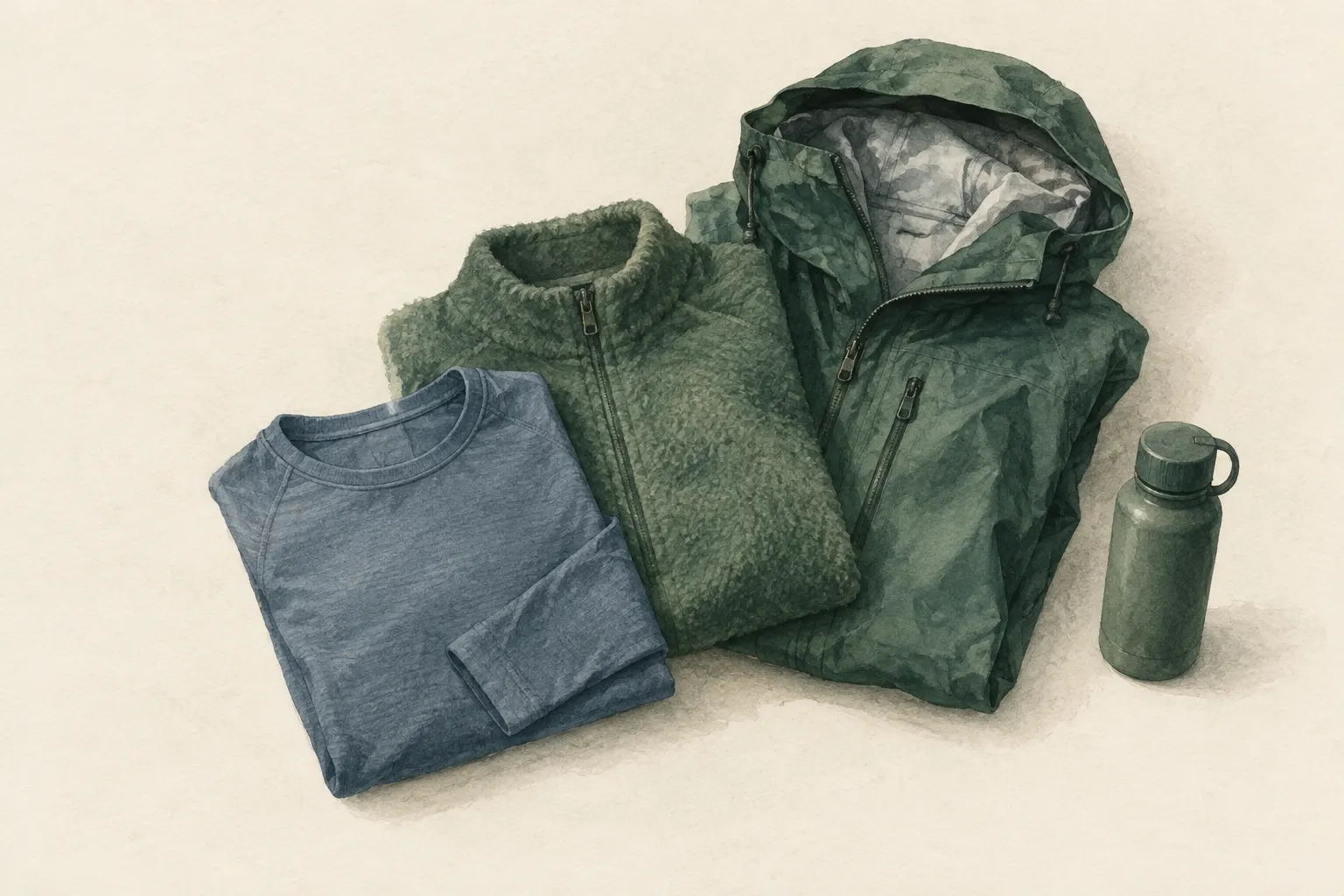
Instead of one thick jacket, layering combines several layers with different jobs: a base layer that moves moisture away from the skin, an insulating mid layer and an outer layer against wind and rain. Putting individual layers on and taking them off keeps you warm without sweating – crucial in cold and changeable weather.
- Assembled once; adjusted constantly on the way
Explained simply
Imagine putting on one single thick jacket on a cold morning. Walking uphill you get hot, you sweat, and your T-shirt gets wet. When you stop at the top you suddenly feel freezing – because wet clothing hardly keeps you warm any more. Layering solves this problem: instead of one thick jacket you wear several thinner pieces on top of each other, like the skins of an onion.
Each layer has its own job. Right next to your skin is the base layer: it moves sweat away from the skin. In the middle sits the warm layer, for example a fleece or a wool jumper. It holds on to air, and still air works like an invisible warm blanket. On the outside a jacket protects you from wind and rain. If you get warm, take a layer off. If you get cold, put one on.
The most important point for your safety: wet clothing and wind can chill you dangerously even when it is not freezing. If someone is shivering hard or seems confused, find shelter, put on dry clothes and get help.
How it works
Your body produces heat all the time and loses it in several ways: through contact with cold things such as the ground (conduction), through air and wind moving past (convection), through radiation and through sweat evaporating. Clothing mainly slows the first two by holding on to lots of tiny pockets of air. Still air conducts heat very poorly. That is why a lofty fleece is warmer than a densely woven shirt of the same weight. When we call a garment “warm”, what we really mean is: it traps a lot of still air.
Two things destroy these air pockets. Water fills the gaps, and water conducts heat many times better than air. Wind pushes through the clothing and keeps swapping the warmed air for cold air. On top of that comes evaporation: when wet fabric dries on your body, it draws heat out of you. It is the same effect that makes you shiver in the wind after a swim.
Layering gives each of these problems its own layer. The base layer keeps the skin as dry as possible, the mid layer provides the air pockets, the outer layer keeps wind and rain out. Because the layers are separate, you can adjust each one on its own. So you do not just have the choice between “jacket on” and “jacket off”, but many steps in between.
What really matters
What matters is not the single jacket but the regulating. Many people do not get cold on the way because they carry too little, but because they sweat first and then cool down. A well-tried rule is: set off feeling slightly chilly, because after a few minutes of moving you will warm up anyway. Before a climb, take off a layer before you start to sweat – not when your shirt is already wet.
At breaks it is the other way round: put on a warm layer straight away while you are still warm. Then you do not have to win back lost heat with effort; you simply hold on to the heat you have. When it rains, put on the outer layer early, not once the mid layer is already damp. Getting damp insulation dry again is very hard on the way.
Fit counts as well. The base layer should sit close to the body so it can pick up moisture directly from the skin and pass it on. The outer jacket has to be roomy enough not to squash the warm layer underneath – compressed insulation holds less air and keeps you less warm. Head, hands and feet are part of the system: a hat, gloves and dry spare socks often make more difference than an extra jacket.
Gear and materials
Synthetic fibres and wool are suitable for the base layer. Synthetics absorb little water and dry quickly. Wool, such as merino, can take up moisture inside the fibre, feels less wet while doing so and stays warmer than cotton when damp. Cotton is unsuitable as the layer next to the skin in cold and wet conditions: it soaks up water, dries slowly and barely insulates when wet.
Mid layers can be fleece, wool jumpers or jackets with down or synthetic fill. Down is very warm for its weight and packs small, but loses much of its effect when wet. Synthetic fill is heavier but keeps more warmth when damp. Fleece is robust and dries quickly but lets wind through – in wind it needs a tight outer layer on top.
The outer layer is a wind- and waterproof jacket with a hood, ideally with vents. In dry, windy weather a light wind jacket that lets more water vapour out is often enough. Specialist clothing is not a must: a wool jumper, a synthetic sports shirt and a rain jacket you already own make a working system. Care, such as renewing the water-repellent finish, follows the manufacturer's instructions.
Safety: what to watch out for
Hypothermia means that the temperature inside the body drops. It does not only happen in deep winter: rain, wind and wet clothing can become dangerous even above freezing, especially when someone is exhausted or has eaten little. Early signs are feeling cold, shivering and clumsy fingers. If the shivering becomes intense or someone seems confused, drowsy or slurs their speech, that is a serious warning sign.
Then: find shelter from wind and wet, swap wet clothing for dry, or at least put a dry insulating layer and a windproof shell on top, insulate the person from the cold ground and get help – via the local emergency number (112 in the EU). Anything beyond that is best learned on a first-aid course.
Preventing is much easier than treating. Change layers in time, carry a dry reserve layer packed waterproof and remember that children and older people often cool down faster and do not always notice or say so. In bad weather, turning back early is not a defeat but a good decision.
How to practise it
Try out your system on a cool day close to home. Notice after how many minutes of walking you warm up and when you start to sweat. Practise putting layers on and taking them off quickly, including with gloves. Decide which pocket holds which layer so you can find it without searching.
During a break you can compare: how fast do you get cold if you put nothing on, and how does it feel if you put on a warm layer straight away? This experience helps you make the right decision later, before you get cold. With children it can be a game: who notices first that it is time for one layer more or less?
Step by step
Choose the base layer
Close-fitting underwear made of synthetic fibre or wool (e.g. merino) moves moisture on and stays warmer when damp than cotton.
- 1
Choose the base layer
Close-fitting underwear made of synthetic fibre or wool (e.g. merino) moves moisture on and stays warmer when damp than cotton.
- 2
Choose the mid layer
Fleece, wool jumpers or insulated jackets with synthetic or down fill. Synthetic retains more warmth when damp than down; down is warmer for its weight as long as it stays dry.
- 3
Choose the outer layer
A wind- and waterproof jacket with hood, large enough for the layers underneath. Vents help against sweating.
- 4
Head, hands, feet
Hat, gloves (a spare pair in the cold) and socks are part of the system. Carry spare socks packed dry.
- 5
Regulate on the way
Remove a layer before climbs, before you sweat; put on a warm layer immediately when stopping, before you cool down. Put on the outer layer early when it rains.
- 6
Care for it
Wash according to the manufacturer's instructions; for water-repellent outer layers, re-treatment (reproofing) per manufacturer instructions can restore beading. Dry down clothing completely.
Common mistakes
- Setting off in all layers and being soaked with sweat after ten minutes
- Cotton T-shirt as base layer in the cold
- Outer jacket too tight for the insulating layer
- No spare gloves in winter
- Waiting to layer up at breaks until already cold
Quick view
Materials
Base layer
Dry spare clothing
Insulating mid layer, e.g. fleece or insulated jacket
Carry it in waterproof packaging – wet clothing barely insulates.
Rain and wind shell
Suitable for
- Hiking, mountain and winter tours
- Outdoor work with changing exertion
- Emergency kit in the car or backpack
Not suitable for
- Compensating for fundamentally inadequate gear in extreme cold
- A substitute for protective clothing for work with special hazards
Prerequisites
- Knowing the expected temperatures and precipitation
- Clothing in sizes that can be worn on top of each other
Safety
- Cotton absorbs a lot of moisture and dries slowly; when wet it barely insulates. Do not use it as the layer next to the skin in cold and wet conditions.
How it works
Clothing keeps you warm through trapped, still air. Moisture from outside (rain) or inside (sweat) and wind that carries warm air away destroy this effect. Layering separates the jobs: the base layer transports moisture, the mid layer traps air, the outer layer blocks wind and water. Because each layer can be put on and taken off individually, insulation can be matched to exertion.
Advantages
- Adaptable to weather and exertion
- Individual items can be combined in many ways
- Less sweating, therefore warmer
Disadvantages
- Requires constant adjustment
- Several items have to be carried
Deep knowledge
Background
“Mountaineering: The Freedom of the Hills” describes clothing as a system of layers, each with its own function, and stresses how important it is to avoid sweat and wetness. The Wilderness Medical Society guidelines name wetness and wind as major factors in heat loss and hypothermia.
The names of the layers are not standardised, and material claims such as “breathable” are used in different ways. What matters is how the layers work together, not a single label.
Variants
- With clothing you already own
- A layering system does not need specialist clothing: a wool jumper, a synthetic sports shirt and a rain jacket already fulfil the basic functions.
Common mistakes
- Setting off in all layers and being soaked with sweat after ten minutes
- Cotton T-shirt as base layer in the cold
- Outer jacket too tight for the insulating layer
- No spare gloves in winter
- Waiting to layer up at breaks until already cold
Limits and risks
- No product recommendations
- No temperature ranges for individual garments
Material alternatives
Derived from material properties: a substitute must have all relevant properties. Observe the notes on the substitute.
- Dry spare clothing
- Sleeping pad, Dry leaves, grass or conifer boughs (Collect only where allowed; no protected plants. Check for ticks and insects.), Backpack, Wool blanket / duvet (Keep away from candles, stoves and heaters.), Insulated cool box (Keeps cold only for a limited time; without ice packs or ice it is not a fridge.), Sleeping bag (Do not store compressed long-term; do not pack away damp.), Newspaper and cardboard (Flammable – keep away from candles, stoves, heaters and embers.), Insulated cooking box (hay box, thermal cooker) (Never put open flame or embers inside – only the hot, closed pot.)
- Rain and wind shell
- Cotton cloth / T-shirt (Removes coarse particles only – no disinfection.)
Results come exclusively from structured entries. No improvised instructions are generated.
Sources
The Mountaineers Books (2017): Mountaineering: The Freedom of the Hills, 9th edition
Clothing as a layer system, avoiding sweat and wetness
Wilderness & Environmental Medicine (Wilderness Medical Society) (2019): Wilderness Medical Society Clinical Practice Guidelines for the Out-of-Hospital Evaluation and Treatment of Accidental Hypothermia: 2019 Update
Wetness and wind as factors in heat loss