How the body loses heat
The body loses heat in four ways: conduction, convection, radiation and evaporation. A shelter is only as good as its ability to interrupt these paths – a roof and walls are not enough if the ground draws heat away or clothing is wet.
- About 10 minutes to read
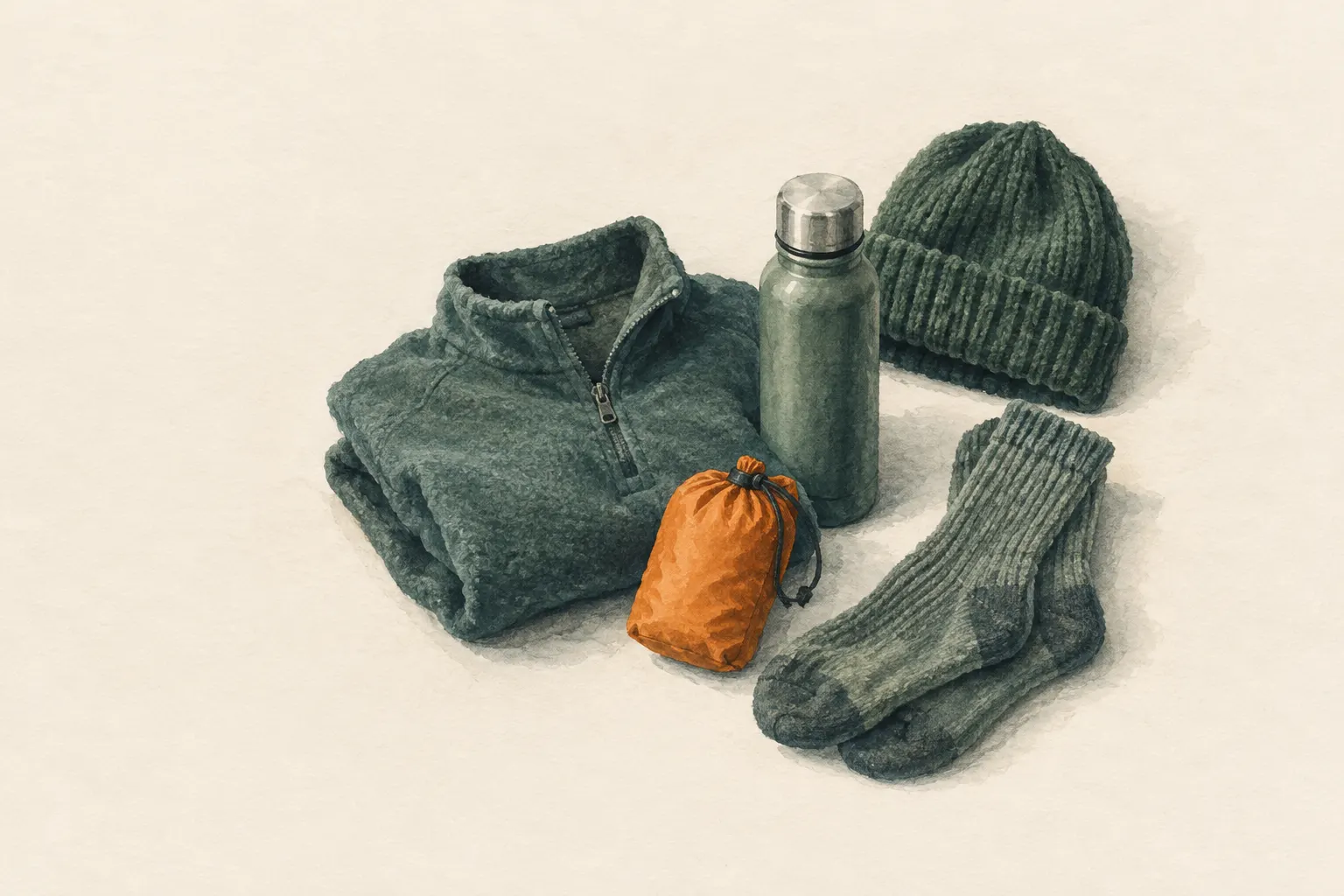
Explained simply
Your body is like a small stove that keeps making heat. Outdoors, your surroundings try to take that heat away again. Heat always travels from warm to cold – just like hot cocoa slowly cooling in a cold mug.
There are four ways the heat disappears: it flows into the cold ground you sit on (conduction). Wind blows it away (convection). It radiates into the cold sky (radiation). And wet skin or wet clothing cools you as it dries (evaporation) – exactly like feeling cold after swimming even when the sun is out.
A good shelter blocks all four paths: something thick underneath you, protection from the wind, a roof above you and, above all, staying dry. The most important point: you can get dangerously cold even above freezing if you are wet and it is windy. Anyone who shivers hard or seems confused needs shelter right away – and if it gets worse, help via the emergency number.
How it works
Conduction means heat passes directly into anything you touch that is colder than you. Ground, rock and snow are large, cold masses that can soak up heat almost without limit. Anyone sitting or lying still on them keeps losing heat through the contact area – and often only notices once hips and back are already cold.
Convection means moving air or water carries away the warm layer of air right next to your body and replaces it with cold air. That is why a windy day feels much colder than a still day at the same temperature. Radiation is heat your body gives off as invisible light. On clear nights it radiates into the cold sky; a roof, a tree or a sheet above you intercepts some of it.
Evaporation costs heat because water needs energy to turn into vapour – and it takes that energy from your skin. Sweating is useful on hot days but becomes a problem in the cold. Wet clothing combines two paths at once: water conducts heat far better than air, and it also evaporates.
What really matters
Which path costs the most heat depends on the situation. Lying on cold ground, it is often conduction. In wind with damp clothing, it is usually convection together with evaporation. So it helps to ask yourself briefly: where am I losing the most right now?
In an emergency there is a simple order: first stay dry and get out of the wind, then put a layer between you and the ground, then add a roof against rain and radiation. A roof alone is not enough if you are lying on wet ground underneath it. Even a thick sleeping bag helps little underneath you, because its fill is squashed flat by your weight.
Acting early is crucial. It is much easier to stay warm than to get warm again. Put on a jacket before you feel cold, and take off a layer before you start to sweat.
Safety: what to watch out for
Hypothermia means the temperature inside the body is dropping. It does not only happen in snow: rain, wind and exhaustion are enough even in mild temperatures. People who sit still or are injured, very tired, hungry or soaked are particularly at risk.
Warning signs are intense shivering, clumsy hands, stumbling, confusion, slurred speech and unusual drowsiness. Important: the person affected often does not notice it themselves, because thinking slows down too. So keep an eye on each other in a group.
At warning signs, act immediately: get out of wind and wet, insulate from the ground, replace wet clothing with dry clothing if possible. If things get worse, call the local emergency number (112 in the EU). Medical treatment belongs in the hands of emergency services – this text only explains how to prevent chilling.
Typical situations
A break on a cold rock after a steep climb: you are sweaty (evaporation), it is windy on the ridge (convection) and you are sitting on rock (conduction). Remedy: sit on your backpack, find the sheltered side, put on a dry, windproof layer straight away.
A clear, still autumn night under the open sky: radiation plays a big role here, and dew or frost often forms on meadows. A tarp over the sleeping spot and a good sleeping pad make the biggest difference.
Drizzle in mild weather: many people underestimate this situation because it is “not really cold”. Yet slowly soaked clothing and a light wind can cost a lot of heat over hours. Putting on rain gear early is the most important step here.
Good to know
You often hear that people lose most of their heat through the head. Put that generally, it is not true: the head loses roughly as much as its share of the body surface. But because it is often the only uncovered part of the body, a hat still makes a noticeable difference.
Shivering is a protective reaction: the muscles produce heat as they do it. But it costs a lot of energy. So anyone who is cold should eat and drink something as long as they can think clearly and swallow.
Clothing does not produce heat itself. It only holds on to the heat your body makes by trapping still air. That is why loose, dry clothing in several thin layers often keeps you warmer than a single tight, thick garment.
Step by step
Interrupt conduction
Never sit or lie directly on ground, snow or rock. Put a sleeping pad, dry vegetation or a backpack in between.
- 1
Interrupt conduction
Never sit or lie directly on ground, snow or rock. Put a sleeping pad, dry vegetation or a backpack in between.
- 2
Reduce convection
Choose a sheltered spot, turn the closed side of the shelter into the wind and wear a windproof outer layer.
- 3
Screen radiation
A roof over the sleeping spot reduces radiation to the clear night sky. A hat and hood protect the head.
- 4
Limit evaporation
Shed layers before you sweat, change out of wet clothing as soon as dry clothing is available, and put on rain gear early.
Common mistakes
- Thinking only about a roof and forgetting the ground
- Settling down in sweat-soaked clothing
- Underestimating wind because the air temperature seems mild
- Reacting only once intense shivering has already set in
Quick view
Suitable for
- Planning any night outdoors
- Judging which protective measure is needed first
- Understanding ground insulation, wind protection and dry clothing
Not suitable for
- Medical assessment or treatment of hypothermia
Safety
- Wet clothing loses much of its insulation, and water conducts heat far better than air. Staying dry takes priority over almost everything else.
How it works
Heat always flows from warmer to colder. Through conduction it passes directly into surfaces you touch, such as cold ground; through convection, moving air or water carries it away; through radiation the body gives it off to colder surroundings or the clear night sky; and through evaporation, drying sweat and moisture costs heat. A shelter must therefore insulate, break the wind, screen radiating surfaces and keep you dry.
Deep knowledge
Background
Which heat-loss path dominates depends on the situation. Someone lying still on cold ground loses a lot of heat by conduction into it – which is why ground insulation often matters more overnight than the thickness of the sleeping bag, whose fill is compressed under body weight. In wind, convective loss rises sharply, especially when clothing is damp.
Wet makes every other path worse: damp clothing conducts heat better, water on the skin evaporates and cools, and wet insulation loses its trapped air. This gives a simple order of priorities for an emergency shelter: first stay dry and get out of the wind, then insulate from the ground, then add a roof against precipitation and radiation.
The medical assessment of hypothermia and its treatment belong to trained responders and emergency services; this entry only describes the physical basics for choosing a shelter.
Illustrations
Common mistakes
- Thinking only about a roof and forgetting the ground
- Settling down in sweat-soaked clothing
- Underestimating wind because the air temperature seems mild
- Reacting only once intense shivering has already set in
Limits and risks
- Does not replace first-aid training
- Says nothing about heat protection and overheating
Sources
Wilderness & Environmental Medicine (Wilderness Medical Society) (2019): Wilderness Medical Society Clinical Practice Guidelines for the Out-of-Hospital Evaluation and Treatment of Accidental Hypothermia: 2019 Update
Mechanisms of heat loss and the role of insulation, wind and wet protection in preventing hypothermia
Headquarters, Department of the Army (USA) (2002): FM 3-05.70 Survival
Principles of cold protection and shelter in the field