Choosing, using and caring for a sleeping bag
A sleeping bag only keeps you as warm as it suits the temperature, the sleeping pad and the person – and only as long as its fill stays dry and lofty. Standardised temperature ratings help with comparison but are no guarantee. Correct storage (loose, dry) and washing per manufacturer instructions preserve insulation for years.
- About 1 hour of research to choose; a few minutes of care after each trip
Explained simply
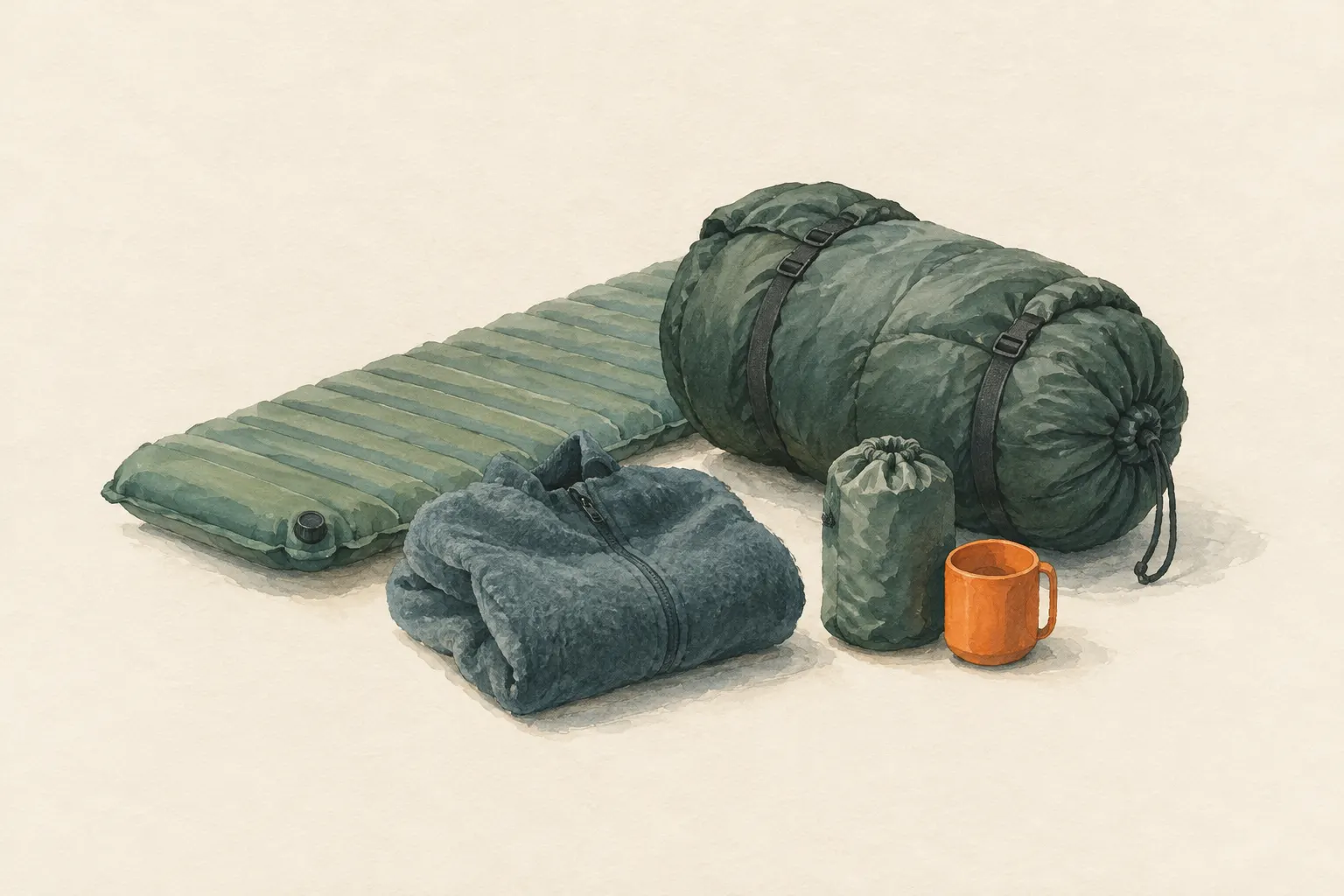
A sleeping bag does not make any heat itself. The heat comes from you. The bag only holds on to it – just as a vacuum flask keeps hot tea warm. The fill of down or synthetic fibres does this: it is full of tiny air pockets, and still air lets heat escape only very slowly.
Two things make a sleeping bag cold: squashing and wetness. Where you lie, your body presses the fill flat. That is why you always need a sleeping pad underneath, otherwise the cold ground pulls the heat out of you. And when the fill gets wet, the air pockets collapse.
Many sleeping bags have temperature figures on them. They help with comparing, but they are not a promise. Never take the “extreme” figure as your target – it already describes a range in which people can get dangerously cold.
How it works
The fill of a sleeping bag traps air. The higher and fluffier it rises – this is called “loft” – the more still air it holds and the better it insulates. The fabric outside and inside keeps the fill in place and slows drafts. Baffles and seams make sure the fill does not shift and no cold spots appear.
Under your body the fill is squashed so much that it barely insulates there. The sleeping pad takes over that job. A very warm bag on a thin pad can therefore feel colder than a simple bag on a good pad. Sleeping bag and pad are one system.
Moisture is the second big enemy. It comes from outside, for example rain or condensation in the tent, but also from inside: your body gives off water vapour every night. If you breathe into the bag, extra moisture from your breath ends up in the fill. Down loses more of its warmth than synthetic fill when this happens. That is why it matters so much to carry the bag dry and air it in the morning.
Reading temperature ratings correctly
Many sleeping bags are tested to the EN ISO 23537 standard. A heated mannequin lies in the bag on a sleeping pad under defined conditions, and three temperatures are derived from the measurements: comfort, limit and extreme. Roughly, the comfort rating describes the temperature at which a person who feels the cold fairly easily does not feel cold lying relaxed. The limit rating describes down to what point a person who does not feel the cold easily can just about sleep curled up without feeling cold.
The extreme rating is not a sleeping temperature but a warning range in which there is a risk of hypothermia. Never choose a bag by this figure. Instead, compare the comfort or limit rating with the lowest night temperatures you expect and allow a margin. If you feel the cold easily, go by the comfort rating.
The standard values only apply under the test conditions. How warm you actually are also depends on how tired and hungry you are, how damp the air is, whether wind blows through the tent and how good your pad is. Not every bag is tested to this standard. Without standardised ratings, manufacturer figures are hard to compare and should be treated with caution.
What really matters
Down or synthetic? Down is lighter and packs smaller for the same warmth but is sensitive to wetness. Synthetic fill is heavier and bulkier, keeps more insulation when damp and is often easier to care for. In damp climates or when you have little chance to dry things, synthetic is often the more relaxed choice.
Fit affects warmth more than many people think. If the bag is too big, your body has to warm up a lot of cold air as well. If it is too tight, you squash the fill from the inside. Hood and draft collar at the neck should close well, because otherwise a lot of warm air escapes there. There are shorter bags made for children – an adult bag that is far too long stays cold at the foot end.
When sleeping, it helps to: shake the bag out first so the fill lofts. Lay it on a suitable pad. Wear a hat and put on dry socks. Do not breathe into the bag; keep mouth and nose outside. A liner protects against dirt and can add a little warmth. Blankets over the bag are possible as long as they do not heavily squash the fill.
Care and storage
In the morning let the night's moisture escape: open the bag, air it or lay it briefly in the sun if possible before packing it again. After the trip, dry it completely at home. A bag forgotten while damp can turn musty, and the fill suffers.
At home, do not keep it in the small compression sack but loosely in a large breathable bag or hanging up. Months of compression can reduce the loft for good. The small stuff sack is only meant for the trip.
Wash it only when really necessary and exactly as the manufacturer says – with the recommended detergent, the stated temperature and the described drying. Down in particular must dry right through, otherwise it clumps and leaves cold spots. The manufacturer's care instructions always take precedence over general tips.
Safety: what to watch out for
Someone who is very cold at night does not just sleep badly but can also become hypothermic. So always plan with a margin: a bag that suits the coldest night you expect, a pad that insulates enough and a dry layer of clothing to put on. On snow or frozen ground you need far more insulation underneath than in summer.
A wet sleeping bag insulates much less well. So pack it waterproof, for example in a dry bag or a plastic bag inside the pack, and watch for condensation in the tent. Good ventilation reduces the moisture that collects on the inside of the tent fabric and drips onto the bag.
If someone shivers hard, seems confused or very drowsy despite the sleeping bag, that is a warning sign of hypothermia. Then protect them from wind and wet, put on dry layers, insulate them well from the ground and get help via the local emergency number (112 in the EU). By the way, a sleeping bag can also help at home if the heating fails.
Step by step
Read the temperature ratings
Many sleeping bags are tested to EN ISO 23537, with comfort, limit and extreme ratings. When choosing, compare the comfort or limit rating with the expected night temperatures and allow a margin; people who feel the cold easily should go by the comfort rating.
- 1
Read the temperature ratings
Many sleeping bags are tested to EN ISO 23537, with comfort, limit and extreme ratings. When choosing, compare the comfort or limit rating with the expected night temperatures and allow a margin; people who feel the cold easily should go by the comfort rating.
- 2
Weigh up the fill
Down: lighter and more compressible for the same warmth but sensitive to wetness. Synthetic: heavier, retains more insulation when damp, often easier to care for. Choose according to climate and use.
- 3
Check the fit
Choose a suitable length and width: too big means cold air that has to be warmed; too tight compresses the fill. Hood and draft collar should close well.
- 4
Use it correctly
Shake the bag out before sleeping so the fill lofts. Lay it on a suitable pad and do not breathe into the bag.
- 5
Air after every night
In the morning let moisture escape, air it or dry it in the sun if possible before packing it again. Dry it completely after the trip.
- 6
Store loosely
At home, store it loosely in a large breathable bag or hanging up, not in the compression sack.
- 7
Wash per manufacturer instructions
Wash only when necessary and exactly per the manufacturer's instructions (detergent, temperature, drying). Down in particular must dry completely or it will clump.
Common mistakes
- Choosing by the extreme rating
- Thick sleeping bag on a thin pad
- Storing it in the compression sack for months
- Bringing it home damp and forgetting it
- Washing with a detergent the manufacturer rules out
Quick view
Materials
Sleeping bag
Do not store compressed long-term; do not pack away damp.
Sleeping pad
No sleeping bag is warm enough without ground insulation
Dry bag
For dry transport
Suitable for
- Nights in a tent, under a tarp or in huts
- Emergency equipment for home and car
- Families choosing gear for several people
Not suitable for
- Expeditions into extreme cold without experienced advice
- Compensating for missing ground insulation
Prerequisites
- Knowing the lowest night temperatures to expect
- Being able to judge your own sensitivity to cold
Safety
- A wet sleeping bag insulates much less well, down more so than synthetic fill. Pack the sleeping bag waterproof and watch for condensation in the tent.
How it works
The fill traps air; the more still air (loft), the better the insulation. Compressed fill – under the body or from long-term compression – and moisture reduce loft. That is why the sleeping pad beneath the bag is as important as the bag itself, and storage and drying determine its lifespan.
Advantages
- Standardised ratings make comparison easier
- Lasts a long time with care
- Can also help at home when the heating fails
Disadvantages
- Temperature ratings are only orientation
- Down is sensitive to wetness
Deep knowledge
Background
The EN ISO 23537-1 standard specifies a test method with a heated mannequin from which temperature ratings for sleeping bags are derived. The values apply under defined conditions with a sleeping pad and underwear; metabolism, fatigue, food, wind and moisture change how warm a person actually feels.
Not all sleeping bags are tested to this standard. Without standardised ratings, manufacturer figures are hard to compare and should be treated with caution.
Variants
- Liner and extra layers
- A liner protects the bag from dirt and can add a little warmth. Extra blankets over the bag are possible as long as they do not heavily compress the fill.
- Quilt (blanket instead of bag)
- Quilts save weight because the underside is missing, but they require a good sleeping pad and more experience with drafts.
Common mistakes
- Choosing by the extreme rating
- Thick sleeping bag on a thin pad
- Storing it in the compression sack for months
- Bringing it home damp and forgetting it
- Washing with a detergent the manufacturer rules out
Limits and risks
- No product recommendations or temperature tables
- The manufacturer's care instructions take precedence
Material alternatives
Derived from material properties: a substitute must have all relevant properties. Observe the notes on the substitute.
- Sleeping bag
- Sleeping pad, Dry leaves, grass or conifer boughs (Collect only where allowed; no protected plants. Check for ticks and insects.), Backpack, Dry spare clothing (Carry it in waterproof packaging – wet clothing barely insulates.), Wool blanket / duvet (Keep away from candles, stoves and heaters.), Insulated cool box (Keeps cold only for a limited time; without ice packs or ice it is not a fridge.), Newspaper and cardboard (Flammable – keep away from candles, stoves, heaters and embers.), Insulated cooking box (hay box, thermal cooker) (Never put open flame or embers inside – only the hot, closed pot.)
- Sleeping pad
- Dry leaves, grass or conifer boughs (Collect only where allowed; no protected plants. Check for ticks and insects.), Backpack, Dry spare clothing (Carry it in waterproof packaging – wet clothing barely insulates.), Wool blanket / duvet (Keep away from candles, stoves and heaters.), Insulated cool box (Keeps cold only for a limited time; without ice packs or ice it is not a fridge.), Sleeping bag (Do not store compressed long-term; do not pack away damp.), Newspaper and cardboard (Flammable – keep away from candles, stoves, heaters and embers.), Insulated cooking box (hay box, thermal cooker) (Never put open flame or embers inside – only the hot, closed pot.)
Results come exclusively from structured entries. No improvised instructions are generated.
Sources
International Organization for Standardization (ISO) / European Committee for Standardization (CEN): EN ISO 23537-1 – Requirements for sleeping bags – Part 1: Thermal and dimensional requirements
Test method and temperature ratings (comfort, limit, extreme) for sleeping bags
The Mountaineers Books (2017): Mountaineering: The Freedom of the Hills, 9th edition
Sleep systems, fill materials and sleeping pad