Staying warm overnight: layers, dry clothing, sleep system
Whether a night outdoors is bearable rarely depends on a single piece of gear but on the interplay of ground insulation, sleeping bag, dry clothing, headwear and starting the night warm. Going to bed dry and insulated from the ground makes for a much warmer night.
- 15–30 minutes of preparation in the evening
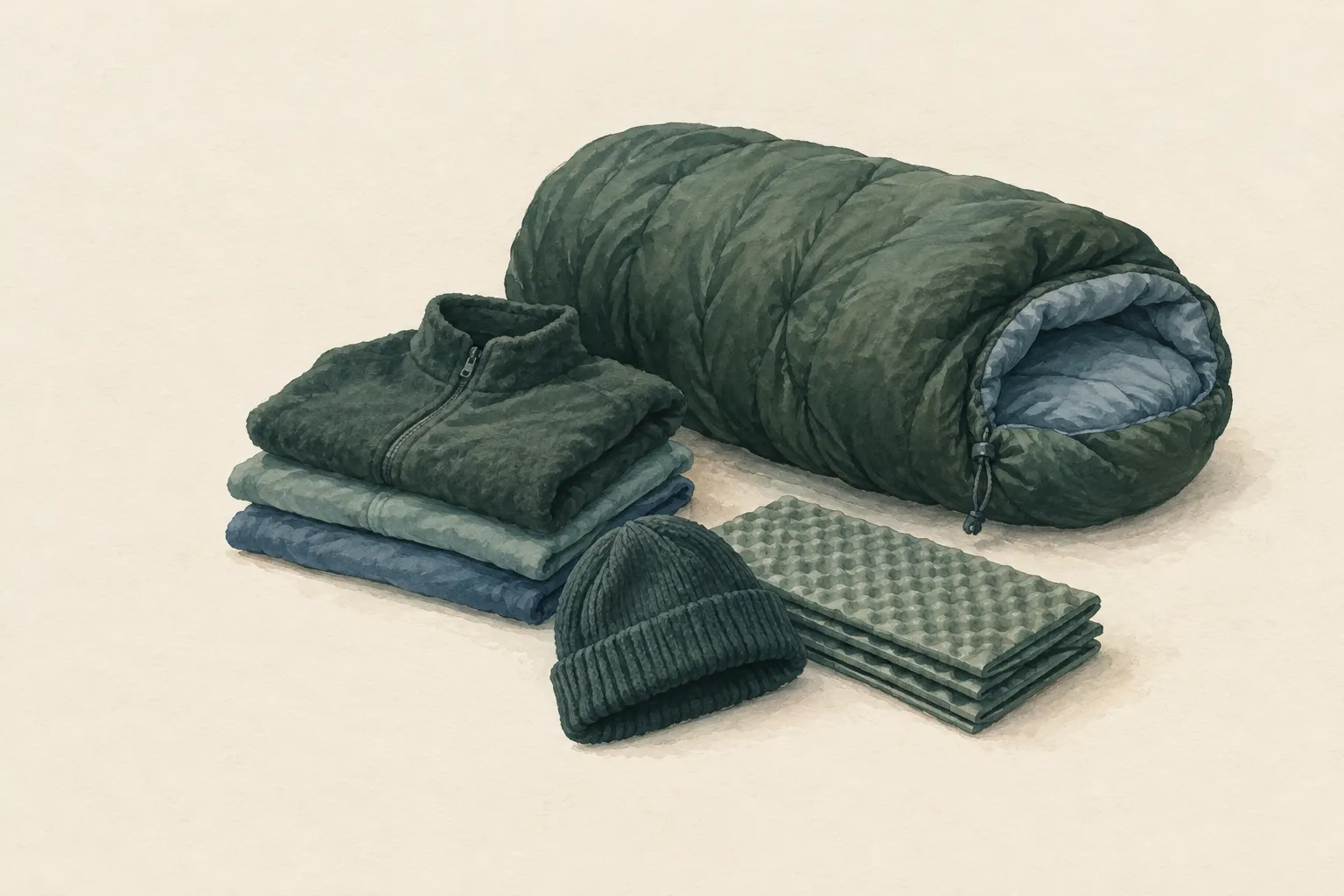
Explained simply
A sleeping bag is not a heater. It makes no heat itself but only holds on to the heat your body produces – like a vacuum flask that keeps hot tea hot but does not warm up cold tea. That is why it is important to crawl into the sleeping bag already warm.
Three things make the biggest difference: a good sleeping pad underneath you so the ground does not steal your heat; dry clothing, because moisture cools you; and a hat. Before sleeping, it helps to eat something and move about briefly without sweating.
If you get cold at night, put on a layer or briefly tense your muscles. And very important: never heat a tent with a stove or grill – it can produce a poisonous gas.
How it works
Your body constantly produces heat, especially from the food it burns and through movement. Sleeping bag and clothing hold on to that heat with trapped air. Whether the night turns out warm or cold therefore depends on how much heat you produce and how much you lose.
At night, three paths of loss are especially important: conduction into the ground, air movement around and through the sleeping bag, and evaporation of moisture. A sleeping pad helps against the ground, a well-closed hood and a sheltered sleeping spot against air movement, and dry clothing and a dry sleeping bag against moisture.
Moisture is the most common reason a night turns colder than expected. It comes from sweat, wet clothing and your own breath. Wet insulation loses its pockets of air and keeps you much less warm.
What really matters
Ground first: many people have a thick sleeping bag but a thin pad or none at all. Under your weight the sleeping-bag fill is flattened and barely insulates. In the cold, add something under hips and shoulders, such as your backpack or a second pad.
Dry and warm into bed: swap damp or sweaty daytime clothing for dry sleeping clothes and dry socks, and put on a hat. Eat and drink something beforehand, ideally something warm, and warm up with light movement without sweating. Go to the toilet before sleeping so you do not have to get up in the cold at night.
Layers in moderation: dry, insulating clothing can be worn inside the sleeping bag. But do not wear so much that the bag becomes tight – you would then squash its fill from the inside. Wet jackets stay outside. Draw the hood closed but keep mouth and nose outside so no breath moisture gets into the insulation.
Safety: what to watch out for
Intense, persistent shivering, confusion, slurred speech or drowsiness are warning signs of hypothermia. Do not wait: seek shelter, wake others, provide dry clothing and insulation, and call the local emergency number (112 in the EU) if things get worse. In a group, look out for each other.
No stoves, grills, charcoal or gas heaters inside a tent or shelter for warmth. They can produce carbon monoxide and start fires.
A bottle of hot water can help as a hot-water bottle, but only if it seals tightly and is suitable for the purpose. Wrap it in fabric and never put it directly on the skin – there is a risk of scalds and burns, especially for children and people with reduced sensation.
Adjusting during the night
If you wake up cold at night, add a dry layer or briefly tense different muscle groups. That produces heat without you having to get up. Also check whether your pad has slipped or lost air.
If you are sweating, take off a layer. Sweat in the sleeping bag later turns into moisture in the insulation and chills you towards morning.
In the morning, air and dry the sleeping bag in sun or wind when you get the chance. That way it insulates fully again the next night – especially important on multi-day trips.
Good to know
Sleeping-bag temperature ratings are based on standardised tests under defined conditions. They assume a suitable sleeping pad and dry clothing. How warm you actually feel also depends on your own sensitivity to cold, exhaustion, hunger and moisture – these factors can reduce warmth considerably.
Without a sleeping bag, for example in an emergency, put on all your dry clothing, improvise ground insulation, lay an emergency blanket or bivvy bag over your clothing and huddle closely with others. That does not replace a sleeping bag but can make a night considerably more bearable.
These tips improve any gear without extra weight. But they cannot make up for fundamentally unsuitable gear in severe frost.
Step by step
Ground first
Lay the sleeping pad on level, dry ground. In cold conditions add extra insulation under hips and shoulders, such as a backpack or second pad.
- 1
Ground first
Lay the sleeping pad on level, dry ground. In cold conditions add extra insulation under hips and shoulders, such as a backpack or second pad.
- 2
Change into dry clothing
Swap damp or sweaty clothing for dry sleeping clothes and dry socks before sleeping. Put on a hat.
- 3
Go to bed warm
Before getting in, eat and drink something, a warm drink if available, and warm up with light movement without sweating. Empty your bladder before sleeping.
- 4
Use layers sensibly
Dry insulating clothing can be worn inside the sleeping bag. Do not wear so much that the bag becomes tight and its fill is compressed. Wet jackets stay outside.
- 5
Do not breathe into the bag
Draw the hood closed but keep mouth and nose outside – moisture from breath dampens the insulation. Keep the shelter slightly ventilated.
- 6
Adjust during the night
If it gets cold, add a layer or briefly tense your muscles. If you sweat, remove a layer. In a group, keep an eye on each other.
- 7
Dry in the morning
Air and dry the sleeping bag when possible so it insulates fully again the next night.
Common mistakes
- A thick sleeping bag but a thin pad or none
- Sleeping in sweaty daytime clothing
- Getting into the bag already chilled
- Burying the head in the bag and breathing into it
- Stuffing the bag with too much clothing
- Running a stove in the tent for warmth
Quick view
Materials
Sleeping pad
More important than often assumed
Dry spare clothing
Dry sleeping clothes, socks, hat
Carry it in waterproof packaging – wet clothing barely insulates.
Double-wall insulated bottle
For a warm drink
Never heat directly.
Emergency blanket
Tears easily once punctured; short-term shelter only.
Conductive – keep away from power lines.
Backpack
As extra insulation under the legs
Suitable for
- Any night in a tent, under a tarp or in a bivouac
- Cold, damp nights in spring and autumn
- Emergencies where the most has to be made of the available gear
Not suitable for
- Compensating for fundamentally unsuitable gear in severe frost
- Treating existing hypothermia
Prerequisites
- A sleeping bag suited to the expected temperatures
- A sleeping pad or other ground insulation
- Dry spare clothing in waterproof packaging
Safety
- If you use a bottle of hot water as a hot-water bottle: only tightly sealing, suitable bottles, wrapped in fabric, never directly on the skin – risk of scalds and burns, especially for children and people with reduced sensation.
How it works
Sleeping bags and clothing generate no heat; they only retain the heat the body produces. So three things count: stop heat loss into the ground with insulation, keep the insulation dry, and get into the sleeping bag warm rather than already chilled. Moisture from sweat, breath and wet clothing is the most common reason a night turns colder than expected.
Advantages
- Improves any gear without extra weight
- Reduces the risk of hypothermia during the night
Disadvantages
- Requires discipline when cold and tired
- Dry spare clothing has to be carried
Deep knowledge
Background
The principles follow the physics of heat loss: conduction into the ground, convection through air movement and evaporation of moisture are the main paths at night. Clinical guidelines on hypothermia such as those of the Wilderness Medical Society emphasise insulation, protection from wind and wet, and changing out of wet clothing as preventive measures.
Sleeping-bag temperature ratings are based on standardised tests under defined conditions; they assume a suitable pad and dry clothing. Individual sensitivity to cold, exhaustion, hunger and moisture can reduce actual warmth considerably.
Variants
- Without a sleeping bag (emergency)
- Put on all dry clothing, improvise ground insulation, place an emergency blanket or bivvy bag over the clothing and huddle closely. This does not replace a sleeping bag.
Common mistakes
- A thick sleeping bag but a thin pad or none
- Sleeping in sweaty daytime clothing
- Getting into the bag already chilled
- Burying the head in the bag and breathing into it
- Stuffing the bag with too much clothing
- Running a stove in the tent for warmth
Limits and risks
- No substitute for adequate gear
- No temperature figures – too dependent on person and gear
- Not treatment for hypothermia
Material alternatives
Derived from material properties: a substitute must have all relevant properties. Observe the notes on the substitute.
- Sleeping pad
- Dry leaves, grass or conifer boughs (Collect only where allowed; no protected plants. Check for ticks and insects.), Backpack, Dry spare clothing (Carry it in waterproof packaging – wet clothing barely insulates.), Wool blanket / duvet (Keep away from candles, stoves and heaters.), Insulated cool box (Keeps cold only for a limited time; without ice packs or ice it is not a fridge.), Sleeping bag (Do not store compressed long-term; do not pack away damp.), Newspaper and cardboard (Flammable – keep away from candles, stoves, heaters and embers.), Insulated cooking box (hay box, thermal cooker) (Never put open flame or embers inside – only the hot, closed pot.)
- Dry spare clothing
- Sleeping pad, Dry leaves, grass or conifer boughs (Collect only where allowed; no protected plants. Check for ticks and insects.), Backpack, Wool blanket / duvet (Keep away from candles, stoves and heaters.), Insulated cool box (Keeps cold only for a limited time; without ice packs or ice it is not a fridge.), Sleeping bag (Do not store compressed long-term; do not pack away damp.), Newspaper and cardboard (Flammable – keep away from candles, stoves, heaters and embers.), Insulated cooking box (hay box, thermal cooker) (Never put open flame or embers inside – only the hot, closed pot.)
- Double-wall insulated bottle
- Single-wall stainless steel bottle (Heat only single-wall bottles without paint/plastic; remove the lid before heating.), PET bottle (clear, max. 2 litres) (Do not heat or place in a fire.), Food-grade water container (Only use containers that never held chemicals or fuel.), Airtight food-grade storage container (Fill only when clean and completely dry; never use containers that previously held chemicals.), Collapsible water container or bag (Protect from sharp objects.), Food-grade water bag (Use only for drinking water, never for chemicals or fuel.), Fermentation jar or crock (Use only food-grade containers of glass, food-safe glazed stoneware or food-grade plastic – no metal containers for acidic food.), Resealable food bags (Use only bags intended for food; do not use with boiling water unless the manufacturer explicitly allows it.)
- Backpack
- Sleeping pad, Dry leaves, grass or conifer boughs (Collect only where allowed; no protected plants. Check for ticks and insects.), Dry spare clothing (Carry it in waterproof packaging – wet clothing barely insulates.), Wool blanket / duvet (Keep away from candles, stoves and heaters.), Insulated cool box (Keeps cold only for a limited time; without ice packs or ice it is not a fridge.), Sleeping bag (Do not store compressed long-term; do not pack away damp.), Newspaper and cardboard (Flammable – keep away from candles, stoves, heaters and embers.), Insulated cooking box (hay box, thermal cooker) (Never put open flame or embers inside – only the hot, closed pot.)
Results come exclusively from structured entries. No improvised instructions are generated.
Sources
Wilderness & Environmental Medicine (Wilderness Medical Society) (2019): Wilderness Medical Society Clinical Practice Guidelines for the Out-of-Hospital Evaluation and Treatment of Accidental Hypothermia: 2019 Update
Insulation, wind and wet protection and changing wet clothing to prevent hypothermia; warning signs
Headquarters, Department of the Army (USA) (2002): FM 3-05.70 Survival
Cold protection, keeping clothing dry and sleeping in cold environments
World Health Organization, Regional Office for Europe (2010): WHO guidelines for indoor air quality: selected pollutants (carbon monoxide chapter)
Carbon monoxide from combustion in enclosed spaces