In the mountains: recognising weather changes and turning back in time
In the mountains the weather can change within a short time: thunderstorms, fog, wind and a sudden drop in temperature turn an easy outing into a serious situation. The most important skill is not stamina but setting a turnaround time and keeping to it – even just below the summit.
- 30 minutes of planning; watching the weather throughout the trip
Explained simply
In the mountains the weather can change faster than in the valley. In the morning the sky is blue, and in the afternoon dark clouds pile up, thunder rolls and fog moves in. That is because mountains push air upwards. Higher up it is colder, and clouds form quickly there – like when you breathe on a cold window and it mists up.
So the most important tool in the mountains is not a strong body but a watch. Before setting off you agree a turnaround time. When it comes, you go back, even if the summit is already in sight. The summit will not run away – you can come back another day.
The most important safety point: if you hear thunder or see tall, dark towering clouds, leave summits and ridges at once and descend. And even in summer a warm jacket, hat and gloves belong in your pack.
How it works
When air has to rise over a mountain, it expands and cools as it does so. Cold air can hold less water vapour, so clouds form and it may rain or snow. On sunny summer days the heating of the ground adds to this: warm air rises during the morning, cumulus clouds grow, and in the afternoon they can turn into thunderstorms. That is why mountain hikes with an early start are often safer in summer.
On average it gets a little colder with every metre of height – roughly half a degree to one degree Celsius per hundred metres, depending on the weather. Add the wind, which often blows much harder on ridges and summits than in the valley and draws even more heat from the body. Someone who sets off in a T-shirt in the valley can be freezing higher up in wind, fog and drizzle, even in high summer.
Fog is an underestimated problem in the mountains. It forms when clouds hang on the slope or moist air cools. Within minutes, waymarks, cairns and drop-offs can disappear from view. Then an easy path suddenly becomes a difficult navigation task.
What really matters
The turnaround time is the most important decision of the day, and it is best made at home or over breakfast with a clear head. Out on the mountain you are tired, want to reach the goal and get carried along by the group. Mountaineers sometimes call this “summit fever”. A fixed time removes that pressure: there is no discussion, you turn round.
The mountain forecast gives information on thunderstorm risk, wind, visibility and the freezing level – the height above which it is below zero. If it is low, there may be snow or icy patches higher up. An uncertain forecast is not a reason to “just give it a try” but a reason for a shorter route with good escape options.
On the way your own observation counts. Warning signs are cumulus clouds that grow quickly upwards and darken at the base, freshening or shifting wind, a noticeable drop in temperature and fog creeping up from the valley. Put on your rain jacket and warm layer before you are wet and cold – afterwards it is much harder to warm up again.
Safety: what to watch out for
In a thunderstorm, summits, ridges, isolated trees and fixed cables on via ferratas are especially dangerous because lightning tends to strike high, exposed points and metal. If you can hear thunder, the storm is close enough to be dangerous. Then descend quickly from exposed places and avoid gullies where water collects. A hut or solid building is the best protection.
Hypothermia is possible even in summer when wetness, wind and exhaustion come together. Warning signs are intense shivering, clumsiness, stumbling, slurred speech and confusion. Then seek shelter from the wind at once, put on dry and warm clothing and call the local emergency number (112 in the EU).
If you have no signal, there is the alpine distress signal: give a signal six times a minute, for example with a whistle, a light or shouts, then pause for one minute and repeat. The reply is three times a minute. In fog and when unsure of the way: stop, work out your position and do not carry on into the unknown.
How to practise it
Practise reading the weather on easy routes where nothing is at stake. Check the mountain forecast in the morning and compare it during the day with what you see: when do the first cumulus clouds form, how fast do they grow, when does the wind pick up? That way you develop a feel for the signs.
Make the turnaround time a habit, even on short routes. Say it out loud in the group and write it down. Once you have felt how good it is to be back in time, it is easier to stick to it next time.
This knowledge is not enough for alpine tours, via ferratas, glaciers or winter trips. For those there are courses with alpine clubs and mountain schools, or certified mountain guides who take you along and show you how decisions are made on the ground.
Step by step
Check the mountain forecast
Read a mountain forecast the evening before and in the morning: thunderstorm risk, wind, freezing level, visibility. An uncertain forecast means a shorter tour.
- 1
Check the mountain forecast
Read a mountain forecast the evening before and in the morning: thunderstorm risk, wind, freezing level, visibility. An uncertain forecast means a shorter tour.
- 2
Set a turnaround time
Before setting off, agree a fixed time at which you will turn back, however close the goal is. Start early when thunderstorms are likely.
- 3
Observe on the way
Watch the sky regularly: rapidly growing cumulus clouds, freshening wind, a drop in temperature and approaching fog are warning signs.
- 4
Decide rather than hope
At warning signs, exhaustion in the group or delays, turn back or take the planned escape route. The weakest group member sets the pace.
- 5
Descend safely
Do not rush the descent; most falls happen when tired. Put on weather protection before you get wet or cold.
- 6
Call for help
In case of injury, loss of orientation or hypothermia, call the local emergency number (112 in the EU) or use the alpine distress signal if there is no network.
Common mistakes
- Setting no turnaround time
- “Just to the summit” despite thunderclouds
- Setting off in summer without a warm layer
- Starting too late in the day
- Splitting up the group on the descent
Quick view
Materials
Rain and wind shell
Dry spare clothing
Warm layer, hat, gloves – even in summer
Carry it in waterproof packaging – wet clothing barely insulates.
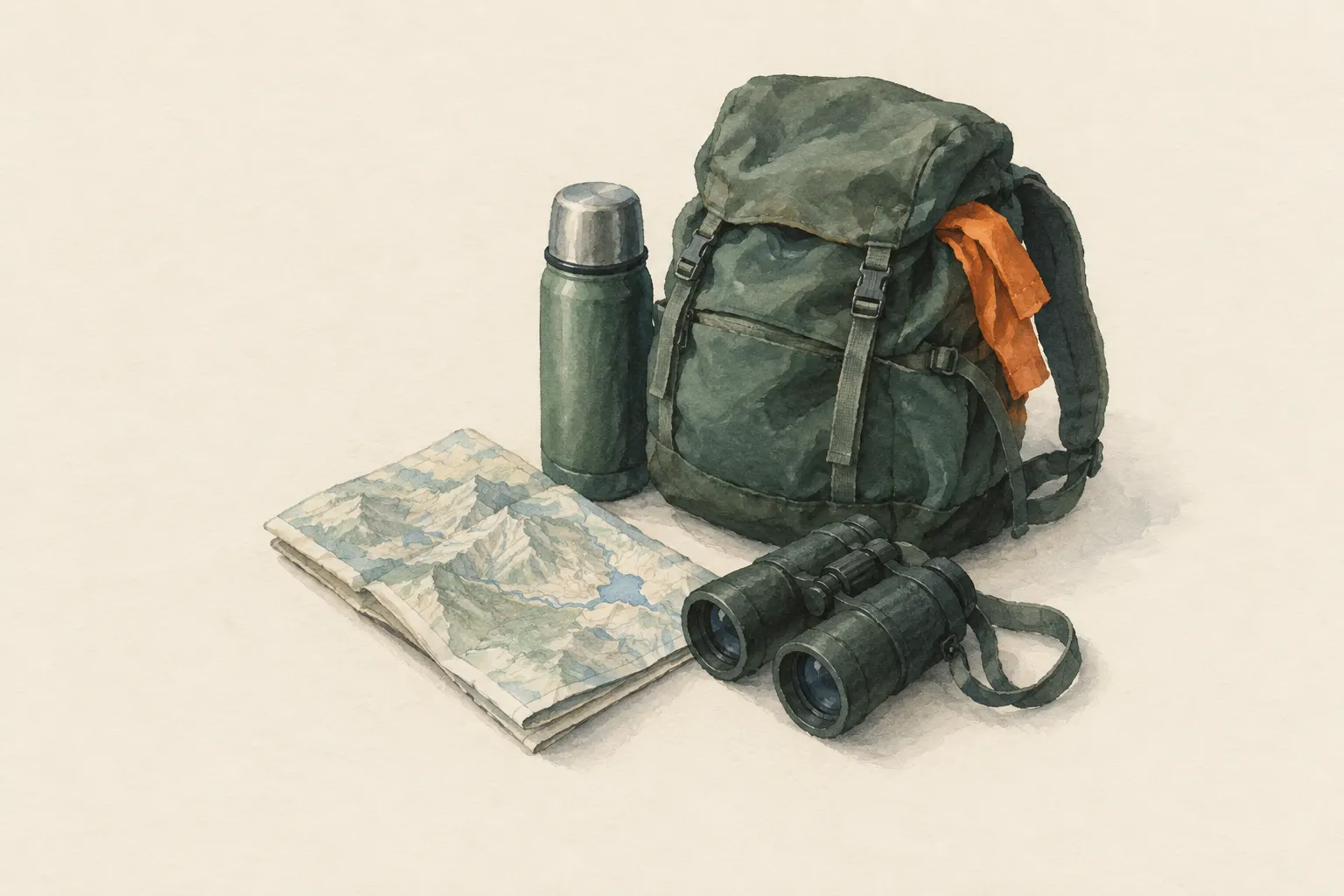
Topographic map
Check the publication date – paths and buildings may have changed.
Protect from wet (map case or bag).
Headlamp / flashlight
Mobile phone
Charged, with power bank
The battery drains quickly in cold and with continuous screen and GPS use.
Do not plan on it as your only means of navigation or emergency calls.
Suitable for
- Mountain hikes and alpine tours above the treeline
- Groups with different fitness levels
- Summer tours with a tendency for thunderstorms
Not suitable for
- A substitute for training in alpine terrain, on glaciers or in avalanche terrain
- A substitute for a mountain guide when experience is lacking
Prerequisites
- A current mountain weather forecast
- A route with time estimates and escape options
- Fitness and experience matching the trip
Safety
- Fog can make paths and waymarks invisible. When unsure of your position, do not carry on – stop, determine your position and call for help if needed.
How it works
Mountains force air upwards, so clouds, precipitation and thunderstorms can form and develop quickly. Temperature drops with height, and wind increases heat loss. Because descents take time and strength declines during the day, the decision to turn back must be made before the situation becomes critical – not once it already is.
Advantages
- Prevents many typical mountain emergencies
- Simple, clear decision rule
- Applicable to any group
Disadvantages
- The goal is sometimes not reached
- Requires discipline against group pressure
Deep knowledge
Background
“Mountaineering: The Freedom of the Hills” treats mountain weather, trip planning and the decision to turn back as central safety topics. Alpine rescue organisations working together in the International Commission for Alpine Rescue (ICAR) also stress good planning and turning back in time.
Forecasts for mountain regions are published by national weather services and alpine clubs. They do not replace your own observation on site.
Variants
- In winter
- In winter short days, cold and avalanche danger are added. See “Out in snow and winter”.
Common mistakes
- Setting no turnaround time
- “Just to the summit” despite thunderclouds
- Setting off in summer without a warm layer
- Starting too late in the day
- Splitting up the group on the descent
Limits and risks
- No training for alpine tours, climbing or glaciers
- No treatment of altitude sickness or hypothermia
Material alternatives
Derived from material properties: a substitute must have all relevant properties. Observe the notes on the substitute.
- Rain and wind shell
- Cotton cloth / T-shirt (Removes coarse particles only – no disinfection.)
- Dry spare clothing
- Sleeping pad, Dry leaves, grass or conifer boughs (Collect only where allowed; no protected plants. Check for ticks and insects.), Backpack, Wool blanket / duvet (Keep away from candles, stoves and heaters.), Insulated cool box (Keeps cold only for a limited time; without ice packs or ice it is not a fridge.), Sleeping bag (Do not store compressed long-term; do not pack away damp.), Newspaper and cardboard (Flammable – keep away from candles, stoves, heaters and embers.), Insulated cooking box (hay box, thermal cooker) (Never put open flame or embers inside – only the hot, closed pot.)
- Headlamp / flashlight
- Mobile phone (The battery drains quickly in cold and with continuous screen and GPS use.), Battery lantern / LED light
- Mobile phone
- Headlamp / flashlight, Battery lantern / LED light
Results come exclusively from structured entries. No improvised instructions are generated.
Sources
The Mountaineers Books (2017): Mountaineering: The Freedom of the Hills, 9th edition
Mountain weather, trip planning and the decision to turn back
NOAA National Weather Service (USA): Lightning Safety
Thunderstorm hazards outdoors
ICAR – International Commission for Alpine Rescue: International Commission for Alpine Rescue (ICAR) – recommendations and information (organisation website)
Alpine rescue and raising the alarm in the mountains
Wilderness & Environmental Medicine (Wilderness Medical Society) (2019): Wilderness Medical Society Clinical Practice Guidelines for the Out-of-Hospital Evaluation and Treatment of Accidental Hypothermia: 2019 Update
Warning signs of hypothermia