Alpine distress signal
The alpine distress signal is a convention widely used in the European Alps: six signals per minute (about every ten seconds), then one minute's pause, repeat. The reply is three signals per minute. Signals can be shouts, whistle blasts or flashes of light. It complements an emergency call but does not replace it.
- Usable immediately, repeat over a long period
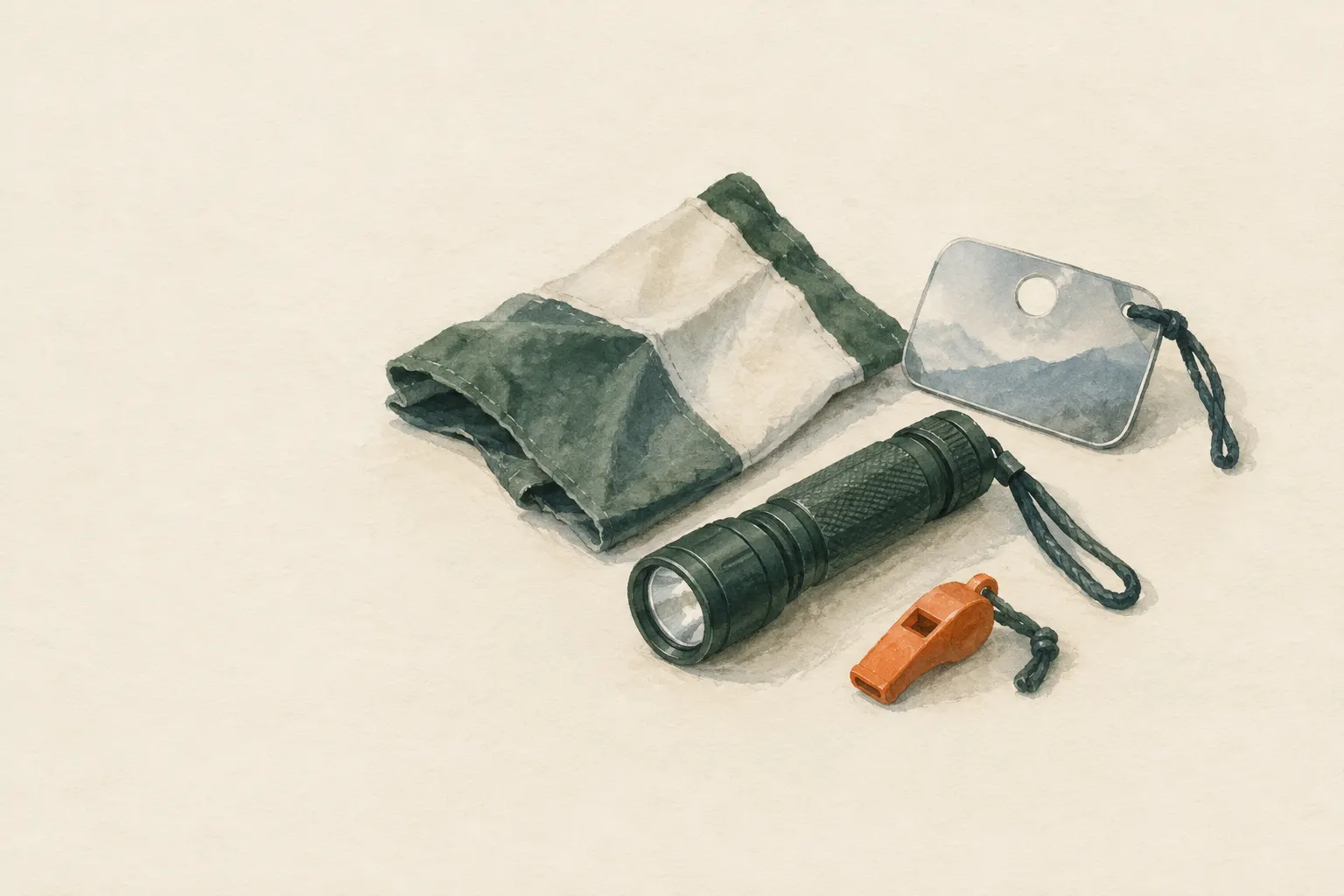
Explained simply
Imagine you are in the mountains, someone is hurt and your phone has no signal. Then you can give the alpine distress signal: six signals in one minute, so about one every ten seconds. Then a one-minute pause. Then start again.
The signal can be a whistle blast, a shout or a flash of your lamp. What matters is the rhythm, like a very slow clock ticking. That way someone who hears or sees it notices: that is not a bird and not chance – a person is calling for help. Whoever has heard you replies with three signals per minute.
The distress signal is not a game. If others hear it, they may call mountain rescue. And if your phone does have signal after all, call the emergency number first – 112 in the EU.
How it works
Nature is full of sounds and lights: birds, wind, rushing streams, sunlight glinting on snow. A single shout is easily lost in all that or mistaken for something else. A steady, unnatural rhythm, on the other hand, stands out. Six signals in one minute, then a minute of silence – no animal and no wind does that.
The pause has two jobs. Anyone listening can count calmly and be sure it is a distress signal. And you yourself can listen and look during the pause to see whether someone replies. The reply is three signals per minute, so about one every twenty seconds, also followed by a minute's pause. If you hear or see it, you know you have been noticed.
Anyone who notices a distress signal should not only reply but also alert rescue via the local emergency number. The reply alone does not bring help – it only shows that someone knows.
What really matters
Pacing yourself is crucial. Anyone who shouts non-stop is hoarse and exhausted after a short time – and often still not heard. A whistle carries further than the voice and costs hardly any effort. That is why a whistle belongs within reach on your jacket or pack strap, not deep inside the pack.
Choose the signal to suit the situation: whistle in fog and forest, lamp at night, mirror or conspicuous waving in sunshine. You can also combine several methods. It is better to give the signal again and again over a long time than to try briefly and frantically and then give up.
Give the signal from a place where sound and light can travel far, if you can reach it without danger. Rushing water, strong wind and ridges swallow sound. That is why no general range can be given.
When it makes sense – and when not
The alpine distress signal is meant for situations where no phone call is possible, or as an addition when rescuers are already on their way and looking for your exact spot. If your phone has signal, calling the local emergency number (112 in the EU) is always the first step.
It is a convention from the Alpine region, not a worldwide standard. Outside the Alps, three signals – three blasts, three flashes – are often understood as a general distress sign. If you travel to other regions, ask beforehand which signal is customary there. In the end: any regular, repeated signal is better than none.
Safety and responsibility
Give the distress signal only in genuine distress. Hikers, hut keepers or farmers who hear it may alert rescuers – possibly even a helicopter. A false alarm ties up people and equipment needed elsewhere. If you want to practise the signal, agree on it beforehand with everyone involved and do it in a way that strangers will not take it as real.
If you notice a distress signal yourself, do not put yourself in danger to reach the person. Reply with three signals per minute, note the direction as well as you can and alert rescue. With your information – direction, rough distance, time – rescuers can search in a targeted way.
Good to know
The alpine distress signal has long been taught by alpine clubs and mountain rescue organisations. Now that almost everyone carries a mobile phone, it is needed less often. It still matters: deep valleys, gorges and remote routes have dead zones, and batteries drain quickly in the cold.
Even when rescuers are already there, the signal helps. From a helicopter or a ridge, a person on the mountainside is often hard to spot. A whistle blast at the right moment or a flash of light at dusk can greatly shorten the last part of the search.
Step by step
Choose a signal method
A whistle carries further than the voice and saves energy. At night a lamp works, in daytime sunshine a mirror or conspicuous waving.
- 1
Choose a signal method
A whistle carries further than the voice and saves energy. At night a lamp works, in daytime sunshine a mirror or conspicuous waving.
- 2
Six signals per minute
For one minute, give a signal about every ten seconds – six in total.
- 3
One minute's pause
Pause for one minute and listen or look for a reply.
- 4
Repeat
Repeat the cycle until a reply comes or help arrives. Pace yourself.
- 5
Recognise or give the reply
The reply is three signals per minute (about every 20 seconds), then one minute's pause. Anyone who notices a distress signal replies this way and alerts rescue via the local emergency number.
Common mistakes
- Shouting continuously until hoarse
- No pauses to listen
- Only signalling although an emergency call would be possible
- Replying as an observer but not alerting rescue
Quick view
Materials
Signal whistle
Carry within easy reach, not deep in the pack.
Do not blow right next to other people's ears.
Headlamp / flashlight
Signal mirror
Do not flash into the eyes of people nearby or of drivers.
Glass mirrors can break – risk of cuts.
Suitable for
- Emergencies in the mountains without phone signal
- Attracting attention when people may be within hearing or sight
- In addition to an emergency call
Not suitable for
- A substitute for an emergency call when calling is possible
- Regions where the convention is unknown – it may not be understood there
Prerequisites
- None
Safety
- This is an alpine convention in Europe. Outside the Alps other signals are customary (e.g. three signals as a general distress sign); not everyone knows the rule.
- Not a game, and no practice without prior agreement – others could take it for a real emergency and alert rescuers.
How it works
A regular, clearly unnatural rhythm stands out from random noises and lights. Alternating one minute of signalling with one minute of pause allows listeners to count the signals and distinguish them from other sounds. A reply of three signals per minute confirms that you have been heard or seen.
Advantages
- Possible without technology or network
- Widely known in the Alps
- Very energy-efficient with a whistle
Disadvantages
- Range limited by wind, terrain and rushing water
- Only works if someone is nearby
- Less known outside the Alps
Deep knowledge
Background
The alpine distress signal has long been established in the Alpine region and is taught by alpine clubs and mountain rescue organisations. It is a convention, not a worldwide standard.
In the age of mobile phones it has lost some importance, but it remains important in dead zones and when rescuers are already searching the area and need to find the exact spot.
Variants
- General distress sign: three
- Outside the Alps, three signals (three whistle blasts, three flashes) are often understood as a distress signal. If you are unsure which signal is known locally, ask before the trip.
Common mistakes
- Shouting continuously until hoarse
- No pauses to listen
- Only signalling although an emergency call would be possible
- Replying as an observer but not alerting rescue
Limits and risks
- No range figure – strongly dependent on terrain and weather
- Not uniform worldwide
Material alternatives
Derived from material properties: a substitute must have all relevant properties. Observe the notes on the substitute.
- Headlamp / flashlight
- Mobile phone (The battery drains quickly in cold and with continuous screen and GPS use.), Battery lantern / LED light
- Signal mirror
- Emergency blanket (Tears easily once punctured; short-term shelter only.), High-visibility vest (Keep within reach inside the cabin, not in the boot/trunk.), Warning triangle (Whether warning triangles are mandatory, or should be placed at all on certain roads (e.g. motorways), differs between countries – check local rules.), Aluminium foil (heavy-duty) (Edges can be sharp; conducts heat and electricity.)
Results come exclusively from structured entries. No improvised instructions are generated.
Sources
ICAR – International Commission for Alpine Rescue: International Commission for Alpine Rescue (ICAR) – recommendations and information (organisation website)
The alpine distress signal as a convention in the Alpine region
The Mountaineers Books (2017): Mountaineering: The Freedom of the Hills, 9th edition
Distress signals in the mountains
European Commission: 112 – the European emergency number
Europe-wide emergency number 112