Signal whistle and signal mirror: basics
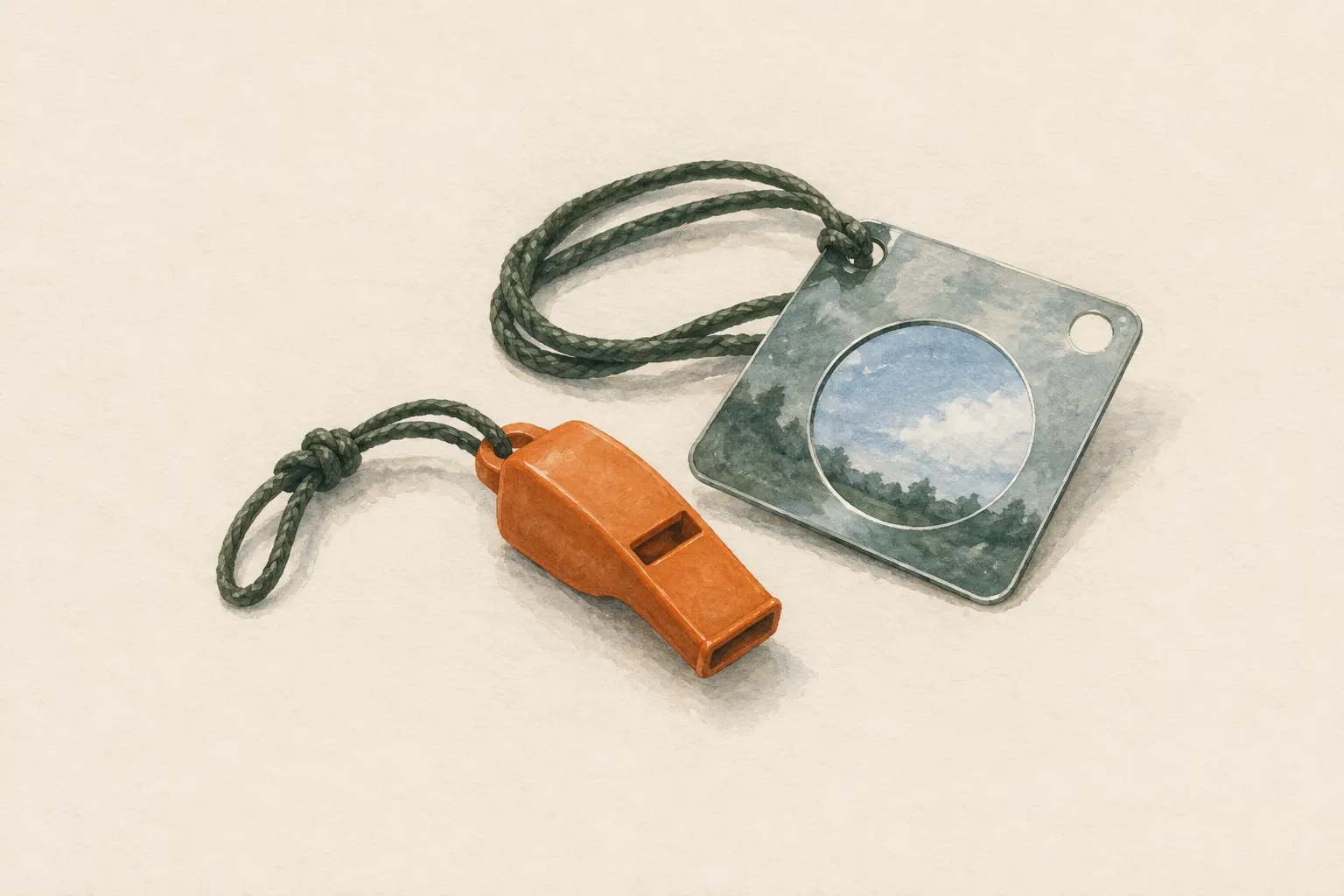
A whistle carries further than the voice and costs little energy; a mirror can produce flashes visible over long distances in sunshine. Both are light, cheap and battery-free – but they only work if someone is within hearing or sight.
- Whistle immediately; mirror takes some practice
Explained simply
A whistle is like a loud voice that never gets hoarse. A short blast can be heard further than shouting and costs almost no effort. Even when you are tired or hurt, you can still blow a whistle. That is why the whistle belongs on your jacket or pack strap, so you can always reach it quickly.
A signal mirror works like the game where you throw a bright spot of light onto a wall with a watch or a mirror. Outdoors in sunshine, that spot of light can be seen as a bright flash from very far away – for example from an aircraft or by people on another mountain.
Both only work if someone nearby can hear or see. And neither is a toy: never shine light into other people's or drivers' eyes, and do not give distress signals for fun.
How it works
A whistle tone is high and shrill. Tones like this stand out well from wind, rustling leaves and many other natural sounds, and the ear picks them up easily. In addition, blowing a whistle only needs a short, strong breath. Shouting is tiring, and after a while your voice gives out. With a whistle you can attract attention for much longer.
A mirror does not collect light, it redirects it. The sunlight that falls on the mirror is thrown in one direction as a concentrated spot. Anyone standing or flying exactly in that direction sees a bright flash that stands out clearly from the landscape. The skill lies in steering this light spot deliberately onto the target – because nobody beside the target will see it.
What really matters: aiming the mirror
A proven method goes like this: stretch out one arm and make a V with two fingers so that you see the target in it – for example an aircraft or a hut. Hold the mirror close to your face with the other hand. Tilt it slowly until the bright light spot falls on your fingers. Then let it sweep a little further across the target and back again.
Many signal mirrors have a small sighting hole in the middle that makes aiming easier. In any case it helps to practise aiming beforehand, for example at a light-coloured wall or a tree trunk some distance away. Aiming a mirror for the first time under stress in a real emergency is hard.
If you cannot see a target, you can slowly sweep the light spot across the horizon or along distant paths and slopes. Someone may be there whom you cannot see, but who can see you.
Using the whistle well
Give short, strong blasts in a recognisable rhythm. In the Alps the alpine distress signal is customary: six signals per minute, then a minute's pause. Elsewhere three blasts are often understood as a call for help. In any case it is important to be quiet between groups of blasts and listen for a reply.
A good signal whistle has no ball inside that could freeze or stick in the cold, and it works even when wet. Attach it so you can reach it with one hand and while wearing gloves – for example on a short cord on your shoulder strap. Children should carry their own whistle and know when they may use it.
Safety: what to watch out for
Flashes of light can dazzle. Never aim the mirror at drivers, cyclists or people near you. Once an aircraft or helicopter has clearly noticed you – for instance because it turns towards you or circles overhead – stop flashing into the cockpit and show yourself with body signals instead. A glass mirror can break; then there is a risk of cuts.
Do not blow the whistle right next to other people's ears – a shrill blast at close range can hurt. Above all: whistle and mirror complement an emergency call; they do not replace it. As soon as you have signal, dial the local emergency number (112 in the EU). Never give distress signals for fun, because others might alert rescuers.
Gear and substitutes
Whistle and mirror are light, cheap and need no batteries. That makes them a good backup for a phone and a beacon. Signal mirrors are made of glass or of break-resistant plastic; plastic is lighter and does not shatter, but often reflects somewhat less strongly.
If you have no mirror, other shiny surfaces can help: the silver side of an emergency blanket, a phone screen, a CD or a polished piece of metal. They usually reflect more weakly and are harder to aim, but it is worth a try. At night a headlamp or torch takes over the mirror's role – in the same rhythm as the whistle blasts.
Step by step
Carry the whistle within reach
Attach the whistle to your jacket or pack strap so you can reach it even when injured.
- 1
Carry the whistle within reach
Attach the whistle to your jacket or pack strap so you can reach it even when injured.
- 2
Whistle in a rhythm
Give short, strong blasts in a recognisable rhythm – in the Alps the alpine distress signal, elsewhere often three blasts – and listen during the pauses.
- 3
Aim the mirror
Extend one arm and form a V with two fingers around the target. Tilt the mirror close to your face until the light spot falls on your fingers, then sweep it across the target.
- 4
Sweep the horizon
Even without a visible target you can slowly sweep the light spot across the horizon or along distant paths.
- 5
Stop once answered
When you get a reply, stop signalling or use it only to help locate you, and follow the rescuers' instructions.
Common mistakes
- Whistle stowed deep in the pack
- Using the mirror for the first time in an emergency
- Whistling without pauses
- Flashing randomly instead of controlling the light spot
Quick view
Materials
Signal whistle
Carry within easy reach, not deep in the pack.
Do not blow right next to other people's ears.
Signal mirror
Alternatively other shiny surfaces (e.g. emergency blanket, phone screen)
Do not flash into the eyes of people nearby or of drivers.
Glass mirrors can break – risk of cuts.
Emergency blanket
Tears easily once punctured; short-term shelter only.
Conductive – keep away from power lines.
Suitable for
- Being found without phone signal
- Communication within a group over distance
- Children (whistle)
Not suitable for
- Overcast sky (mirror)
- A substitute for an emergency call
Prerequisites
- For the mirror: sunshine
- Some practice beforehand
Safety
- Flashes can dazzle. Do not aim at drivers or nearby people. Once an aircraft has clearly seen you, do not keep flashing into the cockpit.
- Do not give distress signals for fun – others might alert rescuers.
How it works
A shrill whistle tone sits in a frequency range that stands out from wind and natural sounds, and needs little breath. A mirror directs sunlight as a concentrated spot in one direction; the flash stands out clearly in the landscape. The key is to aim the light spot deliberately at the target.
Advantages
- Light, cheap, battery-free
- A whistle saves voice and energy
- A mirror is very conspicuous in sunshine
Disadvantages
- Only effective within hearing or sight
- A mirror needs sun and practice
- Wind and terrain muffle whistles
Deep knowledge
Background
Whistle and mirror are part of the basic kit in many recommendations for trips to remote areas. Survival manuals such as FM 3-05.70 describe aiming a signal mirror in detail.
Their strength is independence from power and networks. They do not replace a phone or an emergency beacon, but they are a valuable backup.
Variants
- Improvised mirrors
- Emergency blankets, screens, CDs or polished metal also reflect, though usually more weakly and harder to aim.
- Lamp at night
- At night a headlamp or torch takes the mirror's role; give signals in the same rhythm.
Common mistakes
- Whistle stowed deep in the pack
- Using the mirror for the first time in an emergency
- Whistling without pauses
- Flashing randomly instead of controlling the light spot
Limits and risks
- No range figures – strongly dependent on conditions
- Rhythm conventions differ by region
Material alternatives
Derived from material properties: a substitute must have all relevant properties. Observe the notes on the substitute.
- Signal mirror
- Emergency blanket (Tears easily once punctured; short-term shelter only.), High-visibility vest (Keep within reach inside the cabin, not in the boot/trunk.), Warning triangle (Whether warning triangles are mandatory, or should be placed at all on certain roads (e.g. motorways), differs between countries – check local rules.), Aluminium foil (heavy-duty) (Edges can be sharp; conducts heat and electricity.)
Results come exclusively from structured entries. No improvised instructions are generated.
Sources
Headquarters, Department of the Army (USA) (2002): FM 3-05.70 Survival
Signal mirror, whistle and light signals
European Commission: 112 – the European emergency number
Europe-wide emergency number 112