Ground-to-air signs
Large, high-contrast signs on the ground – such as 'SOS' – can be recognised by search aircraft and helicopters, even when you cannot actively signal at that moment. What matters is size, contrast, straight lines and an open location.
- One to several hours, depending on material
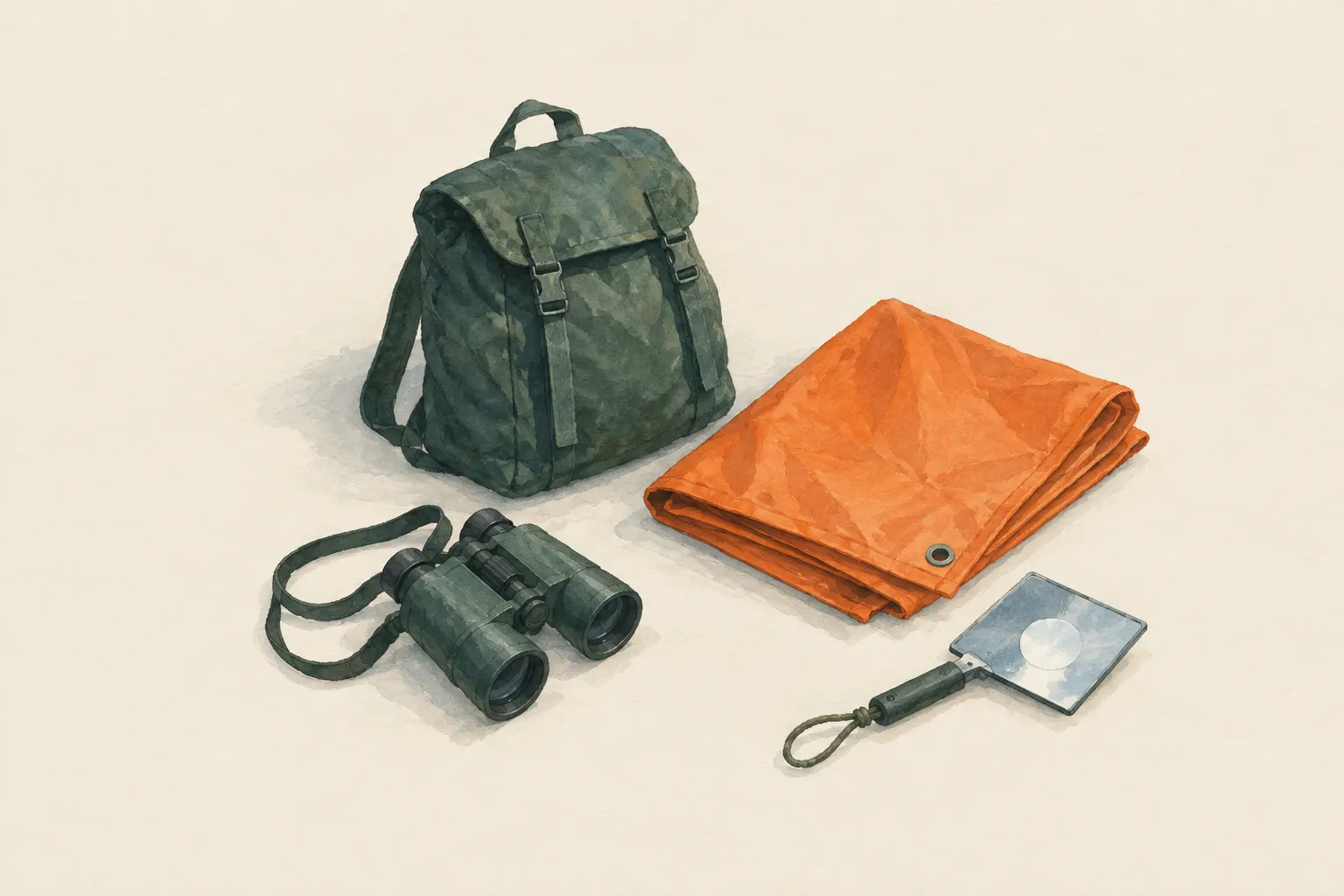
Explained simply
Imagine looking down from an aircraft. The forest looks like a green carpet, rocks like grey patches. A person is tiny down there. But a huge 'SOS' made of dark branches on a light meadow or snowfield stands out at once, because nature does not make straight lines and letters.
Ground signs like this have one big advantage: they work for you even while you sleep or rest. To be seen, they need three things: they must be large, contrast strongly with the ground and lie in an open area, not under trees.
But careful: your own protection comes first. Staying warm, having shelter and drinking water are more important than a big sign. Only build it if you have enough strength.
How it works
From high up, the eye mainly recognises shapes and contrasts, hardly any details. In nature, lines are mostly curved and irregular: streams meander, forest edges are ragged. Straight lines, right angles and letters, on the other hand, look man-made – and that is exactly what makes searchers take notice.
Contrast decides whether a sign is visible at all. Dark material on light ground or light material on dark ground works; material of the same colour disappears. Shadows help too: if you pile up material or stamp deep trenches into snow, the edges cast shadows, especially when the sun is low. That makes the lines stand out even more clearly.
'SOS' is generally known as a distress signal and is easy to read from the air. There are also special codes for communicating with aircraft that survival manuals describe; they are deliberately not listed here. A large, clear SOS is easier to build and is understood.
What really matters
The location is the most important thing. Look for an open, preferably level area that is clearly visible from above: a clearing, a meadow, a snowfield, a beach or a gravel bar. Under trees or in the shadow of a rock, nobody will see your sign. Make sure the spot itself is safe – no avalanche slope, no rockfall gully, no place that floods at high tide or high water.
Better one large, clear sign than several small ones. Exactly how large cannot be said in general – larger is better, as far as your energy allows. Use what is there: branches, stones and turf on snow or light sand; an emergency blanket, a light tarp or colourful clothing on grass. In snow you can stamp out lines and darken them with branches.
Weigh down sheets, tarps and blankets with stones. Wind can tear them away, and a helicopter's downwash is much stronger still. A piece of foil flying into the rotors endangers the rescuers.
When it makes sense – and when not
Ground signs are worthwhile when you are likely to wait a long time and an air search is probable – for example in very remote terrain, after a breakdown in open country, or when others know you are overdue. In Europe people are usually located by phone today; ground signs matter most where that does not work.
In dense forest without a clearing or under low cloud, ground signs achieve little. And if you are cold, soaked or short of water, that comes first. Building a large sign takes a lot of energy; it must not leave you exhausted and chilled by the time rescuers arrive.
Safety: what to watch out for
Pace yourself. Work in stages, take breaks and drink if you have water. Sweating in the cold is dangerous because wet clothing chills you later. Do not lay out your warm clothing as a sign if you need it to stay warm.
Some manuals also describe three fires in a triangle or a line as a distress signal. A signal fire is only an option where it is safe and permitted: mind wildfire danger and fire bans and check local rules. A fire that gets out of control endangers you and others.
Once you have been rescued, remove the sign if possible or tell the rescuers about it. Otherwise a later search flight might take it for a new emergency.
Together with other signals
A ground sign is a quiet, lasting signal. When you hear an aircraft or helicopter, you can also become active: mirror in sunshine, lamp at dusk, waving a coloured cloth or showing the Y signal with your arms. Combining a fixed sign with an active signal increases the chance of being spotted.
If possible, stay close to your sign. Rescuers who spot it will search there first. If you have a phone with signal or a distress beacon, use those first – ground signs complement them but do not replace them.
Step by step
Choose an open area
Find an open, preferably level area that is easily visible from above: clearing, meadow, snowfield, beach – without hazards such as avalanche slopes or a flood line.
- 1
Choose an open area
Find an open, preferably level area that is easily visible from above: clearing, meadow, snowfield, beach – without hazards such as avalanche slopes or a flood line.
- 2
Create contrast
Lay dark material on light ground or light on dark: branches and stones on snow or sand, an emergency blanket or light tarp on grass; stamp lines into snow.
- 3
Large, simple signs
Form a simple sign such as 'SOS' with straight lines, as large as possible. Better one large, clear sign than several small ones.
- 4
Secure the material
Weigh down sheets and blankets with stones so wind or rotor downwash cannot tear them away.
- 5
Signal actively when aircraft approach
When you hear aircraft, additionally attract attention with a mirror, light or body signals.
Common mistakes
- Sign too small or low in contrast
- Sign under trees or in shade
- Loose sheet that blows away
- Neglecting warmth and shelter to build it
Quick view
Materials
Emergency blanket
Tears easily once punctured; short-term shelter only.
Conductive – keep away from power lines.
Tarp
Sturdy sticks / poles
Do not cut live wood where prohibited.
Suitable for
- Longer waits for rescue in remote terrain
- When an air search is likely
Not suitable for
- Dense forest without a clearing
- Situations where protection from cold or heat takes priority
Prerequisites
- An open area nearby
- Material that contrasts with the ground
- Energy and time – not at the expense of warmth and shelter
Safety
- Your own safety first: warmth, weather protection and water take priority. Do not risk exhaustion building large signs.
- Remove signs after rescue so that later search flights are not misled.
How it works
From the air, straight lines, right angles and regular shapes stand out because they are rare in nature. Contrast (dark on light, light on dark) and size determine whether a sign is recognised from altitude. Shadows from piled-up material increase visibility.
Advantages
- Works continuously, even while you sleep or rest
- No technology needed
Disadvantages
- Laborious to build
- Only effective with visibility from the air
- Barely visible in forest and under cloud
Deep knowledge
Background
Survival manuals such as FM 3-05.70 describe ground signs with large geometric shapes and high contrast, as well as codes for communicating with aircraft. 'SOS' is generally known as a distress signal.
In Europe people are usually located by phone today; ground signs are mainly relevant in very remote areas and during longer waits.
Variants
- Three fires
- Three fires in a triangle or a line are regarded as a distress signal. Only where safe and permitted; smoke is more visible than flames in daytime.
Common mistakes
- Sign too small or low in contrast
- Sign under trees or in shade
- Loose sheet that blows away
- Neglecting warmth and shelter to build it
Limits and risks
- No size figures – larger is better as far as your energy allows
- Specific codes (ground-signal alphabets) are not listed here
Material alternatives
Derived from material properties: a substitute must have all relevant properties. Observe the notes on the substitute.
- Tarp
- Plastic sheet / large bin bag (Tears easily; never pull over the head (suffocation risk).), Emergency blanket (Tears easily once punctured; short-term shelter only.), Document folder (waterproof) (Store securely – contains sensitive personal data.), Rain poncho (When used as a shelter, it no longer protects your body from rain.), Bivy bag (Never fully close off the face.), Tent (Do not cook or heat inside the tent (fire and carbon monoxide danger).), Heavy-duty bin bag (large) (Suffocation risk: never pull plastic bags over the head or face and keep them away from small children.), Group shelter bag (Airtight – ventilate regularly.)
Results come exclusively from structured entries. No improvised instructions are generated.
Sources
Headquarters, Department of the Army (USA) (2002): FM 3-05.70 Survival
Ground signs, contrast, geometric shapes and signal fires