Out in snow and winter
In winter everything becomes slower and scarcer: days are short, cold costs energy and battery charge, tracks drift over, and in steep terrain there may be avalanche danger. Choosing shorter goals, starting early, staying dry and taking the avalanche bulletin seriously reduces the typical winter risks.
- More planning than in summer; allow generous time
Explained simply
In winter everything outside is a bit harder. The days are short, it gets dark early, and in snow you move much more slowly than on a dry path. Cold costs your body energy, a bit like a stove that needs more wood when it is freezing outside. Even your phone battery runs down faster in the cold.
A big enemy in winter is wetness. Wet clothing hardly keeps you warm any more. So it is smart to take off a layer when walking uphill so that you do not sweat, and to put on a warm jacket straight away when you stop. Like an onion, you wear several thin layers on top of each other.
The most important safety point: on steep, snowy slopes in the mountains, avalanches can come down. Without training you stay on cleared and secured paths. And you only go onto a frozen lake when the ice has been officially opened.
How it works
Your body constantly gives off heat: to the air, to the wind, to the ground you sit on and through your breath. In winter the difference between body and surroundings is large, so more heat flows away. Wind makes this much worse because it keeps blowing away the warm layer of air right next to your skin and inside your clothing. Wetness is worse still: water conducts heat much better than air, and wet clothing loses the trapped air that actually insulates.
At the same time usable time is short. In many regions there are only a few hours of daylight in midwinter, and walking in snow is tiring and slow. A route that takes two hours in summer can take considerably longer in winter. Tracks drift over, signposts are snowed in, and markings on the ground disappear.
Technology suffers in the cold too. Batteries in phones, headlamps and GPS devices deliver noticeably less power in the cold, though they often recover once warm. Drinks freeze if they are not insulated. Winter trips therefore need reserves: of time, clothing, food and energy for your devices.
What really matters
The layering principle is key in winter. Next to the skin a layer that moves moisture away (not cotton, because it soaks up water and dries slowly), over it an insulating layer and on the outside a jacket against wind and wet. Start a bit cool, take layers off on the climb before you sweat, and put something warm on as soon as you stop. Spare gloves, a hat and dry socks are small and light but help enormously.
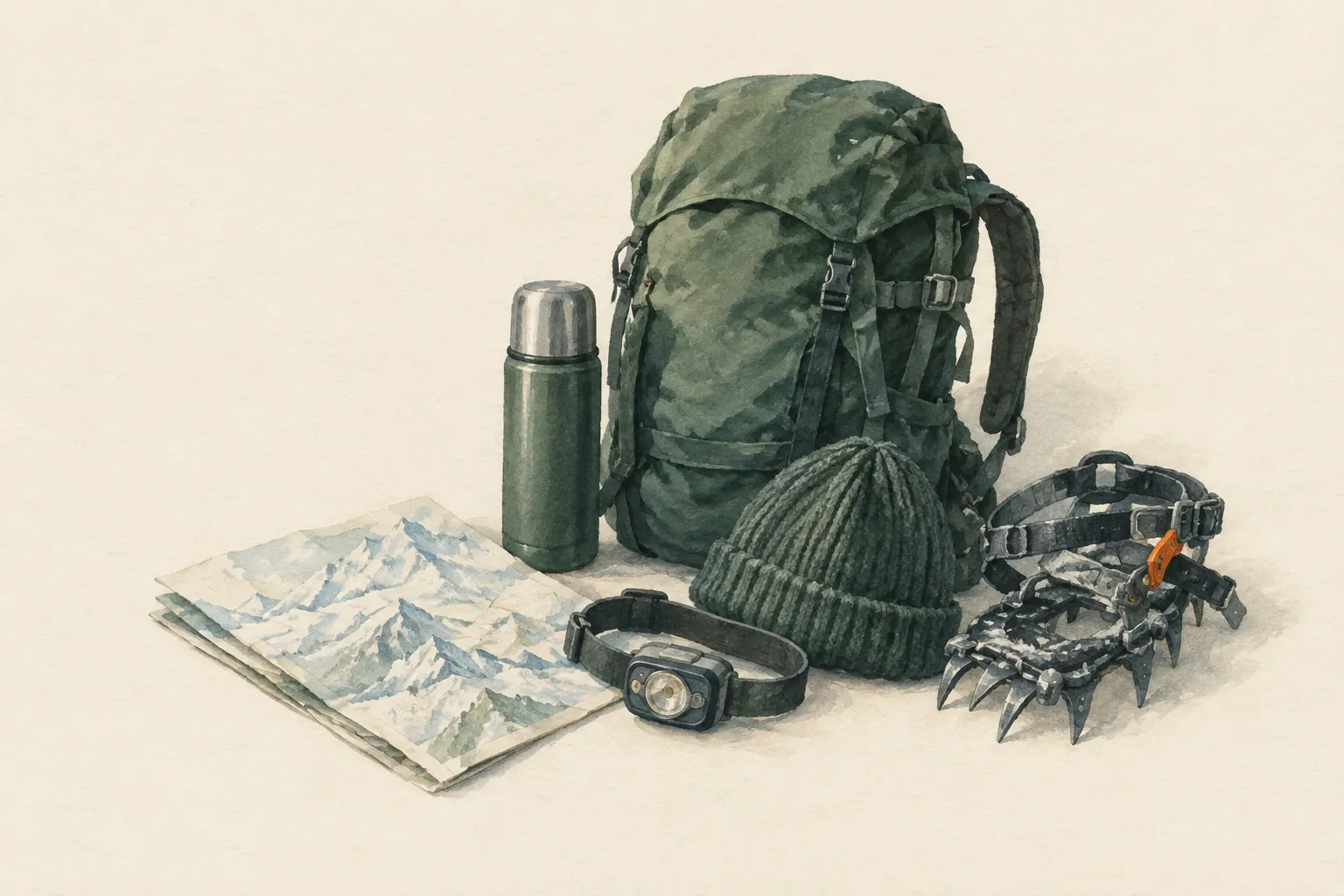
In winter, food and drink are fuel for your body's heater. Eating regularly and drinking warm drinks means you feel less cold and stay more alert. An insulated bottle with a warm drink not only feels good but also stops the water from freezing. Melt snow rather than eating it, because snow in your mouth cools you even more.
Plan the trip so you are back well before dark. Carry your phone and spare batteries close to your body, for example in an inside pocket. And agree in the group to watch each other: white patches on the nose, cheeks or ears are usually noticed not by the person affected but by someone else.
Safety: what to watch out for
In the mountains, avalanches are the danger you are least able to judge yourself. They can release on moderately steep slopes, even in bright sunshine, and they are often triggered by the people on the slope. Without an avalanche course, emergency equipment and the current avalanche bulletin, you do not belong in such terrain. Stay on cleared winter trails and secured pistes and respect closures.
Hypothermia announces itself with intense shivering, confusion, slurred speech and drowsiness. Frostbite often shows as white or grey, numb skin. In both cases: seek shelter from wind and cold, wrap up warm and dry and call the local emergency number (112 in the EU). Do not rub frozen skin with snow – that is an old myth and tends to do harm.
Frozen lakes and rivers are not a shortcut. You cannot reliably tell from the outside how thick and strong the ice is. Only walk on ice when the responsible authority has opened it. Slippery paths and roads are also a common cause of accidents – non-slip shoes and shorter steps help.
Good to know
Snow reflects a lot of sunlight. That is why you can get sunburnt in winter, and without sunglasses your eyes can become painfully irritated, which is called snow blindness. Sunglasses and sunscreen belong in your pack in winter too, especially in the mountains.
In heavy snowfall or fog over snow a “whiteout” can occur: ground and sky blur into one white surface, and you can see neither edges nor slopes. Navigation then becomes almost impossible. It is better to wait, stay on the known path or turn back.
In Europe the avalanche bulletin is based on a common five-level scale. It is an important tool, but it does not replace on-site assessment, for which you must be trained. Winter stays demanding in the lowlands too: cold, ice, short days and wetness are the main problems there.
Step by step
Plan short, start early
Allow generous walking times in snow and plan the trip to end well before dark.
- 1
Plan short, start early
Allow generous walking times in snow and plan the trip to end well before dark.
- 2
Read the avalanche bulletin
In mountain regions read the regional avalanche bulletin. In Europe the warning services use a common five-level danger scale. It does not replace on-site assessment, which requires training.
- 3
Regulate layers
Start slightly cool, remove layers on climbs to avoid sweating, put on a warm layer immediately when stopping.
- 4
Eat and drink
Eat regularly and drink warm drinks; cold and walking in snow use a lot of energy. Protect drinks from freezing in insulated bottles.
- 5
Keep batteries warm
Carry phone, headlamp and spare batteries close to your body; cold noticeably reduces usable capacity.
- 6
Watch each other
Watch each other for white patches on the face, shivering and changes in behaviour. Turn back early if someone is very cold.
Common mistakes
- Applying summer walking times to winter
- Sweating in cotton clothing
- Ignoring the avalanche bulletin because the sun is shining
- Letting the phone get cold in an outer pocket
- Taking a shortcut across a frozen lake
Quick view
Materials
Dry spare clothing
Spare gloves, hat, dry socks
Carry it in waterproof packaging – wet clothing barely insulates.
Double-wall insulated bottle
Warm drink; otherwise water freezes
Never heat directly.
Headlamp / flashlight
Short days
Sleeping pad
As a seat for breaks and emergencies
Emergency blanket
Tears easily once punctured; short-term shelter only.
Conductive – keep away from power lines.
Suitable for
- Winter hikes and snowshoe trips on secured routes
- Winter camping with experience
- Planning winter trips
Not suitable for
- Trips into avalanche terrain without training, equipment and experienced companions
- A substitute for an avalanche course
Prerequisites
- Winter-proof clothing in layers
- Weather forecast and, where relevant, avalanche bulletin
- For avalanche terrain: training and equipment
How it works
Cold continuously draws heat from the body through wind, wetness and contact with cold ground; sweat and snow make insulation wet and therefore less effective. At the same time, few daylight hours and laborious walking in snow shorten the usable time. Winter planning therefore means smaller goals, reserves of time, clothing and energy, and avoiding terrain whose hazards you cannot assess.
Advantages
- Good planning makes winter trips manageable
- Snow can serve as a water source and insulation
Disadvantages
- Little daylight and high energy needs
- Avalanche danger in the mountains requires specialist knowledge
Deep knowledge
Background
The European Avalanche Warning Services (EAWS) use a common avalanche danger scale on which regional avalanche bulletins are based. The Wilderness Medical Society guidelines on hypothermia describe how cold, wetness and wind interact and which warning signs occur.
Avalanche knowledge is a specialist field with courses run by alpine clubs and mountain guide associations. This entry only conveys the basic rule: avoid avalanche terrain without training.
Variants
- Winter in the lowlands
- Even without avalanche danger, cold, ice, short days and wetness remain the main problems. Non-slip footwear and a plan for darkness are especially important.
Common mistakes
- Applying summer walking times to winter
- Sweating in cotton clothing
- Ignoring the avalanche bulletin because the sun is shining
- Letting the phone get cold in an outer pocket
- Taking a shortcut across a frozen lake
Limits and risks
- No avalanche training or snowpack assessment
- No treatment of hypothermia or frostbite
Material alternatives
Derived from material properties: a substitute must have all relevant properties. Observe the notes on the substitute.
- Dry spare clothing
- Sleeping pad, Dry leaves, grass or conifer boughs (Collect only where allowed; no protected plants. Check for ticks and insects.), Backpack, Wool blanket / duvet (Keep away from candles, stoves and heaters.), Insulated cool box (Keeps cold only for a limited time; without ice packs or ice it is not a fridge.), Sleeping bag (Do not store compressed long-term; do not pack away damp.), Newspaper and cardboard (Flammable – keep away from candles, stoves, heaters and embers.), Insulated cooking box (hay box, thermal cooker) (Never put open flame or embers inside – only the hot, closed pot.)
- Double-wall insulated bottle
- Single-wall stainless steel bottle (Heat only single-wall bottles without paint/plastic; remove the lid before heating.), PET bottle (clear, max. 2 litres) (Do not heat or place in a fire.), Food-grade water container (Only use containers that never held chemicals or fuel.), Airtight food-grade storage container (Fill only when clean and completely dry; never use containers that previously held chemicals.), Collapsible water container or bag (Protect from sharp objects.), Food-grade water bag (Use only for drinking water, never for chemicals or fuel.), Fermentation jar or crock (Use only food-grade containers of glass, food-safe glazed stoneware or food-grade plastic – no metal containers for acidic food.), Resealable food bags (Use only bags intended for food; do not use with boiling water unless the manufacturer explicitly allows it.)
- Headlamp / flashlight
- Mobile phone (The battery drains quickly in cold and with continuous screen and GPS use.), Battery lantern / LED light
- Sleeping pad
- Dry leaves, grass or conifer boughs (Collect only where allowed; no protected plants. Check for ticks and insects.), Backpack, Dry spare clothing (Carry it in waterproof packaging – wet clothing barely insulates.), Wool blanket / duvet (Keep away from candles, stoves and heaters.), Insulated cool box (Keeps cold only for a limited time; without ice packs or ice it is not a fridge.), Sleeping bag (Do not store compressed long-term; do not pack away damp.), Newspaper and cardboard (Flammable – keep away from candles, stoves, heaters and embers.), Insulated cooking box (hay box, thermal cooker) (Never put open flame or embers inside – only the hot, closed pot.)
Results come exclusively from structured entries. No improvised instructions are generated.
Sources
European Avalanche Warning Services (EAWS): European Avalanche Danger Scale
Common European avalanche danger scale as the basis of avalanche bulletins
Wilderness & Environmental Medicine (Wilderness Medical Society) (2019): Wilderness Medical Society Clinical Practice Guidelines for the Out-of-Hospital Evaluation and Treatment of Accidental Hypothermia: 2019 Update
Cold exposure and warning signs of hypothermia
The Mountaineers Books (2017): Mountaineering: The Freedom of the Hills, 9th edition
Winter travel and basics of avalanche hazard