Following a stream downstream – chances and dangers
Water flows into valleys, and in populated regions valleys hold paths, roads and villages. Following a stream downstream can therefore lead you out of the wild – but only if you do it right: beside the water rather than in it, up on the slope rather than in the gorge, never climbing down beside waterfalls and never in narrow valleys when thunderstorms threaten. If you are expected and will be searched for, staying where you are is often better.
- Hours to days, depending on terrain
Explained simply
Water always flows downhill. Small streams flow into bigger streams, which flow into rivers, and people almost always live by rivers and in valleys. That is why a stream can show you the way out of the forest – like a signpost built by nature.
But streams are dangerous too. Sometimes they drop over rocks as a waterfall or flow through a narrow gorge. You must never climb down there. You rather walk along higher up the slope and hear the rushing water from the side.
Very important: if a thunderstorm is coming, you immediately move away from the stream to higher ground. In rain a small stream can turn into a raging river within a few minutes. And if someone knows where you are, it is usually better to stay where you are.
How it works
Waters form a network that keeps joining as it goes downhill. If you follow a stream down, sooner or later you reach a larger stream, a river or a lake. In populated regions such as the Alpine countries and uplands, there are almost always paths, forestry roads, houses or villages by such waters, because people have always used water and flat valley floors.
A stream is a handrail you can hardly lose: you hear it, you see the valley, and the terrain leads you down anyway. That is a big advantage over a direction you can only hold with the sun or signs. But the handrail is not the route – right by the water it is often wet, slippery, steep or overgrown.
Running water shapes obstacles. Where the ground is hard, it cuts ravines and gorges with vertical walls. At steps in the terrain, waterfalls form. In flat sections bogs and dense bank scrub develop. Knowing this, you keep your distance and stay a little higher up the slope.
What really matters
Before you follow a stream, decide consciously: does nobody know where you are? Can you not stay? Is there enough daylight, and is no thunderstorm in sight? Only if these questions speak for it do you set off. If you left a trip plan, staying at a visible place is usually better.
Walk beside the water, not in it. Use paths, game trails and the slope above the bank. If the valley narrows and the banks become rock walls, or you hear a loud roar, do not go in. Climb out sideways in good time and bypass the spot higher up. The most important rule: what you climb down you may not be able to climb back up – and then you are stuck in a gorge.
As soon as you reach a path, a forestry road or a bridge, follow it downhill. Paths lead to settlements. Leave a sign for searchers at junctions and wear bright clothing so you can be seen.
Safety: what to watch out for
Falls at waterfalls, on wet rock and from gorge edges are the biggest danger. Wet, mossy rock is extremely slippery, and even a short fall can cause serious injury. Never descend beside a waterfall, never climb over wet rock steps – turn back and go around higher up, even if it takes longer.
Flash floods can come out of a clear sky when it rains further up in the catchment. In narrow valleys, gorges and dry stream beds the water then rises within minutes. Alarm signs are muddy or suddenly rising water, drifting wood, a rumbling sound and thunderclouds up the valley. Then climb sideways to higher ground at once. Never walk in gorges when thunderstorms threaten, and never camp right by the stream.
You only cross streams when unavoidable and safe. Cold, fast water can sweep your legs away even when shallow. Treat stream water before drinking it. With phone signal, call 112; in Austria you can also reach the mountain rescue on 140.
When it makes sense – and when not
Following a stream makes sense in populated regions with a dense path network, when you have to move and nobody knows where you are. There a stream often leads to a path within a manageable time. Even when you know that a road runs through the valley, the stream is a good handrail to it.
It does not make sense during thunderstorms, heavy rain or strong snowmelt, in areas with gorges and ravines, and in large, uninhabited wilderness areas where a valley can be empty of people for days. And if a search for you can be expected, it is usually better to stay at a clearly visible place.
Good to know
Research on the behaviour of missing persons shows that lost people often follow paths and terrain lines. Search teams know this and search such lines specifically. Anyone who marks where they are going is found sooner.
On every trip, note which valley the streams in your area flow into and where roads run there. A quick look at the map before setting off – 'all streams here flow south into the valley with the main road' – can be the most important information in an emergency.
Step by step
Decide first: stay or go?
Apply the STOP rule. If someone knows where you are and a search will start, it is usually better to stay at a visible place. Follow the water only if that is not an option, in daylight and with no thunderstorm in sight.
- 1
Decide first: stay or go?
Apply the STOP rule. If someone knows where you are and a search will start, it is usually better to stay at a visible place. Follow the water only if that is not an option, in daylight and with no thunderstorm in sight.
- 2
Find water and check the flow
Go downhill, into hollows and gullies, and listen for rushing water. Once you have found a stream, drop a leaf in to see which way it flows. Downstream, streams grow larger through tributaries – that confirms the direction.
- 3
Walk beside the water
Walk on paths, game trails or the slope above the bank, not in the stream bed and not over wet stones. Stay close enough to hear the water or see the valley – that way you will not lose the handrail.
- 4
Bypass gorges and waterfalls
If the valley narrows, the banks turn into rock walls or you hear a loud roar, do not go further in. Climb out sideways in good time and bypass the spot high on the slope or over the ridge. Never descend beside a waterfall or over wet rock; what you climb down you often cannot climb back up.
- 5
Avoid thickets and bogs
Banks are often overgrown with brambles or willow scrub, or they are boggy. Instead of fighting your way through, go a little higher up the slope, where the forest is more open. Keep the valley in sight while you do so.
- 6
Watch for storms and rising water
Look at the sky regularly, especially up the valley. With thunderclouds, thunder or rain higher up, leave narrow valleys and stream beds at once and climb to higher ground. Muddy, rising water or drifting wood are alarm signs. Never camp right by the stream.
- 7
Decide at a path or road
When you reach a path, forestry road or power-line corridor, follow it downhill – paths lead to settlements. Leave a sign for searchers at junctions and make yourself noticeable with a whistle and bright clothing.
Common mistakes
- Walking in the stream bed over wet stones
- Descending into a gorge 'because it carries on'
- Climbing down beside a waterfall
- Missing thunderclouds up the valley
- Leaving although a search can be expected
Quick view
Materials
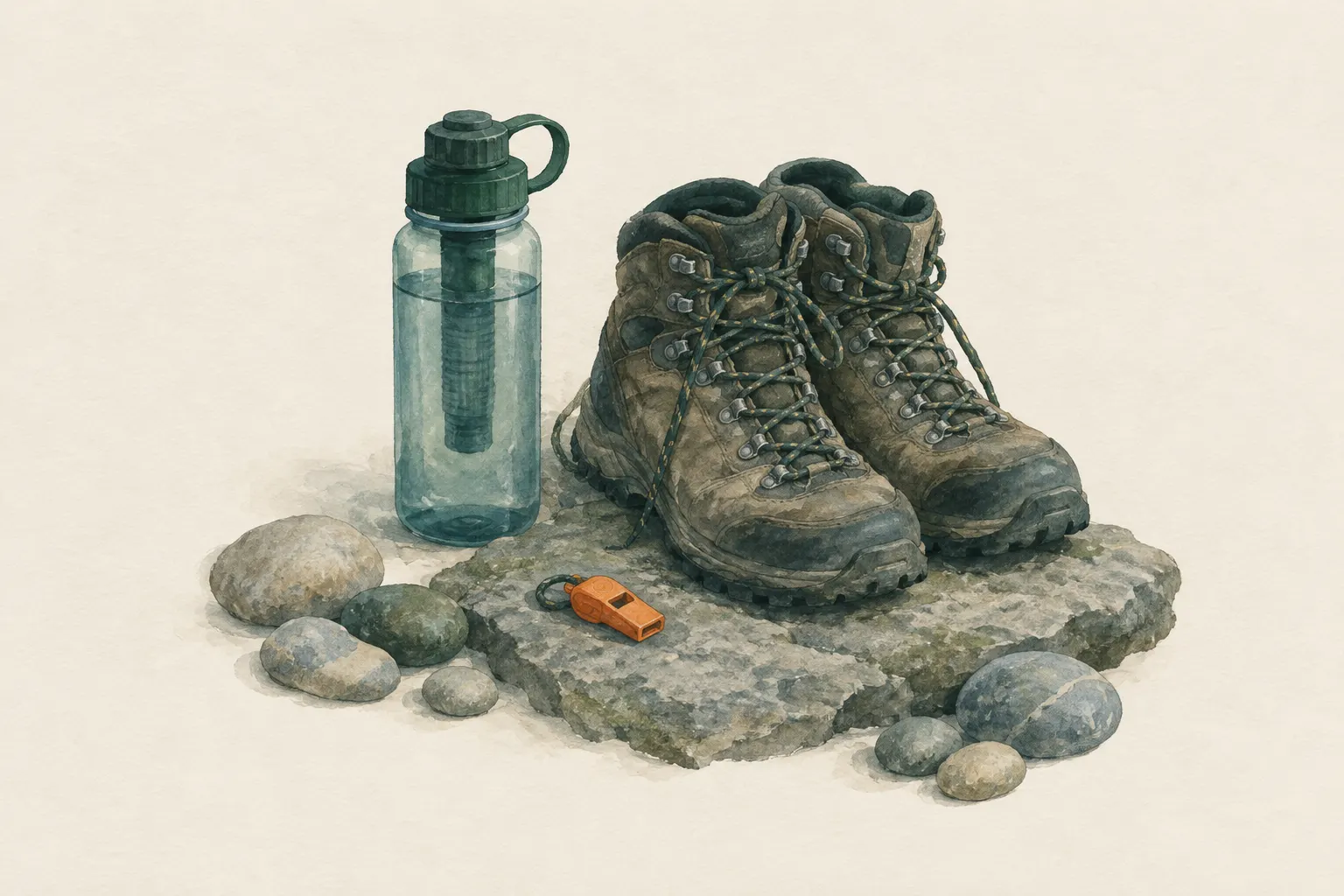
Sturdy closed shoes
Trekking poles
Or a strong stick for support
Portable water filter (hollow fibre / membrane)
Always treat stream water
Do not let it freeze – fibres can be damaged without visible signs.
Signal whistle
Carry within easy reach, not deep in the pack.
Do not blow right next to other people's ears.
Suitable for
- Central European uplands and pre-Alps with a dense path network
- When nobody knows where you are and you have to move
- As a handrail to a known road in the valley
Not suitable for
- Narrow gorges and ravines
- Thunderstorms, heavy rain or snowmelt
- Very remote wilderness where valleys are uninhabited too
- When a trip plan was left and a search can be expected
Prerequisites
- STOP rule applied: staying is not a better option
- Enough daylight
- No thunderstorm in sight or forecast
Safety
- Do not walk in the water and only cross streams when unavoidable and safe: cold, fast water can sweep your legs away even when shallow. Treat stream water before drinking.
How it works
Waters gather downhill into ever larger streams and rivers, and people have always settled by water and in valleys. A stream is therefore a natural handrail you cannot lose. At the same time, running water cuts gorges, forms steps and waterfalls, and banks are often covered in dense scrub – the handrail is right, the route right beside the water is often wrong.
Advantages
- A handrail you can hardly lose
- In populated regions often leads to paths
- Water nearby (treat it!)
Disadvantages
- Gorges, waterfalls and thickets
- Danger from flash floods
- No guarantee of settlements in remote wilderness
Deep knowledge
Background
The advice to follow water downstream appears in many survival books. In densely populated countries such as Austria and Germany it usually leads to a path quickly. In large wilderness areas, however, a valley can remain uninhabited for days.
Research on the behaviour of missing persons shows that lost people often follow paths and terrain lines. For a search it is nevertheless usually easier when someone stays in one place – that is why the STOP rule always comes first.
Variants
- Dry gullies
- Dry gullies and channels lead downhill too. Especially in dry regions, however, they are particularly dangerous in thunderstorms and can fill within minutes.
- Lakes and large rivers
- At lakes and large rivers follow the shore to paths, jetties or houses. Never swim across large rivers.
Common mistakes
- Walking in the stream bed over wet stones
- Descending into a gorge 'because it carries on'
- Climbing down beside a waterfall
- Missing thunderclouds up the valley
- Leaving although a search can be expected
Limits and risks
- No instructions for crossing water – see separate entry
- No climbing or abseiling techniques
- Applies mainly to populated regions
Material alternatives
Derived from material properties: a substitute must have all relevant properties. Observe the notes on the substitute.
- Trekking poles
- Sturdy sticks / poles (Do not cut live wood where prohibited.), Tent pole repair sleeve (Temporary only – have broken sections replaced at home.), Round logs (straight, sound) (Fell or take only with the forest owner's permission.)
Results come exclusively from structured entries. No improvised instructions are generated.
Sources
Robert J. Koester – dbS Productions (2008): Lost Person Behavior: A Search and Rescue Guide on Where to Look – for Land, Air and Water
Behaviour of lost persons; importance of staying put and of paths for a search
Ready.gov – U.S. Federal Emergency Management Agency (FEMA): Floods
With flash flood danger move to higher ground at once; avoid streams and low areas
NOAA National Weather Service (USA): Lightning Safety
Leave exposed terrain when thunderstorms threaten
Headquarters, Department of the Army (USA) (2002): FM 3-05.70 Survival
Moving through terrain and hazards near water