Estimating direction with a wristwatch (very imprecise)
With an analogue watch and the sun you can estimate a north–south line. The method is well known but crude: time zones, daylight saving, season and latitude distort it considerably, especially around midday and near the equator. Use it only as a makeshift.
- One minute
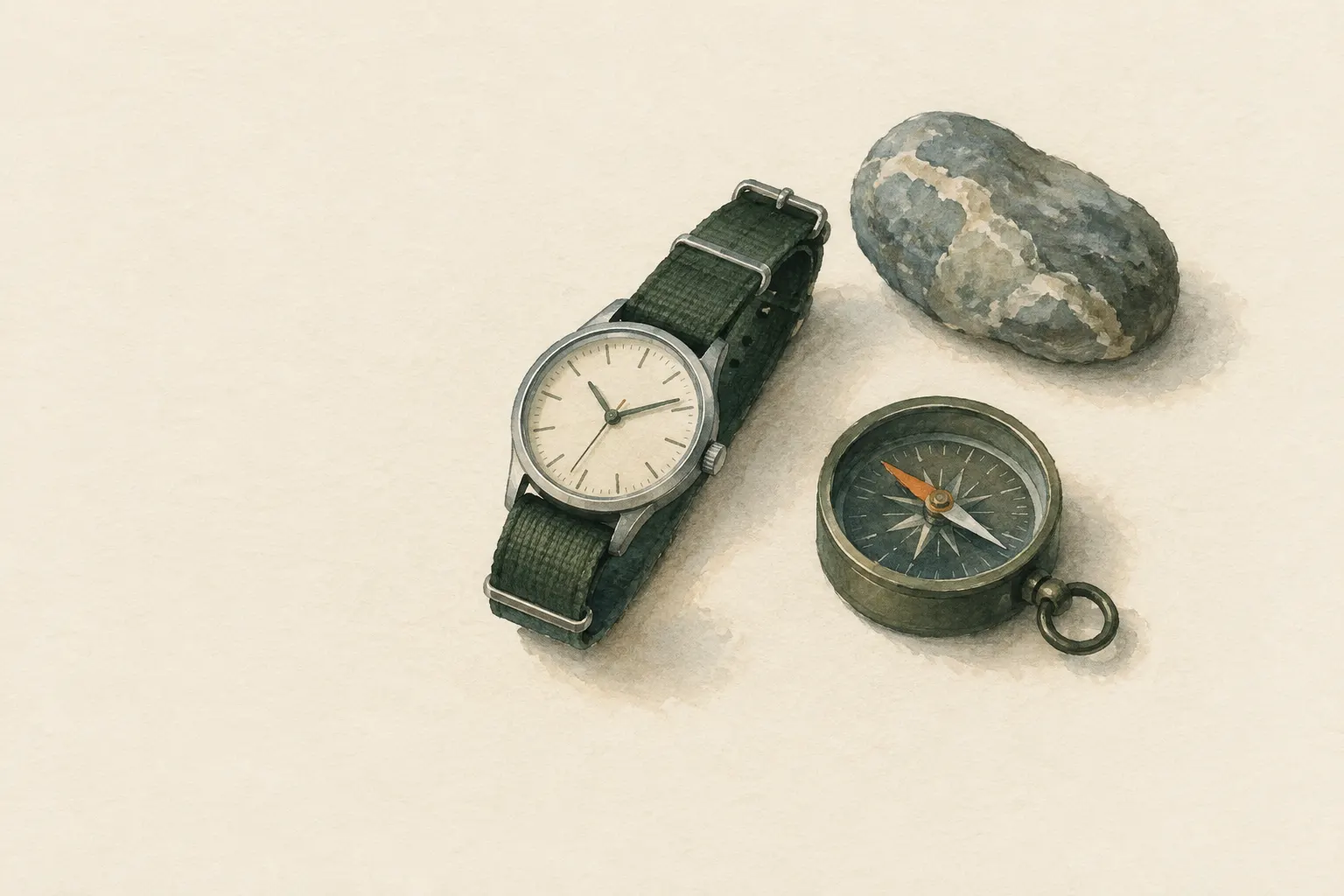
Explained simply
The sun rises in the east, stands roughly in the south at midday (here in Europe) and sets in the west. A watch with hands shows how far the day has progressed. If you put the two together, you can roughly estimate where south is – like a puzzle where two clues together give the answer.
This is how it works in the northern hemisphere: hold the watch flat, turn it so the small hour hand points at the sun, and imagine a line exactly halfway between the hour hand and 12. This line points roughly south. If daylight saving time applies, use 1 instead of 12.
But be careful: this method is very imprecise. Depending on place, season and time of day it can be well off. Use it only as a rough hint and never on its own to walk long distances or into dangerous terrain.
How it works
The sun appears to travel once around the Earth in 24 hours, so about 15 degrees per hour. The hour hand of a watch, however, goes round once in 12 hours, twice as fast. That is why you halve the angle between the hour hand and 12: this cancels out the hand's double speed.
The method rests on an assumption: that the sun is due south (northern hemisphere) or due north (southern hemisphere) at 12 o'clock by the clock. That is only roughly true. Clock time applies to a whole time zone, but the sun pays no attention to time zones: at the eastern edge of a zone it reaches south earlier than at the western edge. Add daylight saving time, which shifts everything by an hour, and a small seasonal variation in the sun's path.
In the southern hemisphere you reverse the method: point 12 at the sun, and the line halfway between 12 and the hour hand points roughly north. If you do not know which hemisphere you are in, you cannot use the method sensibly.
When it makes sense – and when not
The watch method is most usable in mid-latitudes (for example in Europe), in the morning or afternoon when the sun is not too high. Then it can help you roughly confirm a direction: 'So the valley I want lies roughly to the west – does that match my map?'
Around midday it becomes very imprecise, because the angle between the hand and 12 is small and every little error has a big effect. In the tropics and near the equator it is hardly usable: there the sun stands almost straight overhead at midday, and depending on the season it can even be in the north rather than the south at noon. Under an overcast sky the method does not work at all.
A digital watch or a phone also works: draw a clock face showing the current time on a scrap of paper or on the ground and use it the same way.
What really matters
Hold the watch level, otherwise the direction of the hand will not match the direction of the sun. Never look straight into the sun. A trick helps: hold a thin stalk or stick upright at the tip of the hour hand and turn the watch until its shadow falls exactly along the hand towards the centre – then the hand points at the sun.
Do not forget daylight saving time: it is the most common mistake. And treat the result as a rough estimate. Compare it with other clues: where did the sun rise this morning? Where does a shadow stick point if you watch it for a while? What does the terrain say? Only when several clues agree do you have a usable direction.
Safety: what to watch out for
The biggest danger of the watch method is false confidence. Because it looks so simple, it is easy to think the result is precise. Over a long distance, an error that looks small at the start can take you far from your target. So never navigate long distances or into steep, unknown terrain by the watch alone.
If you are lost, a rough compass direction is often not the most important thing. First stop, calm down, clarify your position as well as you can and, if there is danger, get help (local emergency number, 112 in the EU). The direction can then help you head for a large, safe handrail.
Good to know
The watch method appears in many survival manuals – almost always with a note that it is imprecise. More accurate without a compass is the shadow stick, watched over a longer period, or the North Star at night. Most reliable of all, though, is simply always carrying a small compass.
A good exercise: try the method at home at different times of day and compare it with a compass each time. That way you see for yourself when it is usable and when it is well off.
Step by step
Allow for daylight saving
If daylight saving time applies, use 1 o'clock instead of 12 as the reference.
- 1
Allow for daylight saving
If daylight saving time applies, use 1 o'clock instead of 12 as the reference.
- 2
Northern hemisphere
Hold the watch level and point the hour hand at the sun. The line halfway between the hour hand and 12 points roughly south.
- 3
Southern hemisphere
Point 12 at the sun. The line halfway between 12 and the hour hand points roughly north.
- 4
Cross-check
Compare with other clues (sunrise and sunset, shadow stick, terrain) and treat the result as a rough estimate.
Common mistakes
- Forgetting daylight saving
- Using the method for the wrong hemisphere
- Treating the result as precise
- Using it at midday in the tropics
Quick view
Materials
Analogue wristwatch
A digital watch also works: draw a clock face with the current time on paper
Only a very rough direction aid – never a substitute for a compass in precise navigation.
Suitable for
- Rough orientation without a compass
- Sanity-checking a direction
Not suitable for
- Precise navigation
- The tropics and midday
- Overcast skies
Prerequisites
- Sun visible
- Knowing which hemisphere you are in
Safety
- The watch method can be far off depending on place, date and time. Never navigate long distances or into dangerous terrain by it alone.
How it works
The sun appears to move about 15° per hour across the sky, the hour hand 30° per hour – which is why the angle is halved. The method assumes that the sun is due south (northern hemisphere) or due north (southern hemisphere) at 12 noon local time. In practice this is only approximately true: clock time and solar time differ depending on position within the time zone and because of daylight saving, and near the equator the sun is almost overhead at midday.
Advantages
- Quick
- Only a watch needed
Disadvantages
- Considerable errors that are hard to estimate
- Only with sunshine
- Hardly usable near the equator
Deep knowledge
Background
The watch method is described as a makeshift in many survival manuals, usually with a note about its inaccuracy.
More accurate compass-free methods are a shadow stick over a longer period or the stars at night; more reliable still is always carrying a compass.
Common mistakes
- Forgetting daylight saving
- Using the method for the wrong hemisphere
- Treating the result as precise
- Using it at midday in the tropics
Limits and risks
- No accuracy figure possible – strongly dependent on place and time
- Not for navigating long distances
Sources
Headquarters, Department of the Army (USA) (2002): FM 3-05.70 Survival
The watch method as a field-expedient method and its limits
Headquarters, Department of the Army (USA) (2001): FM 3-25.26 Map Reading and Land Navigation
Field-expedient methods of finding direction