Roughly estimating direction from the sun
Without a compass, the sun gives a rough indication of direction, for example with the shadow-stick method. The result is imprecise, depends on season, time of day, latitude and hemisphere, and does not replace proper navigation.
- About 15–30 minutes for the shadow-stick method
Explained simply
The sun rises roughly in the east, travels across the sky and sets roughly in the west. A shadow always points away from the sun. Because the sun moves, the shadow moves too – and from that you can read the directions roughly.
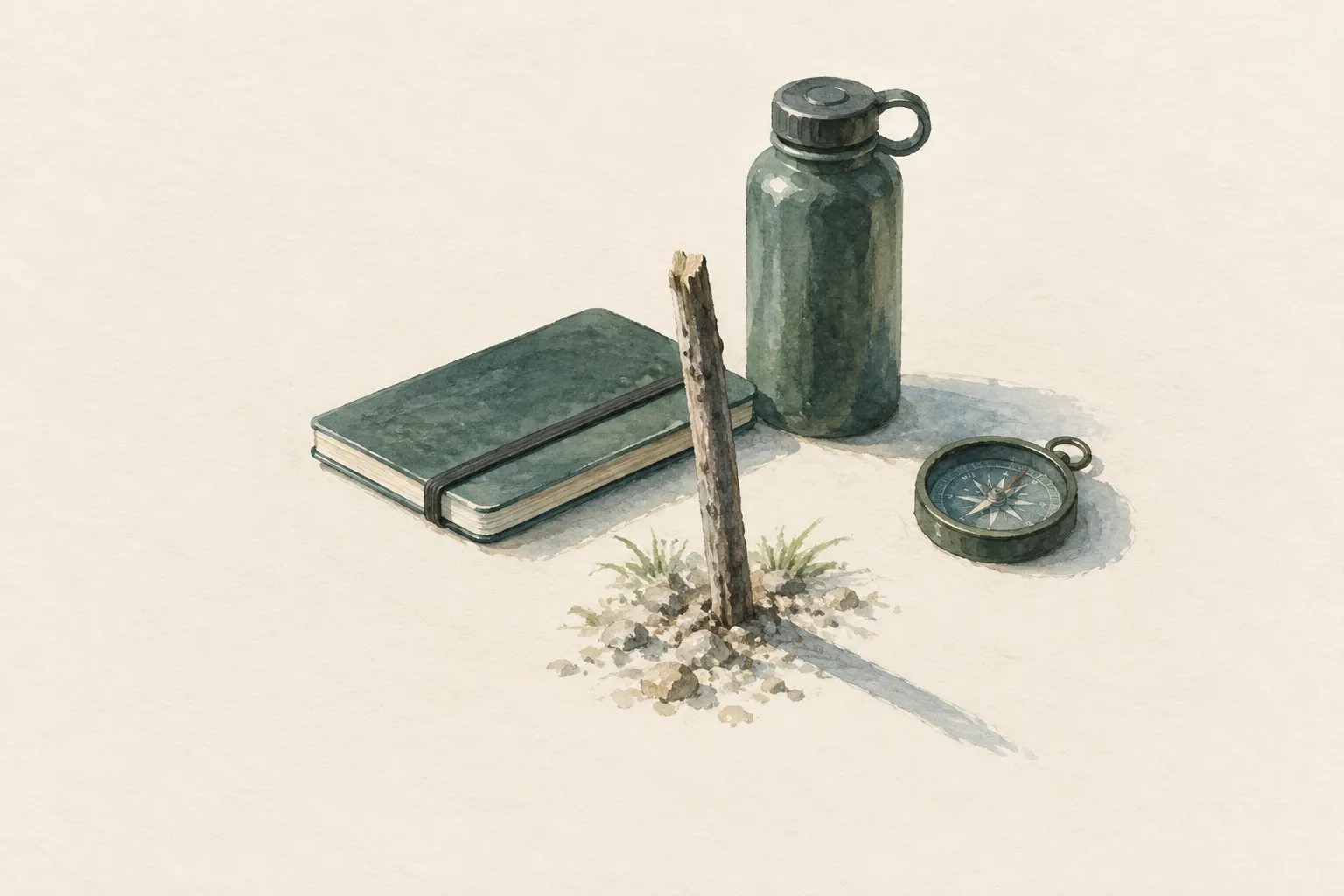
Here is how: push a straight stick upright into the ground. Put a small stone exactly at the tip of its shadow. Wait a quarter of an hour or longer and put a second stone at the new shadow tip. The first stone lies roughly west, the second roughly east. A line across them points roughly north and south.
The most important thing: the result is only approximate – it is not a compass. And never look directly at the sun; it can damage your eyes.
How it works
The Earth turns from west to east. To us it therefore looks as if the sun moves across the sky from east to west. A stick's shadow moves the opposite way – so its tip travels from west to east. This is true in both the northern and the southern hemisphere.
At midday the sun is at its highest and the shadow at its shortest. Outside the tropics, in the northern hemisphere the sun is then roughly south, and the shadow points roughly north. In the southern hemisphere it is the other way round. But careful: 'midday' here means the sun's highest point, not 12 o'clock on your watch. Time zones and daylight saving can shift that moment by an hour or more.
Sunrise and sunset also give only a very rough indication. Only around the spring and autumn equinoxes does the sun rise almost exactly in the east and set in the west. In the northern summer, sunrise is clearly north of east, in winter clearly south of it – the further from the equator, the more so.
What really matters
The ground should be as level as possible and the stick upright. A longer stick casts a longer shadow on which the movement is easier to see. Mark the shadow tip as exactly as possible – a small stone or twig right at the tip.
The longer you wait, the clearer the movement and the less small marking errors matter. A quarter of an hour is the minimum; more time usually makes the result more reliable. With clouds that keep hiding the sun it gets difficult, because the shadow blurs.
Check the result against everything else you know: where is the sun right now? Which way does the stream flow according to the map? Where is a summit you recognise? If the clues contradict each other, do not trust the method blindly.
When it makes sense – and when not
The method helps when you have no compass and only want to know roughly where north is – for example to orient a map roughly, or to check whether a direction is plausible at all. It is too imprecise for accurate navigation.
In the tropics the sun stands very high around midday, almost straight overhead. The shadow is then tiny and its movement hard to see. At high latitudes, far north or south, the sun is often very low and the shadow becomes extremely long. In both cases the method is particularly unreliable. Under complete cloud cover it does not work at all.
Important: when you are lost, the first thing you usually need is not a compass direction but a clear plan. The shadow-stick method replaces neither the STOP rule nor an emergency call.
Small errors, big effect
A direction that is only slightly wrong leads far from the target over a long distance. Just a few degrees off means hundreds of metres of offset after a few kilometres. So the shadow method is better suited to finding a rough direction towards a long line you cannot miss – such as a big road or a river – than to hitting a small target precisely.
Well-known 'rules of thumb' such as 'moss grows on the north side of trees' are unreliable. Where moss grows depends on moisture, shade, wind and the individual tree. Lopsided trees or anthills are not reliable compasses either.
How to practise it
Try the method on a sunny day in the garden or a park where you already know the directions or can check them with a compass. Do it once in the morning, once at midday and once in the afternoon. That way you see for yourself how well or badly the result fits at different times of day.
For children it is an exciting experiment: they see with their own eyes that the shadow moves, and understand how the Earth turns. Explain to them at the same time why you never look at the sun.
Step by step
Set up the stick
Push a straight stick upright into level ground so that it casts a clear shadow.
- 1
Set up the stick
Push a straight stick upright into level ground so that it casts a clear shadow.
- 2
First mark
Mark the tip of the shadow with a stone or twig.
- 3
Wait
Wait about 15 minutes or longer until the shadow tip has clearly moved.
- 4
Second mark and line
Mark the new shadow tip. The line from the first to the second mark points roughly from west to east; perpendicular to it is roughly north–south.
- 5
Cross-check with other clues
Compare with the map, known landmarks or the sun's position. If there are contradictions, do not trust the method blindly.
Common mistakes
- Treating 12 o'clock clock time as the sun's highest point
- Ignoring the hemisphere
- Waiting too briefly
- Using moss or tree growth as a compass
Quick view
Materials
Sturdy sticks / poles
One straight stick and two small markers
Do not cut live wood where prohibited.
Suitable for
- Rough choice of direction when no compass is available
- Plausibility check of other aids
Not suitable for
- Precise navigation
- Overcast sky
- Tropics around midday when the sun is very high
- High latitudes with a very low sun
Prerequisites
- Sunshine with a clear shadow
- Level ground
Safety
- The method is only rough. A small error in direction leads far from the target over longer distances. It does not replace a decision by the STOP rule or an emergency call.
- Never look directly at the sun.
How it works
The sun rises roughly in the east and sets roughly in the west, and its shadow moves accordingly. If you mark the tip of a stick's shadow twice, a few minutes apart, the line between the marks is roughly west–east (first mark roughly west). At midday, outside the tropics, the sun is roughly south in the northern hemisphere and roughly north in the southern hemisphere. 'Midday' means the sun's highest point, not 12 o'clock on the watch – time zones and daylight saving shift it.
Advantages
- No equipment needed
- Easy to learn
Disadvantages
- Imprecise
- Only works in sunshine
- Time-consuming
Deep knowledge
Background
The shadow-stick method is described in survival manuals such as FM 3-05.70 as a makeshift way to find direction. Its accuracy varies with season, time of day and latitude.
Common 'rules of thumb' such as moss on the north side of trees are unreliable because growth depends on local moisture, shade and wind.
Variants
- Sunrise and sunset
- Sunrise and sunset directions give only a very rough indication: depending on season and latitude they deviate noticeably from east and west.
Common mistakes
- Treating 12 o'clock clock time as the sun's highest point
- Ignoring the hemisphere
- Waiting too briefly
- Using moss or tree growth as a compass
Limits and risks
- No accuracy figure possible
- Particularly unreliable in the tropics and at high latitudes
- Not usable under cloud cover
Sources
Headquarters, Department of the Army (USA) (2002): FM 3-05.70 Survival
Shadow-stick method for rough direction finding
Headquarters, Department of the Army (USA) (2001): FM 3-25.26 Map Reading and Land Navigation
Determining direction without a compass