Standing out with colour: signal panel, flag, clothing
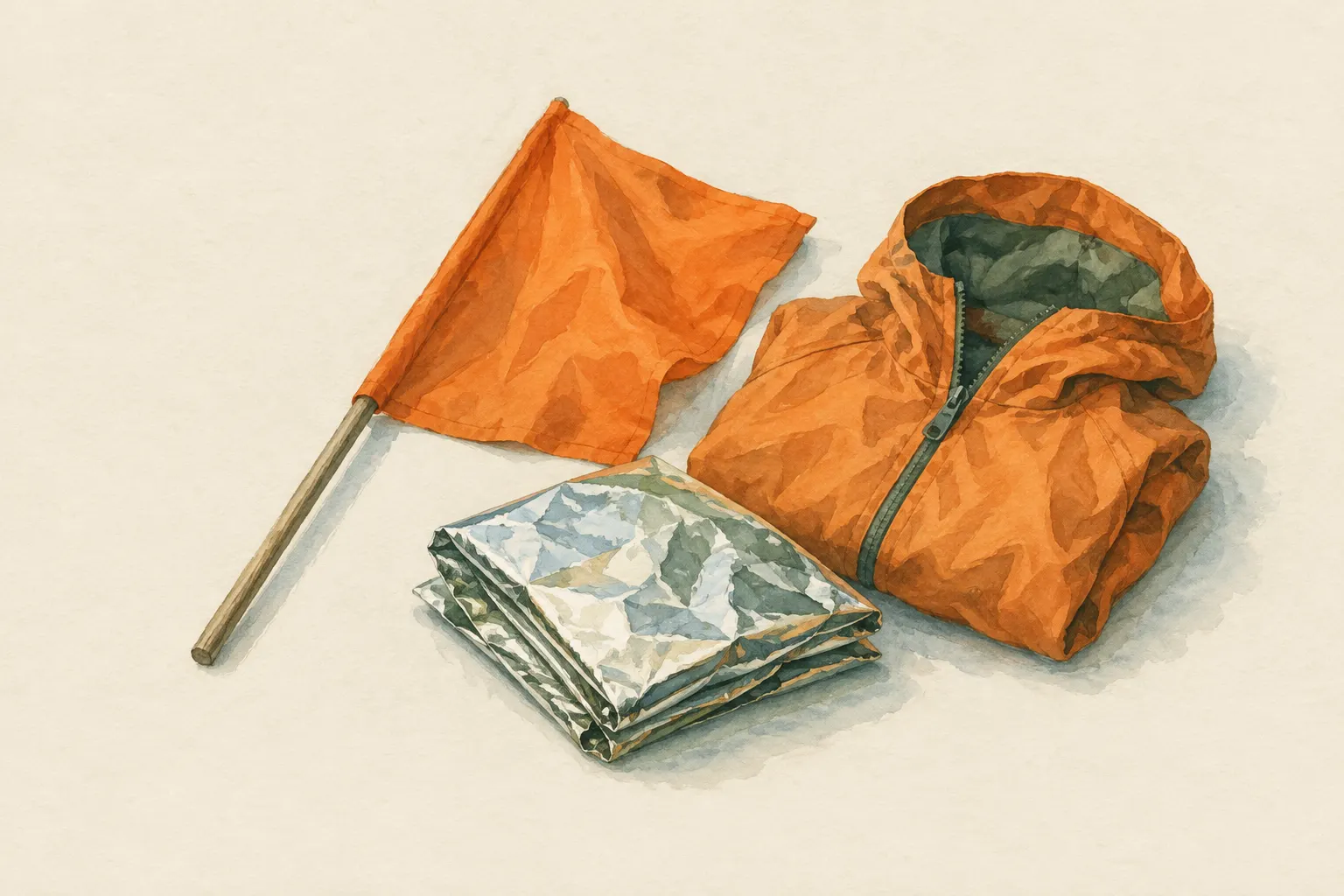
Bright colours and movement make people visible from the air and from afar. An orange cloth, an emergency blanket, a jacket waved on a stick or laid out flat – anything that contrasts with the surroundings improves the chance of being found.
- A few minutes
Explained simply
Do you know those picture puzzles where you have to find one small detail? For rescuers in a helicopter, the landscape is such a puzzle – and you are the tiny detail. But if you spread out something bright like an orange cloth, it catches the eye like a red dot on a green leaf.
That works with anything that has a different colour from the surroundings: a colourful cloth, an emergency blanket, a bright jacket. On snow, dark things stand out; in forest and on meadows, light, vivid colours do. If you wave a cloth in big arcs, it stands out even more, because the eye notices movement at once.
Two things to watch: when it is cold, do not take off your warm jacket to lay it out as a signal – staying warm comes first. And when a helicopter wants to land, gather up loose cloths so its strong wind does not blow them into the rotors.
How it works
Our eyes respond especially to three things: colours that do not fit the surroundings, shapes that look man-made, and movement. Nature consists mostly of green, brown and grey. Fluorescent orange, red and yellow rarely occur there over large areas and therefore stand out strongly. Against snow it is the other way round: dark colours stand out.
Shape matters too. A cloth spread flat and stretched with straight edges looks man-made; a crumpled bundle looks like a stone or a bush. Large, regular shapes are easier to recognise from the air than small, irregular ones.
Movement is the strongest signal as long as someone is looking. A cloth waved in large arcs draws the eye at once. A cloth laid out or a flag on a stick, on the other hand, works continuously – even while you rest or sleep.
What really matters
Find an open spot that is easy to see from above and from the sides: a clearing, a knoll, a shore or a snowfield. Nobody can see your cloth under trees. Spread it flat and as large as possible and weigh down the corners with stones, so the wind does not carry it away or crumple it.
A flag on a long stick at a raised point is visible from the side too, for example to people on an opposite slope. When you hear or see an aircraft, take a cloth and wave it in large arcs. Then you can show the Y signal with your arms – both arms raised diagonally for 'We need help'.
An emergency blanket is versatile: the shiny side reflects sunlight and can act like a large mirror; the coloured side (often gold or orange) provides contrast. If you wear conspicuous clothing or carry a small orange cloth, you improve your chances without carrying much extra weight.
Safety: what to watch out for
A helicopter's downwash is very strong. Loose cloths, tarps and emergency blankets can be lifted and drawn into the rotors – that endangers the aircraft and everyone on board. As soon as a helicopter approaches to land, gather up loose items or weigh them down firmly. Keep your distance and follow the crew's signals.
In the cold, warmth comes first. Do not lay out your own insulating layer – jacket, fleece, sleeping bag – as a signal if you need it to stay warm. Hypothermia can become more dangerous than waiting a few hours longer. Use additional items instead: pack cover, tarp, spare clothing, emergency blanket.
When it makes sense – and when not
Coloured signals only work in daylight. In fog, dusk and night they are useless; then a lamp and a whistle help. In dense forest without a clearing they achieve little, because the canopy blocks the view from above. They work best in an air search and when you are waiting at a fixed place.
Colour complements other signals well: a ground sign made of branches becomes even more conspicuous with an orange cloth in the middle, and a signal mirror catches the eye before the cloth is recognised. If you have a phone with signal, call the local emergency number first (112 in the EU); the cloth then helps rescuers find you over the last stretch.
Good to know
Survival manuals have long recommended bright colours and high-contrast shapes for being found from the air. That is why life jackets, life rafts and much emergency equipment come in signal colours.
On water, orange cloths and dye markers are common signalling aids. In addition, slowly and repeatedly raising and lowering the arms outstretched to the sides is one of the internationally recognised distress signals at sea. If you just want to wave cheerfully on the water, keep that in mind – it could be taken as a distress sign.
Step by step
Choose an open spot
Clearing, knoll, shore, snowfield – where you can be seen from above and from the sides.
- 1
Choose an open spot
Clearing, knoll, shore, snowfield – where you can be seen from above and from the sides.
- 2
Lay out flat
Spread the cloth or emergency blanket flat and weigh it down with stones. Large, stretched shapes are better than a bundle.
- 3
Raise a flag
Fix a piece of cloth to a long stick at a raised point – visible even while you rest.
- 4
Wave when something approaches
When you hear or see an aircraft, wave the cloth in large arcs. Then use your arms for the Y signal.
Common mistakes
- Wearing camouflage colours and hoping to be seen anyway
- Laying out the signal under trees
- Cloths not secured
- Turning warm clothing into a signal
Quick view
Materials
Signal panel (fluorescent)
Weigh down or hold firmly in wind, especially near landing helicopters.
Emergency blanket
Tears easily once punctured; short-term shelter only.
Conductive – keep away from power lines.
Sturdy sticks / poles
As a flagpole
Do not cut live wood where prohibited.
Suitable for
- Air searches
- Waiting at a fixed place
- Complementing ground signs
Not suitable for
- Dense forest without a clearing
- Strong wind near landing helicopters (loose cloth)
Prerequisites
- Open ground or a raised point
- Material in a contrasting colour
Safety
- In cold conditions do not lay out your own insulating layer as a signal. Warmth comes first; use additional items instead.
How it works
The eye notices colour, shape and movement that do not fit the surroundings. Fluorescent orange, red and yellow stand out against green, brown and grey; against snow, dark colours work. Straight lines and large regular shapes look man-made. Movement – waving in large arcs – is especially noticeable.
Advantages
- No energy needed
- Works continuously, even while you sleep
- Possible with everyday items
Disadvantages
- Daylight only
- Not very effective in forest
- Wind can blow material away
Deep knowledge
Background
Survival manuals recommend bright colours and high-contrast shapes for being found from the air. The international distress signals at sea include slowly raising and lowering the arms.
Wearing conspicuous clothing or carrying a small orange cloth improves your chances at almost no extra weight.
Variants
- Emergency blanket
- The shiny side reflects light and can act like a large mirror; the coloured side (often gold or orange) provides contrast.
- On water
- At sea, orange cloths and dye markers are common signalling aids; slowly raising and lowering outstretched arms is a recognised distress signal.
Common mistakes
- Wearing camouflage colours and hoping to be seen anyway
- Laying out the signal under trees
- Cloths not secured
- Turning warm clothing into a signal
Limits and risks
- No visibility ranges
- Useless in fog, dusk and night
Sources
Headquarters, Department of the Army (USA) (2002): FM 3-05.70 Survival
Coloured panels, contrast and movement as visual signals
International Maritime Organization (IMO) (1972): Convention on the International Regulations for Preventing Collisions at Sea, 1972 (COLREGs) – Annex IV: Distress signals
Raising and lowering the arms as a distress signal at sea