Checking travel documents and securing copies
A lost or expired passport can end a trip before it starts – or cost a lot of time abroad. If you check validity and entry requirements in good time, keep copies separate from the originals and carry important numbers on paper, loss or theft can be resolved much faster.
- About 1 hour before the trip; check entry requirements weeks to months in advance
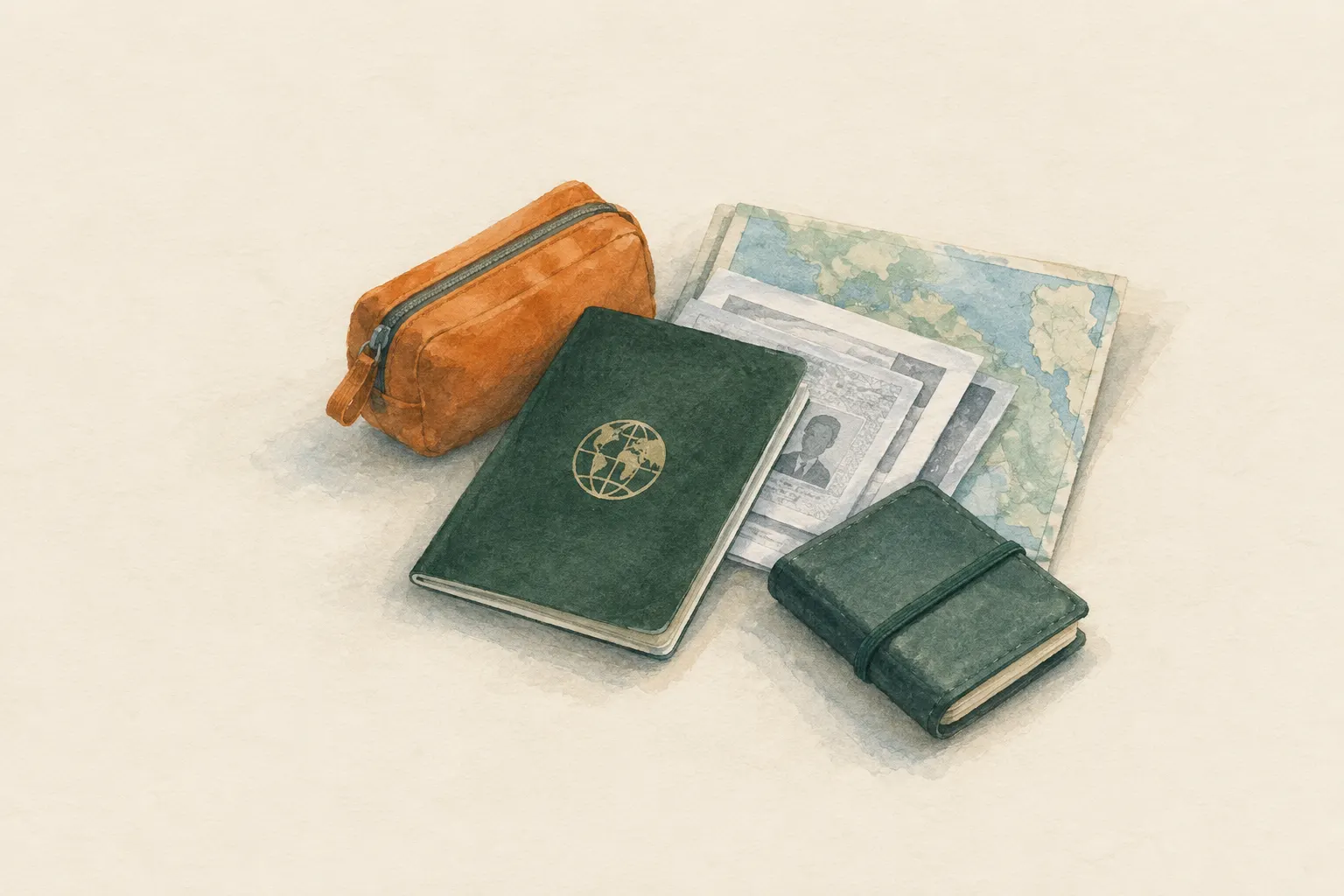
Explained simply
Your passport is like a key to a border. Without it you cannot get in – and sometimes not out again either. And just like a key, it can be lost, stolen or simply “expired” – then it no longer fits the lock.
That is why you check before the trip that the passport is valid for long enough and what the destination country requires. Then you make copies: one on paper in your suitcase, one with a person at home, one well protected on your phone or in secure online storage. A copy is like a photo of your key: you cannot open a door with it, but you can prove what it looked like and get a new one faster.
The most important point: never keep the original and the copies in the same place. If one bag is gone, everything should not be gone at once.
How it works
A travel document is a “single point of failure” – one single part on which everything depends. You can carry the best gear in the world: if the passport is missing, you stay stuck at the counter. The answer is redundancy, meaning protection in several layers. You carry the original on your body, a paper copy is kept somewhere else, an encrypted digital copy can be reached even without your own phone, and important numbers are written on a paper card.
These layers do not replace each other; they catch each other. If your daypack with passport and phone is stolen, you still have the paper copy in the suitcase and the emergency card in your trouser pocket. If the suitcase is lost, you still carry the original and the card. A single loss should annoy you, not paralyse you.
It matters what copies can and cannot do. At borders, copies are generally not accepted as a substitute. But they help with the police report, at the embassy or consulate and when blocking cards, because you have numbers, dates of issue and names to hand immediately.
What really matters
The most common mistake happens long before the trip: validity is checked too late. Some countries require the passport to be valid for a certain time beyond the end of the trip; others need a visa or particular certificates. These rules change and depend on your nationality. So always read them in their current form from the destination country or your own foreign ministry – not in old travel reports or forums.
Allow enough time. A new passport or a visa can take weeks. Children often have extra rules, for example a consent letter when a child travels with only one parent. Also check your driving licence, insurance documents and bookings, because they belong in your copy collection too.
Your emergency card should hold: the destination's emergency number, address and phone of the nearest embassy or consulate, your insurer's emergency line, the blocking numbers for your cards and a contact person at home. On paper, because otherwise a flat battery or a stolen phone takes everything at once. A spare passport photo makes applying for replacement papers easier later.
Safety: what to watch out for
Digital copies are handy, but also a risk. A scan of your passport in an unprotected folder or on a phone without a lock is valuable to fraudsters: it makes identity theft easier. So store scans only encrypted or in protected storage with a good password, and do not put them in publicly shared cloud folders.
Carry the originals close to your body, for example in an inside pocket, and not together with all your cash and all your cards in one place. Check regularly on the way that everything is there – especially after border crossings, hotel changes or rides on crowded transport. If you know when you last saw your passport, you can search more purposefully later.
If something does disappear: report the loss or theft to the local police and keep the confirmation, have cards blocked and contact the responsible embassy or consulate. The entry on lost passports describes how that works in detail.
How to practise it
Turn it into a fixed routine of about an hour before every trip abroad. Put all documents on the table, check the expiry dates, copy the passport data page and everything else important, and write the emergency card. Then distribute the copies: one in the suitcase, one with the trusted person at home, one protected and digital.
Do a small test: can you open your digital copy from someone else's device, without your own phone? Does your contact person at home know where the copy is? If you travel as a family or group, one person can keep a list of everyone's passport numbers and emergency contacts. Even so, each person carries their own emergency card.
After every trip and with every new document, update the copies. Destroy old copies of expired passports securely so that outdated data does not lie around.
Step by step
Check validity
Check the expiry dates of passport, ID card, driving licence and any visas. Some countries require validity beyond the end of the trip – check current information from the destination country or your own foreign ministry.
- 1
Check validity
Check the expiry dates of passport, ID card, driving licence and any visas. Some countries require validity beyond the end of the trip – check current information from the destination country or your own foreign ministry.
- 2
Clarify entry requirements
Clarify visa requirements, transit rules, health certificates and rules for children (e.g. consent letters when travelling with one parent) early. Processing times can be long.
- 3
Make copies
Copy the passport data page, visas, driving licence, insurance documents, booking confirmations and card-blocking numbers. Keep one paper copy in your luggage separate from the originals and leave one with a trusted person at home.
- 4
Protected digital copy
Store scans encrypted so they can be retrieved even without your own phone. A spare passport photo makes applying for replacement papers easier.
- 5
Emergency numbers on paper
Write the destination's emergency number, the nearest embassy or consulate, the insurance emergency line, card-blocking numbers and a contact at home on a card and carry it on your person.
- 6
Carry originals securely
Carry originals close to the body and not together with all cash and cards in one place. Check regularly on the way that everything is complete.
- 7
In case of loss
Report loss or theft to the local police and keep the confirmation, have cards blocked and contact the responsible embassy or consulate about replacement papers. The copies speed this up.
Common mistakes
- Checking passport validity only at the airport
- Copies in the same pocket as the originals
- All emergency numbers only in the phone
- Unencrypted scans in public cloud folders
- Forgetting documents for children
Quick view
Materials
Copies of travel documents
Keep separate from the originals; store digital copies only in protected form.
Document folder (waterproof)
Waterproof sleeve for originals and copies
Store securely – contains sensitive personal data.
Cash reserve
Small reserve, kept apart from the wallet
Store securely and discreetly.
Suitable for
- Any trip abroad
- Trips to remote regions with few diplomatic missions
- Families with children who need their own documents
Not suitable for
- A substitute for valid original documents – copies are generally not accepted at borders
Prerequisites
- Access to a copier or scanner
- Knowing the destination and route
Safety
- Entry requirements (minimum passport validity, visa, certificates) change and differ by nationality. Use only current information from the destination country or your own foreign ministry, not old travel reports.
- Store digital copies only encrypted or in protected storage. Unencrypted scans on a lost phone make identity theft easier.
How it works
Documents are a single point of failure: without them, no amount of gear helps. Redundancy – originals on your person, paper copies in another place, a protected digital copy and emergency numbers on paper – ensures that a single loss does not block everything. Copies do not replace the original but speed up reporting the loss and obtaining replacement papers.
Advantages
- Hardly any cost
- Speeds up replacement papers and blocking cards
- Also helps with illness or accidents abroad
Disadvantages
- Copies have to be updated with every new document
- Digital copies require careful data protection
Deep knowledge
Background
Foreign ministries of many countries publish travel and safety advice with current entry requirements and recommend keeping document copies separately. In case of loss, embassies and consulates usually issue replacement or emergency travel documents; which proof is required varies.
The household document folder (see “Securing important documents and copies”) and travel documents complement each other: the complete set stays at home, on the road only what is needed plus copies.
Variants
- Group and family trips
- One person keeps a list of passport numbers, emergency contacts and insurance details for all travellers; each person still carries their own emergency card.
Common mistakes
- Checking passport validity only at the airport
- Copies in the same pocket as the originals
- All emergency numbers only in the phone
- Unencrypted scans in public cloud folders
- Forgetting documents for children
Limits and risks
- No information on specific countries' entry requirements – these change
- No legal advice on visas or residence rights
Material alternatives
Derived from material properties: a substitute must have all relevant properties. Observe the notes on the substitute.
- Document folder (waterproof)
- Tarp, Plastic sheet / large bin bag (Tears easily; never pull over the head (suffocation risk).), Emergency blanket (Tears easily once punctured; short-term shelter only.), Rain poncho (When used as a shelter, it no longer protects your body from rain.), Bivy bag (Never fully close off the face.), Tent (Do not cook or heat inside the tent (fire and carbon monoxide danger).), Heavy-duty bin bag (large) (Suffocation risk: never pull plastic bags over the head or face and keep them away from small children.), Group shelter bag (Airtight – ventilate regularly.)
Results come exclusively from structured entries. No improvised instructions are generated.
Sources
Auswärtiges Amt, Deutschland: Krisenvorsorgeliste ELEFAND (Elektronische Erfassung von Deutschen im Ausland)
Example of a foreign ministry offering travel advice and crisis preparedness for travellers
U.S. Department of State – Bureau of Consular Affairs: Smart Traveler Enrollment Program (STEP)
Example of a foreign ministry offering travel information and registration