Skip to content
In an emergencyAustriaEmergency numbers →
SurviveBetter
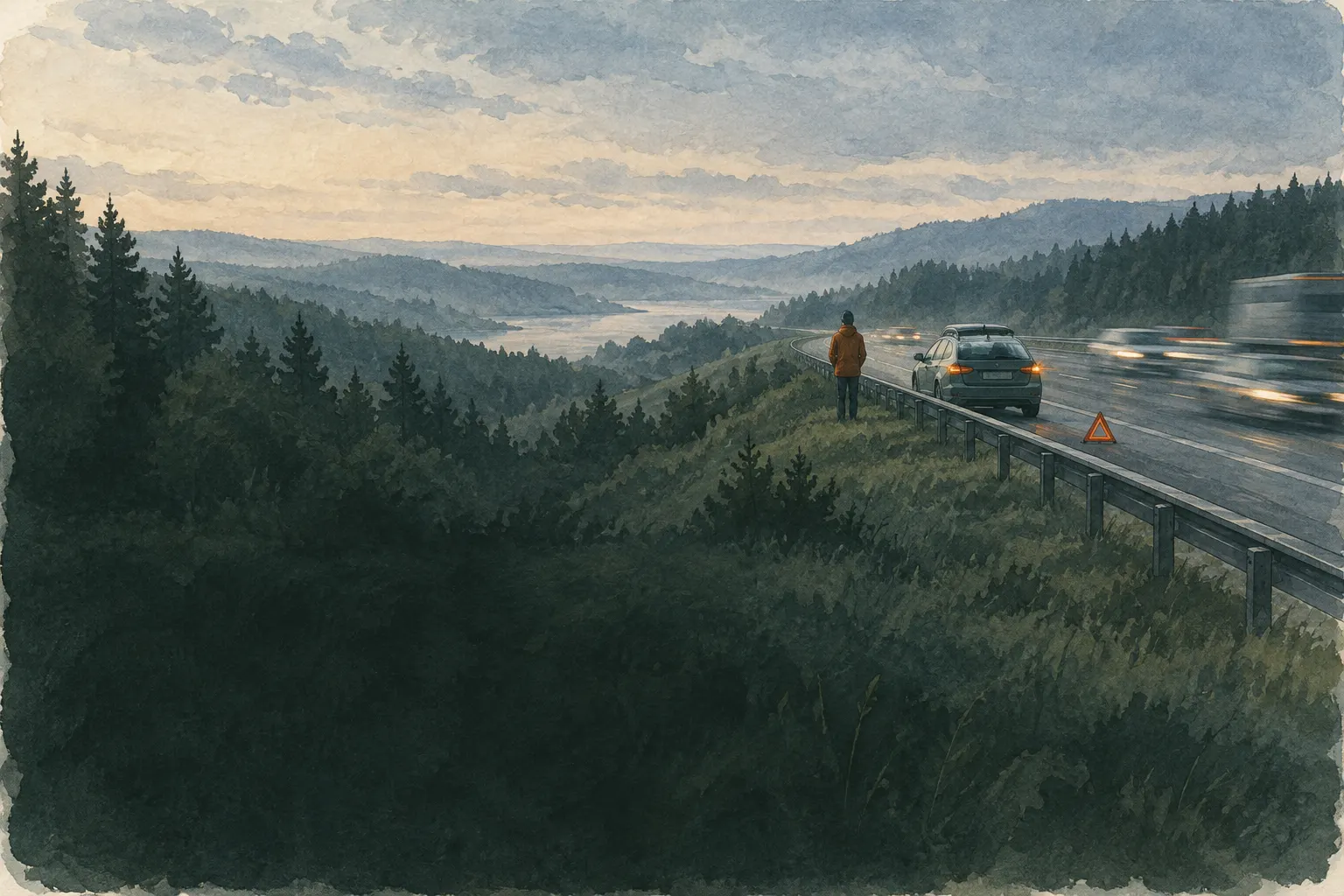
Broken-down car on the hard shoulder, driver waiting behind the barrier

I have broken down on the motorway

Your car loses power or stops on the motorway – beside you, traffic is rushing past at high speed.

First

  1. Switch on the hazard lights and coast as far as possible onto the hard shoulder or an emergency bay.
  2. Put on the hi-vis vest while still in the car, get out on the side away from traffic and go behind the crash barrier.
  3. Secure the scene only according to local rules and only if it is safe to do so.
  4. Use breakdown assistance or the emergency phone; after an accident, with injuries or a vehicle in a live lane, call the local emergency number (112 in the EU).

Call emergency services if

  • Accident or injuries
  • Vehicle is stopped in a live lane
  • Smoke or fire from the vehicle
  • Cold or heat endangers passengers

What is happening

A warning light, a strange noise, the engine cuts out: on the motorway you often have only seconds to decide where the car will come to a stop. With the remaining momentum you can usually still reach the hard shoulder, an emergency bay or the next exit – if you react straight away.

The real danger is not the breakdown but the passing traffic. A stationary vehicle is hard to recognise from behind, especially at night, in rain, fog or low sun. People standing beside or behind their car, making phone calls or working on the engine are particularly at risk. Even the hard shoulder is not a safe place.

A typical mistake is to stay in the car although you could safely get behind the crash barrier – or, the other way round, to run across the carriageway. Many people also try to fix the breakdown themselves and underestimate how close the traffic is.

What matters: stop the vehicle as far away from the traffic as possible, put on the hi-vis vest while still in the car, get out on the side away from traffic, go behind the crash barrier and call for help from there. Whether and how a warning triangle is set up is regulated differently in each country – it is worth knowing beforehand.

Step by step

  1. Phase 1

    In the first seconds

    • Switch on the hazard lights as soon as you notice something is wrong.
    • Use the remaining momentum to coast onto the hard shoulder, into an emergency bay or – if still possible – to the next exit.
    • Stop as far away from traffic as possible; keep the lights on if it is dark.
    • If the car stops in a live lane: keep your seatbelt on, hazard lights on and call the local emergency number (112 in the EU) at once.
  2. Phase 2

    In the first minutes

    • Put on the hi-vis vest while still in the car; everyone else too, if available.
    • Get out on the side away from traffic – children first, holding hands; animals on a lead.
    • Go behind the crash barrier or up the verge, at a distance from the vehicle, and stay there.
    • Only set up a warning triangle if local rules require it and it can be done safely – walk behind the crash barrier where possible.
    • Call breakdown assistance or use the emergency phone; describe your location using kilometre markers, exits or direction of travel.
  3. Phase 3

    While waiting

    • Stay behind the crash barrier and do not work on the vehicle – not even a quick wheel change.
    • Do not make calls or walk around on the hard shoulder.
    • In cold or rain take warm clothing out of the car beforehand; only go back into the car if it would be more dangerous outside, and then wear your seatbelt.
    • In heat find shade and water; never leave children or animals in a hot car.
    • After an accident, with injuries, smoke or fire call the local emergency number at once.
  4. Phase 4

    When help arrives

    • Follow the instructions of breakdown service, police or tow truck.
    • When rejoining, use the hard shoulder to build up speed and only merge when there is a safe gap.
    • If the car is towed, clarify how you and your passengers will get on safely.

What to watch out for

  • Rear-end crashes on the hard shoulder

    Drivers sometimes steer towards tail lights and crash into stationary vehicles. That is why the space beside or behind the car is dangerous – behind the crash barrier you are better protected.

  • Roads without a hard shoulder

    On some stretches, in roadworks or where the hard shoulder is open to traffic there is nowhere to stop. Try to reach the next emergency area or exit; if that fails, stay in the car with your seatbelt on and call the emergency number at once.

  • Tunnels

    In a tunnel drive out if you can, or into a lay-by; engine off, hazard lights on. If there is smoke or fire, walk to the nearest marked emergency exit – away from the smoke.

  • Darkness and poor visibility

    At night, in fog or rain you are hardly visible without a hi-vis vest. Dark clothing and a person standing beside the car are a dangerous combination.

  • Emergency phones and eCall

    Emergency roadside phones usually transmit the location automatically; in some countries arrows on the roadside posts show the way to the nearest phone. Many newer cars in the EU have an SOS button (eCall) that connects to the emergency service.

Common mistakes

  • Getting out on the traffic side.
  • Standing beside or behind the car instead of going behind the crash barrier.
  • Trying to fix the breakdown yourself, e.g. changing a tyre on the hard shoulder.
  • Running across the carriageway to fetch help or pick up objects.
  • Keeping the hi-vis vest in the boot, so you can only reach it once you are outside.
  • Not knowing your location and being unable to describe it on the emergency call.

Prepare in advance

  • Keep hi-vis vests for all passengers within reach inside the cabin.
  • Look up the rules on hi-vis vests, warning triangles and emergency corridors in the country you travel to.
  • Save the number of your breakdown service or insurer in your phone.
  • While driving, note kilometre markers, exits and direction of travel so you can give your location.
  • Have the vehicle serviced regularly and check tyres, fluids and fuel before long journeys.
  • Keep water, a warm jacket and a torch in the car.

Special consideration

Children
Let children out on the side away from traffic, hold their hands and supervise them behind the crash barrier. Explain briefly and calmly why you are waiting there.
Pets
Never let animals run free – a frightened animal can bolt onto the carriageway. Use a lead or a carrier.
Limited mobility
Anyone who cannot safely get over the crash barrier stays in the car with the seatbelt on and says so on the emergency call so that help can respond accordingly.

Sources

Your situation

Where is the car?
Conditions
Passengers

Matching entries

0 rules apply

No AI decides here. Every recommendation is based on a visible rule.

Add details about your situation above to get more specific guidance.

Basics for this situation

Why: Always applies to this situation – regardless of your answers.

All rules of this situation (5)
  1. [not active] If Where is the car? = In a live lane

    If you can safely get out and reach the barrier: do so. Otherwise stay in the car with seatbelt on and hazard lights, and call the emergency number at once.

  2. [not active] If Where is the car? = Hard shoulder or emergency bay

    Wait behind the barrier, a little ahead of the car in the direction of travel; do not work on the vehicle. Give your location via distance markers or exits.

  3. [not active] If Conditions = Night or poor visibility

    In darkness and poor visibility the hi-vis vest is especially important. Do not stand on the carriageway.

  4. [not active] If Conditions = Cold, snow

    Put on warm clothing before getting out. Only go back into the car when it is safe – then keep the exhaust clear.

  5. [not active] If Passengers = Children or pets

    Let children out on the side away from traffic, holding hands; keep pets on a lead or in a carrier.