Breakdown on the motorway: stopping and getting out safely
On fast roads the biggest risk is not the breakdown itself but passing traffic. Stop as far to the side as possible (on the hard-shoulder side), switch on hazard lights, put on a hi-vis vest while still in the car, get out on the side away from traffic and wait behind the crash barrier. Warning triangle and details according to local rules.
- Minutes
Explained simply
If your car suddenly stops on the motorway, the most dangerous thing is not the broken car but the other cars rushing past. A driver coming at high speed often sees a stopped car late. So a breakdown is mainly about two things: being seen and keeping your distance from traffic.
This is how it goes: hazard lights on, roll as far as possible onto the hard shoulder, put on the hi-vis vest while still in the car. Then everyone gets out on the side facing away from the traffic and goes behind the crash barrier – the metal rail next to the road. You wait there and call the breakdown service.
The most important point: nobody stands on the carriageway or between the car and the traffic, and nobody repairs anything on the traffic side – not even a tyre. If someone is injured or the car is stopped in a dangerous place, call the local emergency number (112 in the EU).
How it works
On fast roads, vehicles cover a long distance every second. A driver needs time to notice an obstacle, react and brake, and during that time keeps moving. A car stopped at the roadside is often recognised as stationary only late, especially at night, in rain or after a bend. Vehicles also sometimes drift onto the hard shoulder, for example when a driver is tired or distracted.
This leads to the two most effective protective measures. Visibility: hazard lights and a hi-vis vest make sure others recognise you earlier. Distance: behind the crash barrier or on the verge you are separated from traffic. The car itself is not a safe place in this situation, because it can be hit.
That is why you should not stay sitting in the car if you can get out safely. Anyone standing behind the barrier slightly back from the vehicle – that is, against the direction of travel – is out of reach even if the car is hit and pushed forward.
What really matters
As soon as you notice something is wrong, switch on the hazard lights and roll as far as possible onto the hard shoulder or into an emergency bay. If the car is still moving, the next exit or emergency area is better than the narrow hard shoulder. Turn the wheels away from traffic.
Put on the hi-vis vest before you get out – that is why it belongs inside the cabin and not in the boot. Everyone gets out on the side away from traffic. Hold children by the hand. Animals stay in the vehicle if they cannot be held safely outside; follow local guidance on this.
Call for help via the breakdown service or an emergency roadside telephone. Describe your location with distance markers at the roadside, the last junction or your phone's location. Never walk back along the carriageway, always behind the barrier.
Safety: what to watch out for
Do not repair anything next to moving traffic, not even a tyre change on the traffic side. That is what the breakdown service is for; it comes with protection and equipment. A flat tyre is annoying, but no reason to kneel next to vehicles travelling at high speed.
Rules on warning triangles differ: some countries require them, others discourage them on motorways because placing one is dangerous in itself. Check local rules and only place one if it is required or recommended and you can do it safely – and walk behind the barrier while doing so.
If there is no hard shoulder and you cannot get out safely, stay belted in the car, keep the hazard lights on and call the emergency number immediately. With injuries, after a collision or if the car is stopped in a dangerous place, the local emergency number (112 in the EU) is the right choice.
Good to know
Traffic rules such as the UK Highway Code contain dedicated sections on motorway breakdowns. The principles are similar everywhere: hazard lights, getting out on the side away from traffic, keeping away from the vehicle and calling for help. Mandatory equipment and the rules for warning triangles, on the other hand, are different in each country – check them before driving abroad.
It is best to run through the sequence once in your head with everyone in the car before a long drive begins: where are the vests? Which side do we get out on? Who takes the children? This page gives no binding legal information and no instructions for breakdown repairs.
Step by step
Hazard lights and coast
Switch on hazard lights and roll as far as possible onto the hard shoulder or an emergency bay; turn the wheels away from traffic.
- 1
Hazard lights and coast
Switch on hazard lights and roll as far as possible onto the hard shoulder or an emergency bay; turn the wheels away from traffic.
- 2
Put on the vest in the car
Put on the hi-vis vest before getting out.
- 3
Get out on the safe side
Everyone gets out on the side away from traffic. Hold children's hands; leave animals in the vehicle if they cannot be safely held outside (follow local guidance).
- 4
Behind the barrier
Go behind the crash barrier or onto the verge, at a distance from the vehicle, slightly back against the direction of travel.
- 5
Secure according to local rules
Place the warning triangle only if required or recommended and safe to do; walk behind the barrier while doing so.
- 6
Call for help
Use the breakdown service or emergency roadside telephone; give your location via distance markers, junctions or phone location.
Common mistakes
- Staying in the car when you can get out safely
- Getting out on the driver's side towards traffic
- Hi-vis vest in the boot/trunk
- Changing a tyre on the traffic side yourself
- Walking back along the carriageway
Quick view
Materials
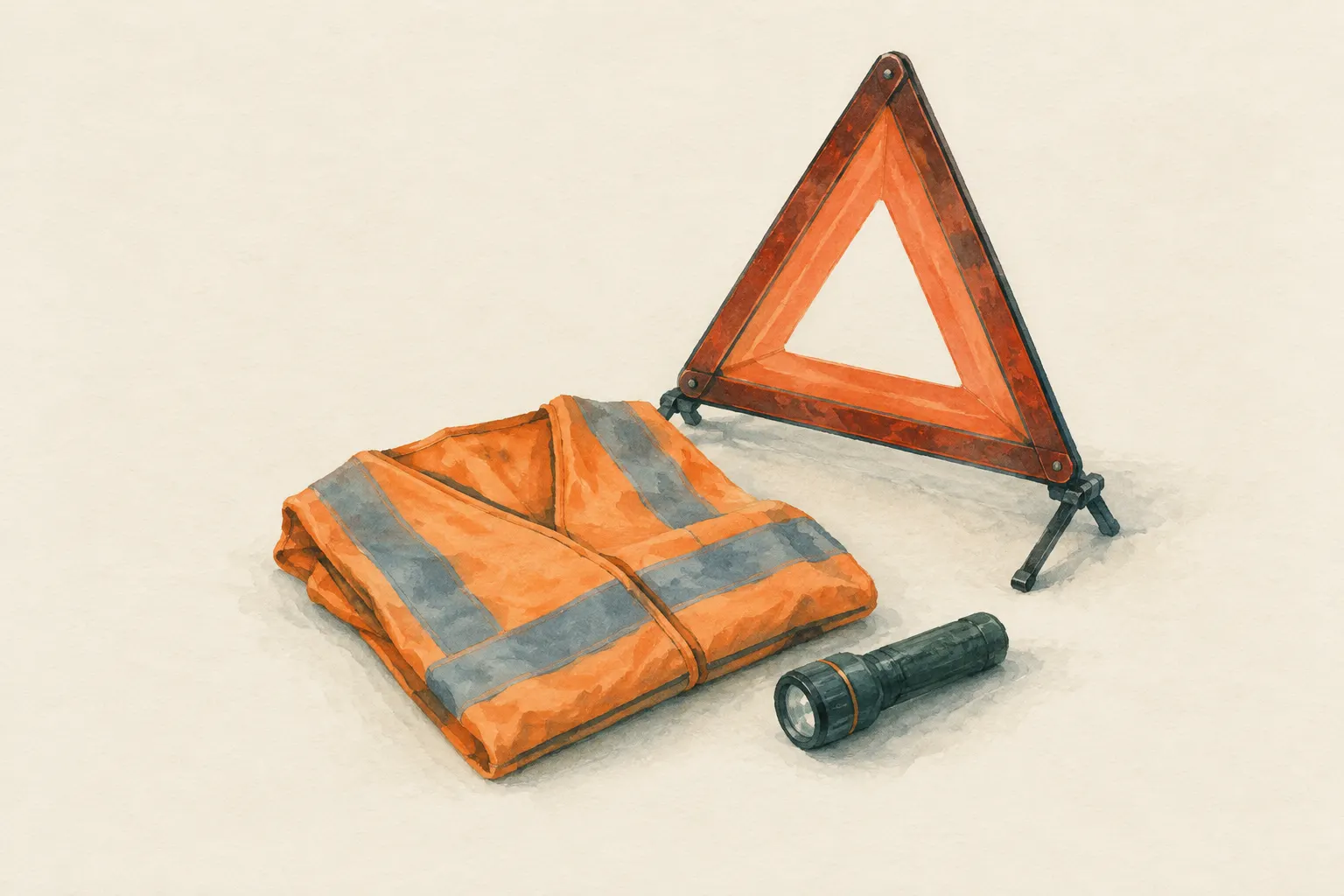
High-visibility vest
Keep within reach inside the cabin, not in the boot/trunk.
Warning triangle
Whether warning triangles are mandatory, or should be placed at all on certain roads (e.g. motorways), differs between countries – check local rules.
Mobile phone
The battery drains quickly in cold and with continuous screen and GPS use.
Do not plan on it as your only means of navigation or emergency calls.
Vehicle emergency kit
Which equipment (e.g. warning triangle, high-visibility vest, first-aid kit) is mandatory differs between countries – check local rules.
Suitable for
- Breakdowns, flat tyres, running out of fuel on motorways and expressways
Not suitable for
- Repairs next to moving traffic
Prerequisites
- Hi-vis vests within reach in the cabin
- Breakdown service number saved
Safety
- Whether and where a warning triangle should be placed is regulated differently; in some countries it is discouraged on motorways. Check local rules and only place it if it can be done safely.
How it works
The danger comes from fast vehicles whose drivers notice a stopped car late. Visibility (hazard lights, vest) and distance from traffic (verge, behind the barrier) are the most effective protective measures.
Advantages
- A few clear actions
Disadvantages
- Rules differ between countries
Deep knowledge
Background
Traffic rules such as the UK Highway Code contain dedicated sections on breakdowns on motorways: hazard lights, getting out on the side away from traffic, keeping away from the vehicle and calling for help.
Mandatory equipment and placing warning triangles are regulated differently in each country – check local rules before travelling abroad.
Variants
- Without a hard shoulder
- If possible continue to the next emergency area or exit. If that is impossible and getting out safely is not feasible: stay belted in, hazard lights on and call the emergency number immediately.
Common mistakes
- Staying in the car when you can get out safely
- Getting out on the driver's side towards traffic
- Hi-vis vest in the boot/trunk
- Changing a tyre on the traffic side yourself
- Walking back along the carriageway
Limits and risks
- No binding legal information
- No breakdown repair
Material alternatives
Derived from material properties: a substitute must have all relevant properties. Observe the notes on the substitute.
- High-visibility vest
- Emergency blanket (Tears easily once punctured; short-term shelter only.), Signal mirror (Do not flash into the eyes of people nearby or of drivers.), Warning triangle (Whether warning triangles are mandatory, or should be placed at all on certain roads (e.g. motorways), differs between countries – check local rules.), Aluminium foil (heavy-duty) (Edges can be sharp; conducts heat and electricity.)
- Warning triangle
- Emergency blanket (Tears easily once punctured; short-term shelter only.), Signal mirror (Do not flash into the eyes of people nearby or of drivers.), High-visibility vest (Keep within reach inside the cabin, not in the boot/trunk.), Aluminium foil (heavy-duty) (Edges can be sharp; conducts heat and electricity.)
- Mobile phone
- Headlamp / flashlight, Battery lantern / LED light
Results come exclusively from structured entries. No improvised instructions are generated.
Sources
Department for Transport and Driver and Vehicle Standards Agency (United Kingdom): The Highway Code
Breakdowns on motorways (example of national rules)
European Commission: 112 – the European emergency number
European emergency number 112