Car emergency kit and winter driving basics
A breakdown, a traffic jam in a snowstorm or a closed road can cost hours. A small basic kit in the vehicle – warning equipment, light, warm clothing, water, food, a charger – and a vehicle prepared for winter make such situations much safer.
- About 1 hour to assemble; check before every winter
Explained simply
A car is like a little house on wheels: it has a roof, walls and heating. But when the engine is off, it gets cold inside quickly, and the lights and battery do not last for ever. That is why you pack a small emergency box in the car, just as you keep supplies in a cupboard at home.
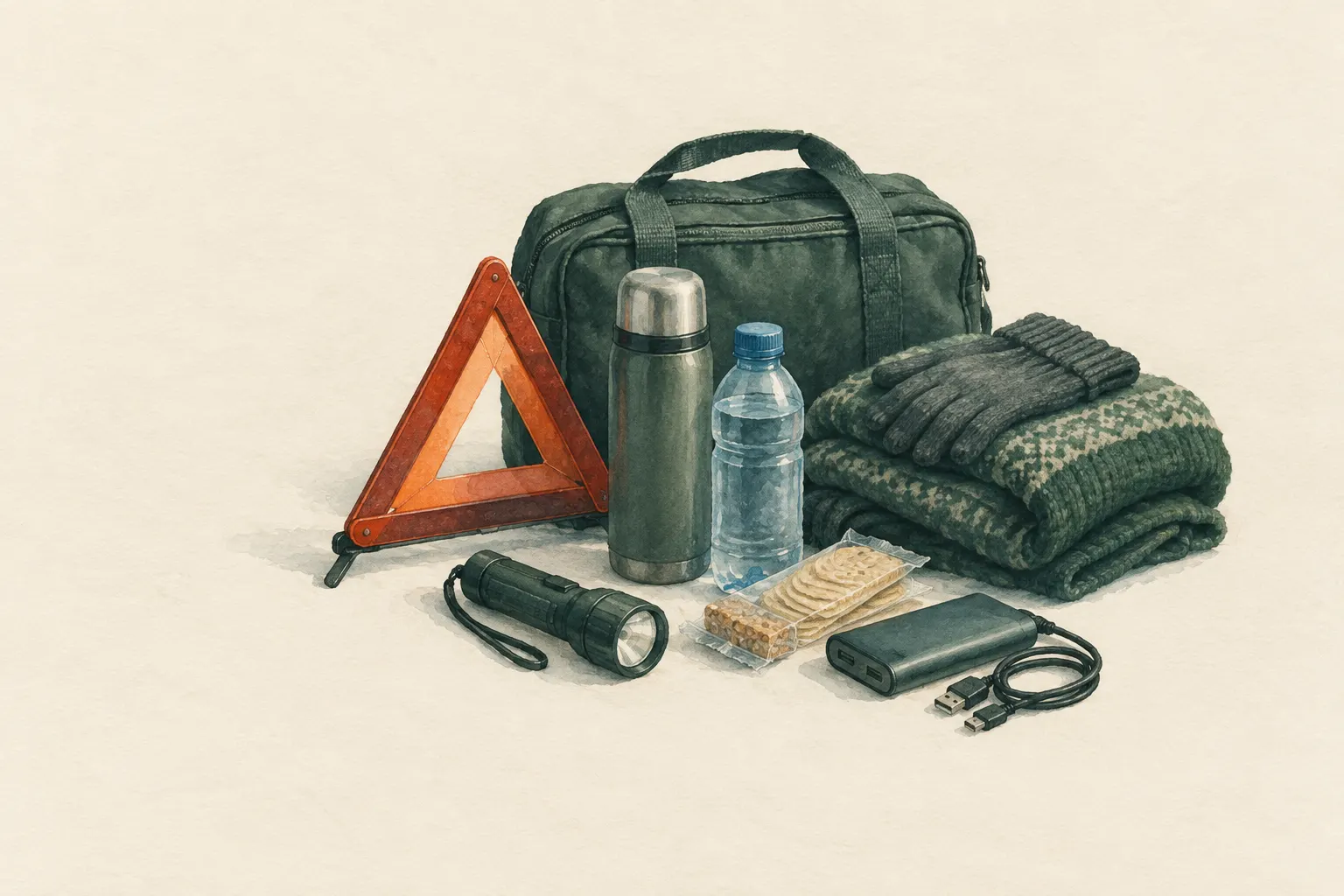
The box holds things for three jobs: being seen (hi-vis vest, warning triangle, lamp), staying warm and supplied (blanket, hat, gloves, water, something to eat) and keeping in contact (charging cable, power bank, important numbers on paper). In winter you add an ice scraper, a brush and a small shovel.
The most important point: the hi-vis vest belongs inside the cabin, not in the boot under the luggage. And when a severe weather warning comes, the safest journey is often the one you do not make.
How it works
A vehicle protects well from wind, rain and snow. But its warmth comes almost entirely from the running engine. When the engine stops, the thin shell of metal and glass loses heat to the outside quickly. From then on it depends on what you have with you: clothing and blankets hold your body heat, just as a down jacket keeps the air around you warm.
Cold also weakens the technology. Car batteries deliver less power in frost, and phone batteries drain faster in the cold. That is why a charged power bank, a charging cable and a lamp with spare batteries belong in the kit. A headlamp is especially practical because it leaves both hands free.
So the kit is not a random collection but follows a simple logic: being seen, staying warm and supplied, keeping in contact. If you assign each item to one of these three jobs while packing, you quickly notice what is missing.
Gear and materials
Basic kit for every journey: hi-vis vest (ideally one per person), warning triangle, first-aid kit, headlamp with spare batteries, a blanket or a sleeping bag in winter, hat, gloves and a warm layer, water, non-perishable food, charging cable and power bank, and a list with the numbers of breakdown service and emergency services. Which of these is legally required is decided by each country – check the rules for your own country and for every country you drive through.
For winter you add: ice scraper and brush, a compact shovel, jump leads, antifreeze in the screen wash and snow chains where appropriate. Practise fitting chains calmly at home first, because fitting them for the first time in a snowstorm with cold fingers hardly ever works.
For remote routes with little traffic and no mobile coverage, take more water and food, plus a paper map. Find out beforehand how far apart the fuel stations are.
What really matters
The best emergency kit is the one you never need. A vehicle in good condition breaks down less often: before winter, check the tyres for condition and suitability for wintry roads, and have the battery, lights and wipers checked. In winter areas, do not drive with a nearly empty tank, because a traffic jam can last for hours.
Before departure, check weather warnings and road conditions and tell someone which route you are taking and when you expect to arrive. Clear windows, lights and roof completely of snow and ice. A small peephole in the windscreen is not enough, and snow from the roof can slide onto the windscreen when you brake or hit the car behind you.
On snow and ice: drive much more slowly, keep a much bigger distance, and steer, brake and accelerate gently. Bridges and shaded sections can be icy even though the rest of the road looks clear. Bridges cool from above and below, so they often freeze earlier.
Safety: what to watch out for
On fast roads, the greatest risk is not the breakdown itself but the passing traffic. That is why you put on the hi-vis vest while still in the car, switch on the hazard lights, leave the vehicle if possible on the side away from traffic and wait behind the crash barrier or away from the carriageway. You secure the scene as local rules require. The entry on motorway breakdowns covers this in more detail.
The kit does not replace a cautious decision or driver training. With warnings of heavy snow, freezing rain or storm, staying at home is often the wisest choice. If you have to drive anyway, go with a full tank, warm clothing inside the cabin and a person who knows your route and arrival time.
How to look after the kit
Check the box twice a year, for example when you change tyres. Do the lamp and batteries work? Is the power bank charged? Are the water and food still within their shelf life? Is the first-aid kit complete and not expired?
Pack things so that you can find them in the dark and with gloves on. The hi-vis vest and lamp belong within reach in the door pocket or under the seat, the blanket and warm clothing inside the cabin or on top in the boot. Many motoring clubs and authorities publish similar packing lists – comparing them is worthwhile, but the basic idea always stays the same.
Step by step
Check mandatory equipment
Check the mandatory equipment for your own country and all transit countries and stow it within reach – the high-visibility vest inside the cabin.
- 1
Check mandatory equipment
Check the mandatory equipment for your own country and all transit countries and stow it within reach – the high-visibility vest inside the cabin.
- 2
Pack the basic kit
Headlamp with spare batteries, blanket or sleeping bag, warm clothing, water, non-perishable food, charging cable and power bank, first-aid kit, gloves, a list of breakdown-service and emergency numbers.
- 3
Add for winter
Ice scraper and brush, compact shovel, snow chains where appropriate (practise fitting them beforehand), jump leads, antifreeze in the screen wash.
- 4
Prepare the vehicle
Check tyres for condition and suitability for winter conditions, have the battery, lights and wipers checked. On trips in winter regions do not run the tank nearly empty.
- 5
Before departure
Check weather warnings and road conditions, tell someone your route and expected arrival, clear windows, lights and roof completely of snow and ice.
- 6
Drive to conditions
On snow and ice reduce speed considerably, increase following distance greatly, steer, brake and accelerate gently. Bridges and shaded sections can be icy when the rest of the road looks clear.
- 7
Check regularly
Check the kit twice a year: batteries, shelf life of water and food, first-aid kit, completeness.
Common mistakes
- High-visibility vest in the boot under the luggage
- Fitting snow chains for the first time in a snowstorm
- Scraping only a peephole in the windscreen
- Driving into winter areas with a nearly empty tank
- No warm clothing because the car is heated
Quick view
Materials
Vehicle emergency kit
Which equipment (e.g. warning triangle, high-visibility vest, first-aid kit) is mandatory differs between countries – check local rules.
High-visibility vest
One per person is sensible
Keep within reach inside the cabin, not in the boot/trunk.
Headlamp / flashlight
Wool blanket / duvet
Or a sleeping bag in winter
Keep away from candles, stoves and heaters.
Dry spare clothing
Hat, gloves, warm layer
Carry it in waterproof packaging – wet clothing barely insulates.
Power bank
Do not use damaged or swollen batteries; do not charge while covered.
Non-perishable food
Prefer food that can be eaten without cooking; consider allergies and dietary needs; do not forget a can opener.
Snow shovel
Compact shovel for winter trips
Always take it inside when digging a snow shelter.
Suitable for
- All car journeys, especially long distances
- Trips in winter regions and remote areas
- Commuting during severe weather
Not suitable for
- A substitute for deciding not to drive at all during a severe weather warning
- A substitute for driver training on snow and ice
Prerequisites
- Vehicle in good technical condition
- Knowing which equipment is mandatory in the country you drive in
Safety
- During severe weather warnings for snow, freezing rain or storm, the safest journey is often the one not taken. Check warnings and road condition reports before departure.
- Mandatory equipment (warning triangle, high-visibility vest, first-aid kit, winter tyres, snow chains) and the related rules differ between countries and sometimes regions – check local rules.
How it works
A vehicle is good weather protection, but without the engine running it cools quickly, and batteries, fuel and patience are limited. The kit should secure three things: being seen (warning equipment, light), staying warm and supplied (clothing, blanket, water, food) and keeping in contact (phone, charger). Preparing the vehicle for winter reduces the chance of getting stuck at all.
Advantages
- Low cost
- Helps in breakdowns, traffic jams and severe weather
- Takes little space
Disadvantages
- Needs regular maintenance
- Does not replace a cautious decision about driving
Deep knowledge
Background
Ready.gov recommends keeping an emergency kit in the car before winter and preparing the vehicle for winter conditions. Many motoring clubs and authorities publish similar packing lists.
Which equipment is legally required and when winter tyres or chains apply is regulated by each country. When driving through several countries, it is worth checking each set of rules.
Variants
- Remote regions
- For routes with little traffic and no mobile coverage, add more water and food, a paper map and information about distances between fuel stations.
Common mistakes
- High-visibility vest in the boot under the luggage
- Fitting snow chains for the first time in a snowstorm
- Scraping only a peephole in the windscreen
- Driving into winter areas with a nearly empty tank
- No warm clothing because the car is heated
Limits and risks
- No legal information on mandatory equipment or winter tyres
- No driver training
Material alternatives
Derived from material properties: a substitute must have all relevant properties. Observe the notes on the substitute.
- High-visibility vest
- Emergency blanket (Tears easily once punctured; short-term shelter only.), Signal mirror (Do not flash into the eyes of people nearby or of drivers.), Warning triangle (Whether warning triangles are mandatory, or should be placed at all on certain roads (e.g. motorways), differs between countries – check local rules.), Aluminium foil (heavy-duty) (Edges can be sharp; conducts heat and electricity.)
- Headlamp / flashlight
- Mobile phone (The battery drains quickly in cold and with continuous screen and GPS use.), Battery lantern / LED light
- Wool blanket / duvet
- Sleeping pad, Dry leaves, grass or conifer boughs (Collect only where allowed; no protected plants. Check for ticks and insects.), Backpack, Dry spare clothing (Carry it in waterproof packaging – wet clothing barely insulates.), Insulated cool box (Keeps cold only for a limited time; without ice packs or ice it is not a fridge.), Sleeping bag (Do not store compressed long-term; do not pack away damp.), Newspaper and cardboard (Flammable – keep away from candles, stoves, heaters and embers.), Insulated cooking box (hay box, thermal cooker) (Never put open flame or embers inside – only the hot, closed pot.)
- Dry spare clothing
- Sleeping pad, Dry leaves, grass or conifer boughs (Collect only where allowed; no protected plants. Check for ticks and insects.), Backpack, Wool blanket / duvet (Keep away from candles, stoves and heaters.), Insulated cool box (Keeps cold only for a limited time; without ice packs or ice it is not a fridge.), Sleeping bag (Do not store compressed long-term; do not pack away damp.), Newspaper and cardboard (Flammable – keep away from candles, stoves, heaters and embers.), Insulated cooking box (hay box, thermal cooker) (Never put open flame or embers inside – only the hot, closed pot.)
Results come exclusively from structured entries. No improvised instructions are generated.
Sources
Ready.gov – U.S. Federal Emergency Management Agency (FEMA): Winter Weather
Car emergency kit and preparing the vehicle for winter
Bundesamt für Bevölkerungsschutz und Katastrophenhilfe (BBK), Deutschland: Ratgeber für Notfallvorsorge und richtiges Handeln in Notsituationen
General emergency preparedness and supplies