Evacuating by road: route, fuel, hazards on the way
In an evacuation many people travel at once, roads may be closed, flooded or congested, and fuel stations fail. Leaving early, using the routes named by the authorities, having a full tank and never driving through flooded roads gets you there more safely.
- About 1 hour of preparation; the journey depends on the situation
Explained simply
Sometimes the authorities say: “Everyone must leave this area” – for example because a flood, a wildfire or a big storm is coming. That is called an evacuation. Then a great many people set off at the same time, like everyone pushing towards the exit at once after a football match. Roads fill up, some are closed, and fuel stations may be empty or shut.
That is why it helps to plan ahead: know two routes to a safe destination, keep the tank full and leave early. On the way, follow the routes the authorities name and listen to the radio.
The most important rule: never drive through a flooded road. You cannot see how deep the water is or whether the road underneath is still there. Even shallow moving water can sweep a car away. Turn around.
How it works
Evacuations rarely fail at the destination but on the way there. When an entire area sets off at once, traffic jams build up, and the later you leave, the fuller the roads. On top of that come hazards that change during the journey: rising water, smoke, fallen trees, damaged bridges or downed power lines.
The remedies are simple: leave early, use the official routes and have a vehicle that can reach a safe destination without refuelling. Authorities choose evacuation routes so that they lead out of the hazard area, and they can direct and monitor them. A shortcut on side roads, by contrast, can lead right into a closed or dangerous area.
Information comes via radio, warning apps and announcements from the authorities, not rumours. A navigation device does not always know about closed or flooded roads and sometimes suggests exactly the route the authorities want to avoid. If the satnav and official instructions disagree, the instructions apply.
Safety: what to watch out for
Water on the road is one of the greatest dangers. You cannot tell from outside how deep it is or how strongly it flows, and the road underneath may be washed out. Even shallow moving water can sweep vehicles away, because a car gains buoyancy like a boat and the tyres lose their grip. Underpasses and dips fill up especially quickly. The US National Weather Service sums this up in its campaign “Turn Around Don't Drown”.
Keep away from fallen power lines and do not drive over them. If your vehicle touches a line, stay inside if possible and call emergency services. At smoke, damaged bridges or fallen trees, turn back and choose another route.
Barriers are not an obstacle to drive around but a warning. Follow the instructions of authorities and emergency services, even if it takes longer. And return only when the authorities allow it – even then, roads, lines and buildings may be damaged.
What really matters
The most important work happens before the emergency. Know at least two routes to a safe destination outside the hazard area, such as relatives, friends or an emergency shelter, and mark them on a paper map. Decide who your contact person outside the region is. If you do not have a car, find out in advance how the authorities evacuate people without vehicles, or arrange rides with neighbours and relatives.
When an evacuation seems likely, fill the tank or charge the vehicle, because fuel stations may be closed or overwhelmed during an evacuation. Have the go bag, document folder, medication and things for pets ready.
When the order comes, leave immediately. Anyone still gathering belongings loses time in which the roads get fuller and conditions worse. On the way, tell your contact person your departure, route and destination – by text message if calls do not get through, because short messages often get through more easily on overloaded networks.
When it makes sense – and when not
Evacuating by car makes sense when the authorities order or recommend it and the route is open. The car carries people, animals and luggage, offers weather protection and can charge phones.
But there are situations in which the authorities explicitly tell people to stay put, for example when the greater danger is outside at that moment. Then you stay in the building. Driving through closed or immediately threatened areas is not an option either. How evacuations are ordered and carried out differs by country and hazard – the local authorities always have the final word.
Step by step
Plan ahead
Know at least two routes to a safe destination outside the hazard area (relatives, friends, emergency shelter) and mark them on a paper map.
- 1
Plan ahead
Know at least two routes to a safe destination outside the hazard area (relatives, friends, emergency shelter) and mark them on a paper map.
- 2
Fill the tank
When an evacuation seems likely, fill the tank or charge the vehicle. During an evacuation, fuel stations may be closed or overwhelmed.
- 3
Leave early
Leave immediately when told to evacuate; leaving earlier avoids traffic jams and dangerous conditions. Take the go bag, documents, medication and pets.
- 4
Use official routes
Follow the routes named by the authorities, even if the navigation device suggests otherwise. Keep the radio on.
- 5
Avoid hazards
Do not drive through water, keep away from power lines, turn back at smoke, damaged bridges or fallen trees and choose another route.
- 6
Inform your contact
Tell your out-of-area contact your departure, route and destination – by text message if calls do not get through.
- 7
Return only when cleared
Return only when the authorities allow it, and watch for damaged roads, lines and buildings.
Common mistakes
- Waiting with a half-empty tank until the order comes
- Driving through a flooded dip
- Driving around barriers
- Relying only on the navigation device
- Leaving too late to pack belongings
Quick view
Materials
Vehicle emergency kit
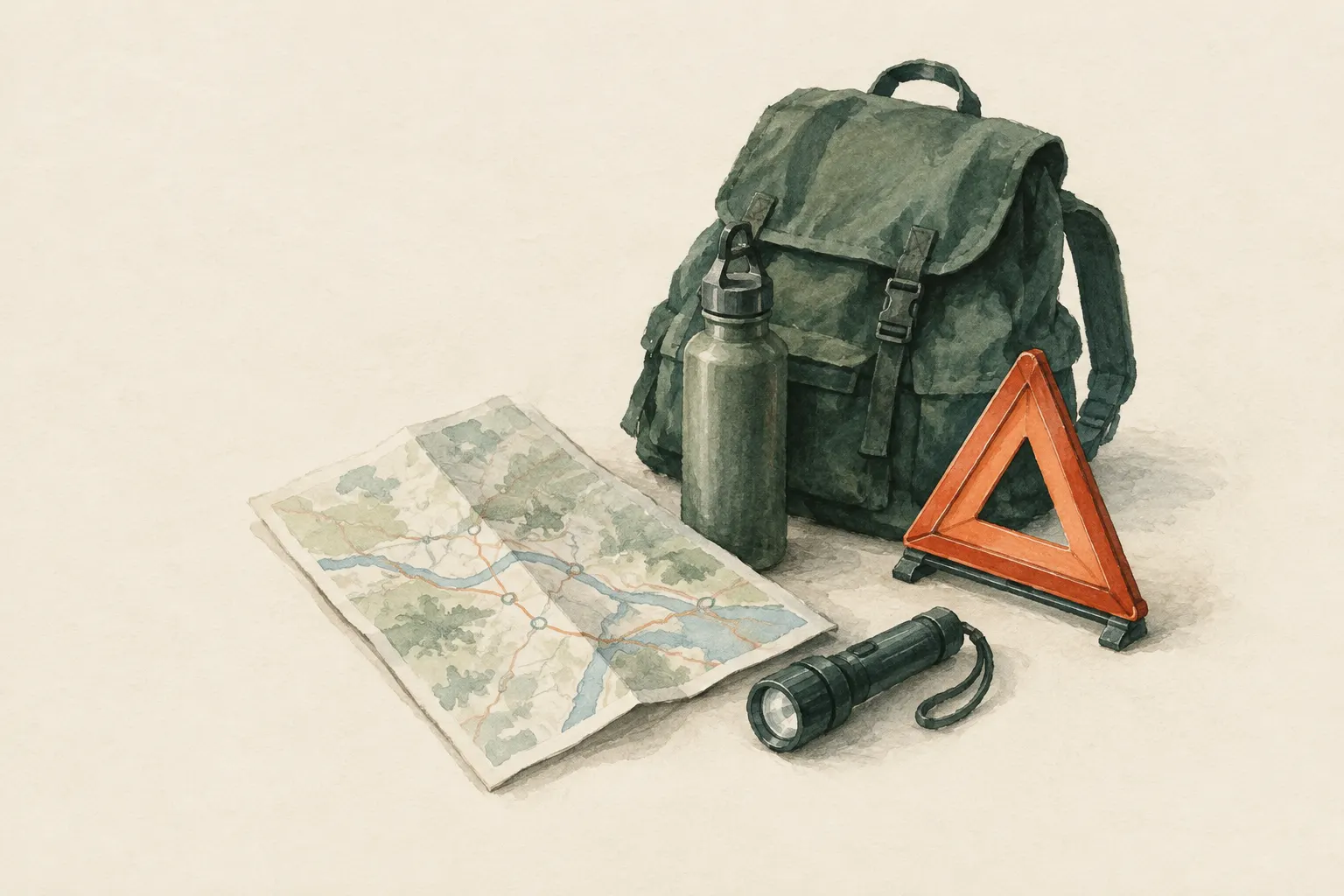
Which equipment (e.g. warning triangle, high-visibility vest, first-aid kit) is mandatory differs between countries – check local rules.
Backpack
Pre-packed go bag
Document folder (waterproof)
Store securely – contains sensitive personal data.
Topographic map
Or a paper road map
Check the publication date – paths and buildings may have changed.
Protect from wet (map case or bag).
Battery or crank radio
Car radio or battery radio for announcements
Check batteries regularly and keep spares.
Power bank
Do not use damaged or swollen batteries; do not charge while covered.
Suitable for
- Official evacuation ahead of floods, wildfires or storms
- Households with their own vehicle
- Preparation in regions with recurring natural hazards
Not suitable for
- Situations in which the authorities tell people to shelter in place
- Driving through areas that are closed or in immediate danger
Prerequisites
- Knowing the regional hazards and how warnings are issued
- A family emergency plan with destination and contact person
How it works
Evacuations rarely fail at the destination but on the way: traffic jams, closed roads, empty fuel stations and hazards such as water, smoke or fallen trees. Leaving early, official routes and a vehicle that can reach a safe destination without refuelling take the edge off these risks. Information comes via radio and warning apps – not rumours.
Advantages
- A vehicle carries people, animals and luggage
- Weather protection and charging power on the way
Disadvantages
- Traffic jams and closures are likely
- Vehicles are especially at risk in floodwater
Deep knowledge
Background
Ready.gov recommends filling the tank when an evacuation seems likely, leaving early, following the routes recommended by the authorities, avoiding shortcuts and staying away from flooded areas and downed power lines. The US National Weather Service campaign “Turn Around Don't Drown” strongly warns against driving through flooded roads.
How evacuations are ordered and carried out differs by country and hazard. The instructions of local authorities always apply.
Variants
- Without a vehicle
- People without a car should find out in advance how the authorities evacuate people without vehicles, or arrange rides with neighbours and relatives.
Common mistakes
- Waiting with a half-empty tank until the order comes
- Driving through a flooded dip
- Driving around barriers
- Relying only on the navigation device
- Leaving too late to pack belongings
Limits and risks
- No information on regional evacuation routes
- Does not replace instructions from the authorities
Material alternatives
Derived from material properties: a substitute must have all relevant properties. Observe the notes on the substitute.
- Backpack
- Sleeping pad, Dry leaves, grass or conifer boughs (Collect only where allowed; no protected plants. Check for ticks and insects.), Dry spare clothing (Carry it in waterproof packaging – wet clothing barely insulates.), Wool blanket / duvet (Keep away from candles, stoves and heaters.), Insulated cool box (Keeps cold only for a limited time; without ice packs or ice it is not a fridge.), Sleeping bag (Do not store compressed long-term; do not pack away damp.), Newspaper and cardboard (Flammable – keep away from candles, stoves, heaters and embers.), Insulated cooking box (hay box, thermal cooker) (Never put open flame or embers inside – only the hot, closed pot.)
- Document folder (waterproof)
- Tarp, Plastic sheet / large bin bag (Tears easily; never pull over the head (suffocation risk).), Emergency blanket (Tears easily once punctured; short-term shelter only.), Rain poncho (When used as a shelter, it no longer protects your body from rain.), Bivy bag (Never fully close off the face.), Tent (Do not cook or heat inside the tent (fire and carbon monoxide danger).), Heavy-duty bin bag (large) (Suffocation risk: never pull plastic bags over the head or face and keep them away from small children.), Group shelter bag (Airtight – ventilate regularly.)
Results come exclusively from structured entries. No improvised instructions are generated.
Sources
Ready.gov – U.S. Federal Emergency Management Agency (FEMA): Evacuation
Fill the tank, leave early, recommended routes, no shortcuts, avoid floodwater and power lines
NOAA National Weather Service (USA): Turn Around Don't Drown
Do not drive through flooded roads
Ready.gov – U.S. Federal Emergency Management Agency (FEMA): Make A Plan
Out-of-area contact, text messages