Checking a rental car before driving off
An unfamiliar car in an unfamiliar country: tyres, lights, spare wheel, warning equipment and how to operate hazard lights, headlights and wipers should be clear before driving off. Equally important: the rental company's breakdown number, fuel type and locally mandatory equipment.
- 10–15 minutes at pick-up
Explained simply
A rental car is like someone else's kitchen: everything is there somewhere, but you don't know where. In a car that can become dangerous. When it suddenly rains, gets dark or you have a breakdown, you don't want to start searching for the wiper switch or the warning triangle.
So you take ten to fifteen minutes before driving off. You walk once around the car and photograph scratches and dents. You look at the tyres, try the lights, find the spare wheel and warning equipment, and ask which fuel goes in the tank. And you save the rental company's emergency number.
The most important point: if something is obviously wrong – a damaged tyre, a broken light or a warning lamp on the dashboard that stays on – do not drive off. Ask for another car.
Why the short check pays off
In an emergency there is no time to try things out. If you break down at night on a country road, you need to find the hazard lights within seconds and know where the hi-vis vest and warning triangle are. In an unfamiliar car, perhaps labelled in another language, that can take surprisingly long.
In daylight and calm, in the rental company's car park, the same search is easy. A few minutes make an unfamiliar vehicle familiar. That also helps while driving: knowing where everything is keeps your mind free for unfamiliar traffic.
There is also a very practical reason: damage you photograph and report at pick-up is documented. Photos with date and time are simple evidence if there are questions on return. Legal or contract questions are for the rental company or an advice service – this entry cannot cover them.
What really matters
Tyres: look at the tread and for damage such as bulges, cuts or embedded objects. A tyre that looks clearly flatter than the others is a warning sign. Lights: switch on dipped beam, high beam, indicators, brake lights and hazard lights once; for the brake lights a fellow traveller or the reflection in a window helps.
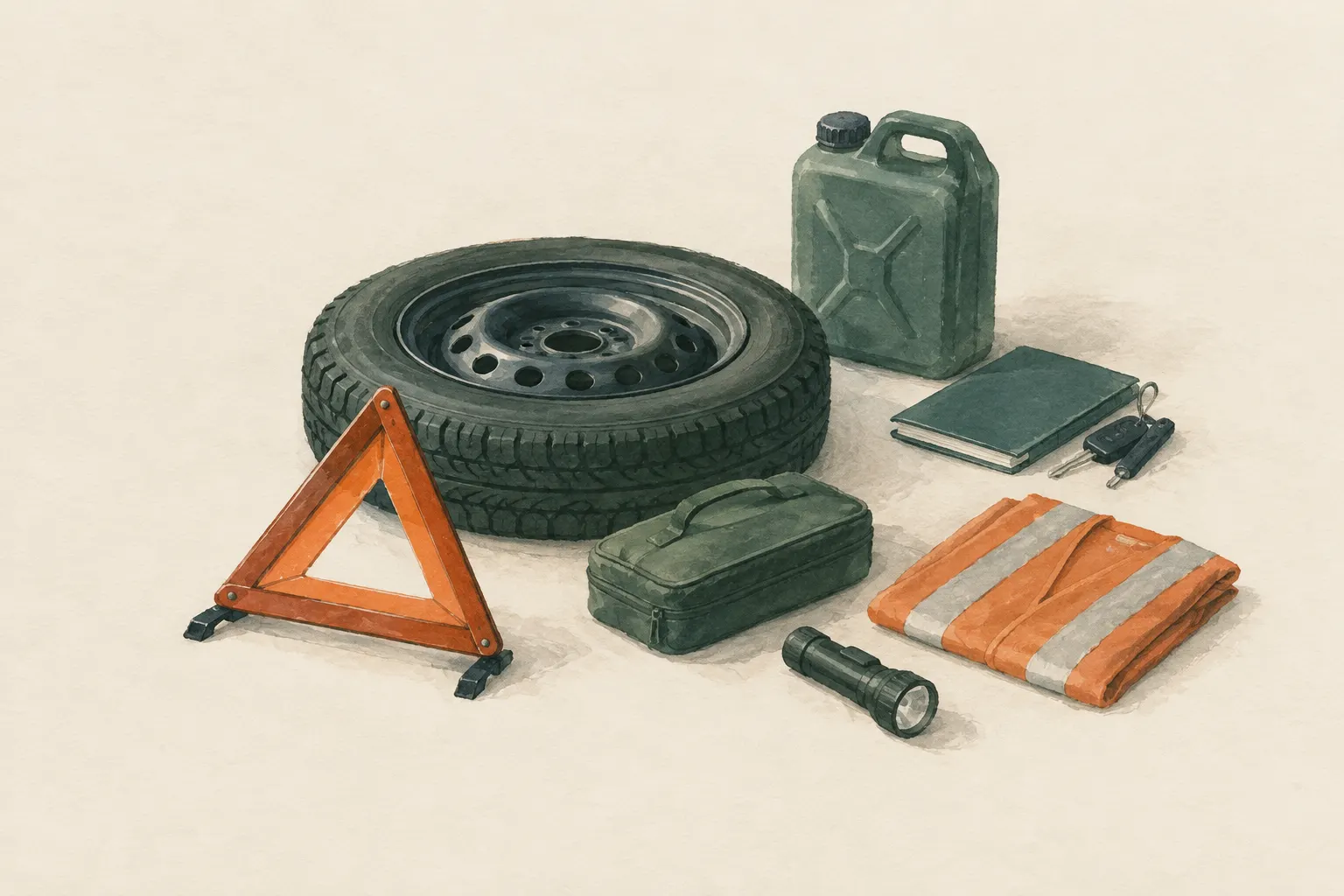
Equipment: find the spare wheel or repair kit, jack, hi-vis vest, warning triangle and first-aid kit – depending on what is provided and what the country requires. Some cars have only a repair kit instead of a spare wheel. You want to know that beforehand, not with a flat tyre at the roadside.
Controls: find out how the hazard lights, headlights, wipers, handbrake and fuel cap work and which fuel goes in. Using the wrong fuel is a typical and expensive mistake with rental cars. The fuel type is often marked on the fuel flap – ask if in doubt.
Country rules and child seats
What must be carried in the car differs from country to country: hi-vis vests, warning triangles, first-aid kits, daytime lights, winter equipment or motorway vignettes. Whether you need an international driving permit also depends on the country. Check these rules before the trip with official sources or motoring organisations and ask the rental company what is in the car.
Check child seats from the rental company yourself: does the seat suit the child's age and size, is it undamaged and complete? Install it according to the instructions found on the seat or in the vehicle, and then check that it is firmly fixed. Do not rely on someone else having done it correctly.
Traffic rules themselves may differ too: right of way, speed limits, roundabouts, driving on the left. A quick look at the official guidance before the trip saves stress at the first junction.
Safety: what to watch out for
Do not drive off with obvious defects. These include damaged or badly worn tyres, faulty lights, brake problems and dashboard warning lamps that do not go out after starting. Asking for another vehicle costs less time than a breakdown on the road.
If possible, do not pick up the car in the dark or completely exhausted after a long flight. In the dark you miss damage, and fatigue makes driving an unfamiliar car on unfamiliar roads much riskier. If it cannot be avoided, still take time for the key points: lights, hazard lights, fuel type.
Save the rental company's breakdown and accident number in your phone and write it down as well. In an accident with injuries the first steps are always: secure the scene and call the local emergency number (112 in the EU). Only then inform the rental company.
Step by step
Walk around
Photograph damage; check tyres for tread and damage; test lights.
- 1
Walk around
Photograph damage; check tyres for tread and damage; test lights.
- 2
Equipment
Locate spare wheel or repair kit, jack, hi-vis vest, warning triangle and first-aid kit – as available or required.
- 3
Controls
Find out hazard lights, headlights, wipers, handbrake, fuel cap and fuel type before driving off.
- 4
Numbers
Save and note the rental company's breakdown and accident number.
- 5
Child seats
Check child seats yourself and install them according to the instructions.
Common mistakes
- Picking up in the dark and checking nothing
- Using the wrong fuel
- No rental emergency number
- Not documenting damage
Quick view
Materials
Mobile phone
The battery drains quickly in cold and with continuous screen and GPS use.
Do not plan on it as your only means of navigation or emergency calls.
High-visibility vest
Keep within reach inside the cabin, not in the boot/trunk.
Warning triangle
Whether warning triangles are mandatory, or should be placed at all on certain roads (e.g. motorways), differs between countries – check local rules.
Suitable for
- Rental cars and car sharing at home and abroad
Not suitable for
- Technical vehicle inspection
Prerequisites
- Valid driving licence, an international driving permit if needed – check local rules
Safety
- Do not drive off with obvious defects (tyres, brakes, lights, warning lamps on the dashboard); ask for another vehicle.
- Mandatory equipment, daytime light requirements, vignettes and child-seat rules differ by country – check local rules.
How it works
In an emergency there is no time to search for switches and equipment. A short check in daylight and calm makes an unfamiliar vehicle familiar.
Advantages
- Little effort
- Avoids trouble and hazards
Disadvantages
- Takes time at pick-up
Deep knowledge
Background
Traffic rules such as the UK Highway Code stress that vehicles must be roadworthy, for example tyres, lights and visibility.
Contract terms and mandatory equipment differ by rental company and country.
Common mistakes
- Picking up in the dark and checking nothing
- Using the wrong fuel
- No rental emergency number
- Not documenting damage
Limits and risks
- No legal or contract advice
Material alternatives
Derived from material properties: a substitute must have all relevant properties. Observe the notes on the substitute.
- Mobile phone
- Headlamp / flashlight, Battery lantern / LED light
- High-visibility vest
- Emergency blanket (Tears easily once punctured; short-term shelter only.), Signal mirror (Do not flash into the eyes of people nearby or of drivers.), Warning triangle (Whether warning triangles are mandatory, or should be placed at all on certain roads (e.g. motorways), differs between countries – check local rules.), Aluminium foil (heavy-duty) (Edges can be sharp; conducts heat and electricity.)
- Warning triangle
- Emergency blanket (Tears easily once punctured; short-term shelter only.), Signal mirror (Do not flash into the eyes of people nearby or of drivers.), High-visibility vest (Keep within reach inside the cabin, not in the boot/trunk.), Aluminium foil (heavy-duty) (Edges can be sharp; conducts heat and electricity.)
Results come exclusively from structured entries. No improvised instructions are generated.
Sources
Department for Transport and Driver and Vehicle Standards Agency (United Kingdom): The Highway Code
Roadworthiness of vehicles (example of national rules)