Skip to content
In an emergencyAustriaEmergency numbers →
SurviveBetter
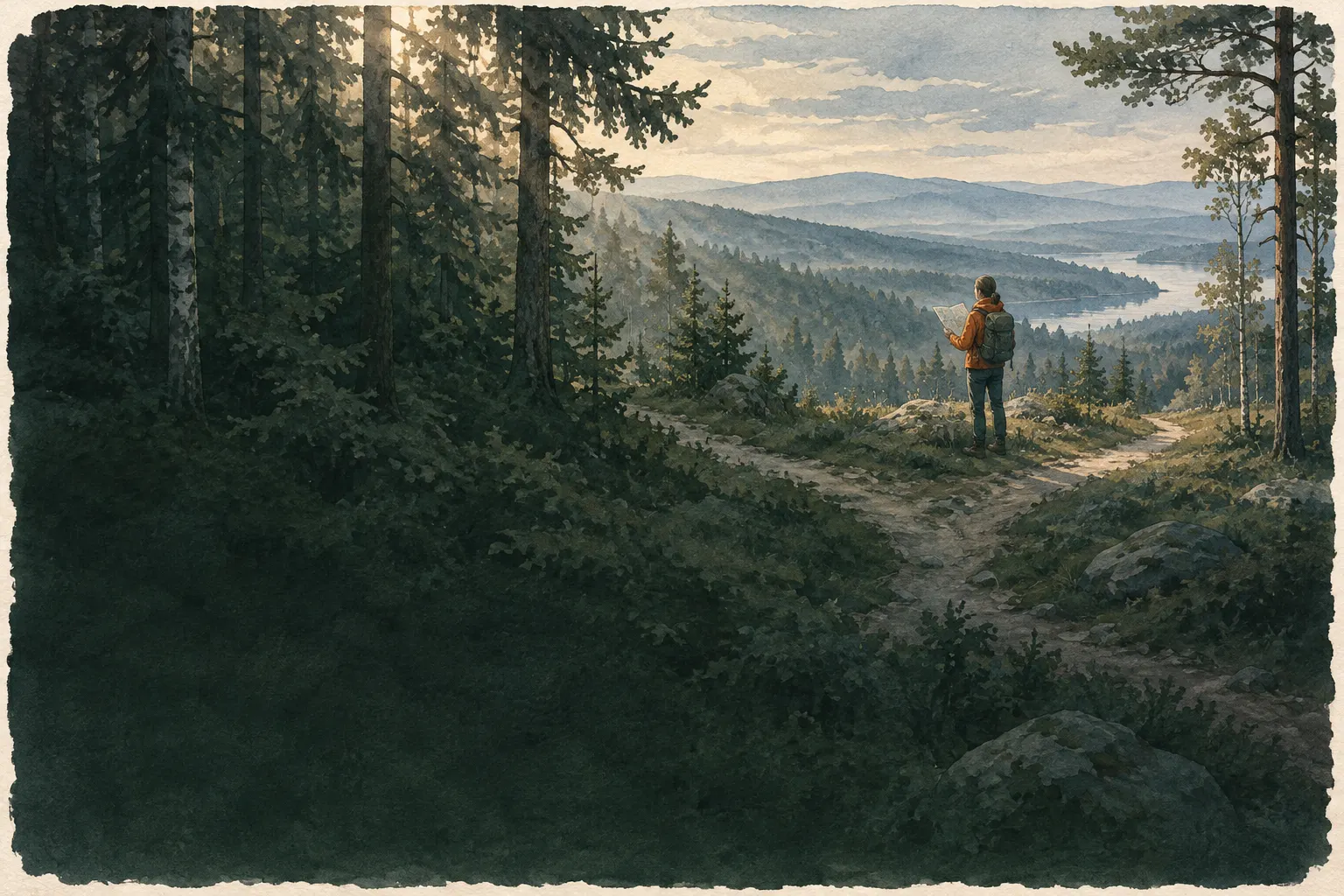
Hiker seen from behind at a fork of forest paths in late afternoon light

I am lost while hiking

The trail has suddenly vanished, nothing matches the map any more and daylight is running short – what you decide in the next few minutes matters most.

First

  1. Stop. Do not keep walking without a plan – it usually increases the distance from the known trail.
  2. If injured, in danger, or darkness is falling without equipment: call the emergency number and give your location (coordinates from your map app, landmarks).
  3. Save battery: lower screen brightness, close unnecessary apps.
  4. Calmly assess your situation, weather, remaining daylight and equipment, then plan.

Call emergency services if

  • Injury or illness
  • Signs of hypothermia (violent shivering, confusion)
  • Darkness without protective gear
  • Dangerous terrain without a safe way back

What is happening

Getting lost rarely happens all at once. It usually starts with a missed junction, a game trail that looks like a path, or a “little shortcut”. You keep walking, expecting the trail to reappear – and only after a while do you notice that nothing matches the map or your memory any more.

At that moment many people react with haste: walking faster, changing direction several times, taking “just a quick look” over the next rise. The urge is normal, but it often leads further from the known trail, costs energy and daylight and makes searchers' work harder. The impulse to follow a stream downhill can also end in gorges and at drop-offs.

The real danger is rarely being lost in itself, but what comes after: darkness in rough terrain, falls, cooling through wet and wind, and a flat phone battery. Under stress people also tend to “bend the map” – reading the terrain so that it fits what they expect to see.

What realistically matters most: stop, work out or pass on your position, save your battery, stay warm and dry – and call the local emergency number (112 in the EU) once too early rather than too late. Someone who knows where you are walking and when you meant to be back is often your most important safety net.

Step by step

  1. Phase 1

    Immediately: stop

    • Stand still, breathe, drink and eat something. Haste is now your biggest enemy.
    • Open your map app and check your position; note the coordinates or take a screenshot while the battery lasts.
    • Think: where was I last certainly on the trail? How long ago was that, and in which direction have I walked since?
    • Observe your surroundings: traces of paths, waymarks, sounds of roads or water, prominent features.
    • Save battery: lower brightness, switch on power-saving mode, close unnecessary apps.
  2. Phase 2

    In the first half hour: decide

    • If you know the way back for certain, follow your own track back to the last safe point.
    • Only scout briefly with a marked starting point, within sight and with a fixed time limit – then return to the starting point.
    • If injured, if the weather turns bad, darkness falls without equipment or the terrain is dangerous: call the emergency number and give your location, condition, equipment and number of people.
    • Tell your contact person where you are and what you plan to do.
    • Do not descend into unknown stream gullies or steep terrain to “get down to the valley quickly”.
  3. Phase 3

    If you have to stay put

    • Choose a safe spot nearby, ideally easy to see – at the edge of a clearing or near a path, not at a drop-off or in a stream bed.
    • Before dark, set up insulation from the ground and protection from wind and wet; put on all your layers before you get cold.
    • Lay out bright clothing or objects where they can be seen; use a whistle or shouts in series, especially when you hear voices or engines.
    • Stay where you told the dispatcher or your contact person you would be. Keep to any agreement on staying reachable and save the phone in between.
  4. Phase 4

    When help arrives – and afterwards

    • Answer calls even if you are tired; use light and whistle.
    • For a helicopter: both arms raised diagonally (a Y shape) means “Yes, we need help”.
    • If you find your own way out, inform the dispatcher and your contact person at once so that no search continues.
    • Later, calmly work out where you left the trail – it helps on your next trip.

What to watch out for

  • Cold drains the battery

    Batteries lose power much faster in the cold. Carry the phone close to your body in an inner pocket and switch it to power-saving mode in between.

  • The shortcut downhill

    Streams and gullies often lead into gorges with drop-offs, waterfalls and slippery rock. A known route back is almost always safer than an unknown route down.

  • It gets dark earlier in the forest

    Under trees and in valleys the light fades noticeably earlier than in the open. Plan by that, not by the time of sunset.

  • Cooling in mild temperatures

    Wet, wind and exhaustion can lead to hypothermia even above freezing. Put on layers before you start to feel cold.

  • Moving on after the call

    Rescuers search where you said you were. Walking on afterwards without telling them makes the search longer.

Common mistakes

  • Walking on in the hope that the trail will reappear any moment.
  • Delaying the emergency call until it is dark or the battery is almost flat.
  • Using up the battery on photos, searching and full screen brightness.
  • Splitting up as a group to look for the trail.
  • Finding your own way out but not telling the dispatcher or your contact person.

Prepare in advance

  • Tell a reliable person your route and planned return time – and agree when they should raise the alarm.
  • Download an offline map to your phone and also carry a paper map and compass – and know how to use both.
  • Carry a headlamp, whistle, emergency blanket, power bank, a warm layer and some food even on short trips.
  • Check the time of sunset and agree on a fixed turnaround time.
  • Practise reading coordinates and sharing your location on your own phone.

Special consideration

Children
Teach children: if you are lost, stay in one place, for example by a tree, and answer when people call. Give them a whistle and tell them clearly that nobody will be cross with them and that searchers are helpers.
People who rely on medication
Anyone who needs regular medication should always carry a reserve for an unplanned night and mention it when calling for help.
Dogs
Keep your dog on a lead. A dog that runs off easily tempts you to follow it into unknown terrain.

Sources

  • FM 3-05.70 Survival · Headquarters, Department of the Army (USA), 2002
  • Mountaineering: The Freedom of the Hills, 9th edition · The Mountaineers Books, 2017
  • International Commission for Alpine Rescue (ICAR) – recommendations and information (organisation website) · ICAR – International Commission for Alpine Rescue
  • Lost Person Behavior: A Search and Rescue Guide on Where to Look – for Land, Air and Water · Robert J. Koester – dbS Productions, 2008

Your situation

Environment
Weather
Time of day
Equipment

Matching entries

0 rules apply

No AI decides here. Every recommendation is based on a visible rule.

Add details about your situation above to get more specific guidance.

Basics for this situation

Why: Always applies to this situation – regardless of your answers.

All rules of this situation (5)
  1. [not active] If Time of day = Dusk / night

    As darkness falls, a sheltered, insulated spot takes priority over moving on through unknown terrain.

  2. [not active] If Weather = Rain or Cold / frost

    Wet and cold greatly increase heat loss. Protection from wind and wet and insulation from the ground come first.

  3. [not active] If Equipment = Tarp and cord

    With a tarp and cord you can build effective protection from rain and wind.

  4. [not active] If Equipment = Emergency blanket / bivvy bag

    An emergency blanket or bivvy bag gives short-term protection from wind and wet – only together with ground insulation.

  5. [not active] If Environment = Mountains or Snow

    In the mountains rely on sight and sound range: know the distress signals before strength and battery run low.