Cord and rope in camp: choice, securing ends, care
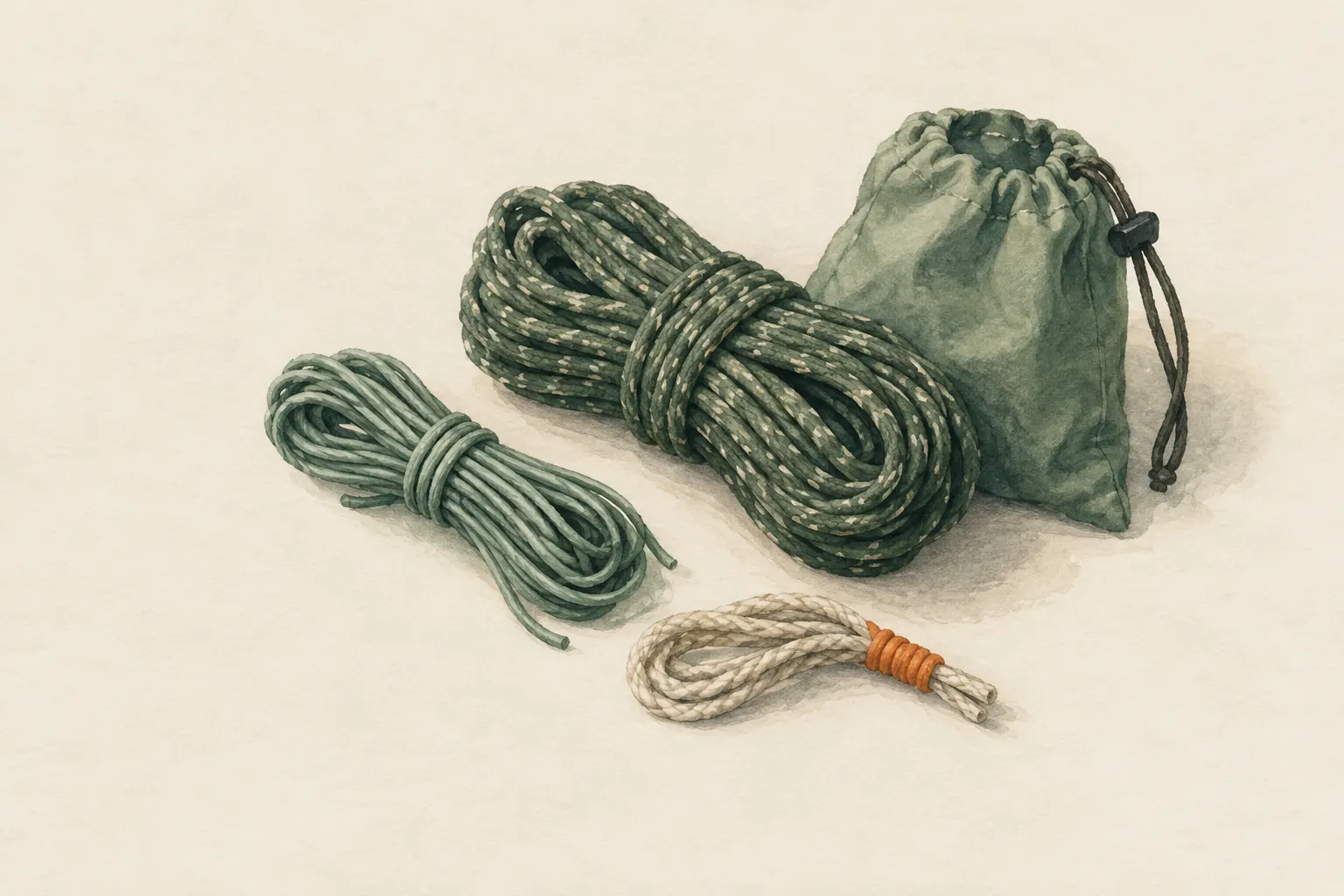
Cord is one of the most versatile aids in camp – for guylines, washing lines, repairs and bundles. To keep it reliable it needs secured ends, careful storage and regular checks for abrasion, sun damage and moisture. Camp and craft cords are never meant for climbing or safety-critical uses.
- A few minutes per line
Explained simply
In camp, cord is something like tape you can tie: you use it to pitch a tarp, hang up wet socks or bundle wood. To last, it needs a little care – a bit like a bicycle that you oil and look over from time to time.
Two things matter most. First: the ends must be secured, or they unravel like a frayed jumper. Plastic cord is briefly melted at the end, natural fibre is wrapped with thin twine. Second: cord does not like sun or wet in the long run. Let it dry and keep it in the dark.
Very important: camp cord is never meant for climbing or securing people. That needs tested climbing rope and training. And be careful when melting ends – molten plastic is hot and sticks to skin.
How it works
A cord is made of many thin fibres that are twisted, braided or held together inside a sheath. Its strength comes from the load being spread across all the fibres. Every damaged fibre stops carrying its share – the rest must do more. That is why a cord is only as strong as its weakest point.
Several things weaken fibres: abrasion on edges, bark or rock; UV light, which makes many synthetic fibres brittle over time; heat and chemicals; and knots, because the fibres are bent sharply inside the knot. Natural fibres such as hemp, cotton or sisal cope better with heat but can rot if stored damp.
An unsecured end comes apart because nothing holds the fibres together. When heat-sealing, synthetic fibres fuse into a firm cap. When whipping, a tight wrap of thin twine holds the fibres together – that also works with natural fibres, which do not melt.
What really matters
Choose the cord for the task. For guylines, a low-stretch, UV-resistant line keeps the tarp from sagging. For bundling and lashing, flexible cord is more pleasant. Near a fire you avoid synthetic fibres because they melt – above a fireplace, natural fibre or a piece of chain is the better choice. When strength matters, use only bought, labelled products; with unknown cord nobody can say what it will hold.
Check cord regularly by running it slowly through your hands before and after use. Hard, glazed, frayed, discoloured or thin spots are warning signs. Cut such a section out or replace the whole line.
Where a line runs over an edge, bark or a rock, pad it with a piece of cloth or tubing. After use, untie the knots, because knots left tight for months are hard to open and strain the fibres.
Safety: what to watch out for
Paracord, washing line and craft cord are never meant for climbing, abseiling or securing people. Such uses require tested, standard-compliant equipment and training. Camp cord is not suitable for lifting heavy loads or towing either.
When heat-sealing, liquid plastic can drip. It is very hot and sticks to skin, so do not shape it with your fingers while it is hot, and do not work inside a tent. Hold the end in the flame only briefly and let it cool.
A line that breaks under tension can snap back. So do not stand in line with a heavily tensioned line. Tensioned lines in camp are also trip hazards, especially in the dark – a brightly coloured piece of cloth or ribbon on them makes them visible.
Gear and materials
Paracord is a popular all-purpose cord. It has a braided sheath and several thin strands inside, the core. You can pull these inner strands out for fine repairs, for example for sewing or as thin binding cord. The empty sheath is much weaker afterwards, though, and only good for light tasks.
Thin twine or thread is useful for whipping rope ends and for small bindings. A piece of tape can secure an end temporarily in an emergency. A knife for clean cuts and a lighter for synthetic ends complete the kit.
Anyone who wants to make cordage from plant fibres is best served by a course with knowledgeable instruction. It also involves identifying plants reliably and following local rules on foraging – a description alone cannot replace that.
How to practise it
At home, take a few leftover pieces of cord and practise both ways of securing an end. Briefly melt a synthetic end and watch how a smooth cap forms. Whip a thicker rope end with thin twine until the wrapping sits so tight that it cannot be pushed along.
Then practise coiling neatly: gather the line in even loops and secure it with the end so that it does not tangle. Let wet lines dry loosely in the air, not on a heater or by the fire. If you treat your cords this way, they last a long time and you always know what condition they are in.
Step by step
Choose the right cord
For guylines use low-stretch, UV-resistant lines; for lashing and bundling flexible cord; near fire avoid synthetics that melt. Use only bought, labelled products when strength matters.
- 1
Choose the right cord
For guylines use low-stretch, UV-resistant lines; for lashing and bundling flexible cord; near fire avoid synthetics that melt. Use only bought, labelled products when strength matters.
- 2
Secure the ends
Synthetic cord: hold the end briefly in a flame until the fibres fuse. Natural fibre or thick rope: wrap the end tightly with thin twine (whipping) or secure it with tape.
Do not touch molten plastic.
- 3
Protect from abrasion
Where a line runs over edges, bark or rock, pad it with a piece of cloth or tubing. Do not tension lines over sharp edges.
- 4
Inspect regularly
Run the line through your hands before and after use: hard, glazed, frayed, discoloured or thin spots mean replace or cut out.
- 5
Store dry and tidy
Untie knots, let wet lines dry loosely (not on a heater or by the fire), then coil them and store them in the dark.
Common mistakes
- Using camp cord for climbing or securing people
- Leaving ends unfinished
- Storing wet natural-fibre rope damp
- Leaving lines hanging in the sun permanently
- Leaving knots tightened for months
Quick view
Materials
Paracord
Not a climbing or safety rope.
Thin twine
Also for whipping rope ends
Low breaking strength – light loads only.
Rope
Never use unknown or damaged rope for life-safety purposes.
Lighter, matches or ferro rod
Lighter for heat-sealing synthetic ends
Observe local fire bans.
Knife (fixed or locking blade)
Cut away from your body.
Rules on carrying knives differ by region – check local rules.
Suitable for
- Guylines for tarps and tents
- Washing lines and hanging gear
- Bundling, repairing, lashing light loads
Not suitable for
- Climbing, abseiling, belaying people
- Lifting or pulling heavy loads, towing
- Permanent fixings without inspection
Prerequisites
- A few basic knots (e.g. figure eight, clove hitch, taut-line hitch)
- Knowing whether the material is synthetic or natural
Safety
- When heat-sealing synthetic ends, molten plastic can drip and cause burns. Do not shape it with your fingers while hot; do not work inside a tent.
- A line that breaks under tension can snap back. Do not stand in line with tensioned lines, and make tensioned lines visible (trip hazard).
How it works
Cords lose strength through abrasion on edges, UV light, heat, chemicals, knots and – for natural fibres – moisture and rot. Unfinished ends unravel. Securing ends, storing lines dry and dark, untying knots after use and inspecting regularly greatly extends their life and reveals damage before it becomes a problem.
Advantages
- Light, versatile, cheap
- Lasts a long time with care
Disadvantages
- The strength of unknown cord cannot be judged
- Synthetic fibres melt near fire
Deep knowledge
Background
Knot books such as those by Clifford Ashley and Geoffrey Budworth describe not only knots but also finishing rope ends, for example by whipping, and handling different rope materials. Bushcraft textbooks treat cord as basic equipment for camp building and repair.
This atlas deliberately does not cover identifying plants for home-made fibres. Anyone who wants to learn traditional cordage making is best served by a course with knowledgeable instruction, observing local rules on foraging.
Variants
- Paracord inner strands
- The inner strands of paracord can be pulled out for fine repairs. The sheath alone is then much weaker and only suitable for light tasks.
Common mistakes
- Using camp cord for climbing or securing people
- Leaving ends unfinished
- Storing wet natural-fibre rope damp
- Leaving lines hanging in the sun permanently
- Leaving knots tightened for months
Limits and risks
- No strength figures – manufacturer's information applies
- No plant identification for natural fibres
- Not for life-safety applications
Material alternatives
Derived from material properties: a substitute must have all relevant properties. Observe the notes on the substitute.
- Paracord
- Rope (Never use unknown or damaged rope for life-safety purposes.)
- Thin twine
- Rope (Never use unknown or damaged rope for life-safety purposes.), Paracord (Not a climbing or safety rope.), Accessory cord (Use only certified cord after training for life-safety purposes.), Webbing (tubular webbing) (Inspect knotted webbing before every use.), Jute or sisal twine (bought) (Low strength, absorbs water and rots – light loads and practice only.), Tree straps (Load only within the manufacturer's limits.)
- Rope
- Paracord (Not a climbing or safety rope.)
- Lighter, matches or ferro rod
- Ferro rod (Practise before you need it.), Fire striker and hard stone (Carbon steel, not stainless.), Bow drill set (bow, spindle, hearth board, bearing block) (Use only dry wood.), Burning lens / magnifier (Never leave lying in the sun – fire risk.), Fire piston (Maintain the seal.)
Results come exclusively from structured entries. No improvised instructions are generated.
Sources
Geoffrey Budworth (1997): The Complete Book of Knots
Rope materials and finishing rope ends
Clifford W. Ashley – Doubleday, Doran & Co. (1944): The Ashley Book of Knots
Whipping and finishing rope ends
Mors L. Kochanski – Lone Pine Publishing: Bushcraft: Outdoor Skills and Wilderness Survival
Cord as basic camp equipment