Lakes and ice
You cannot reliably tell from the outside whether ice will hold. Only walk on ice when the responsible authority has opened it – otherwise do not. If you fall through, calm comes first: settle your breathing, turn back towards where you came from, slide flat onto the ice and roll away. Helpers do not go onto the ice but call emergency services and help from the shore.
- Knowledge beforehand; in an emergency minutes count
Explained simply
Ice on a lake often looks the same everywhere, but it is not equally strong everywhere. In some places it is thick, in others thin – for example where a stream flows in, where reeds grow or where snow lies on the ice. You cannot reliably tell from the outside, and neither can adults. So you only walk on ice when the local council or a responsible authority has officially opened it.
If someone falls through, the water is ice-cold. In the first moment you gasp for air all by yourself. That is cold shock. It passes after a short time. Then it is important to stay calm, turn towards the side you came from, slide flat onto the ice and roll away instead of standing up.
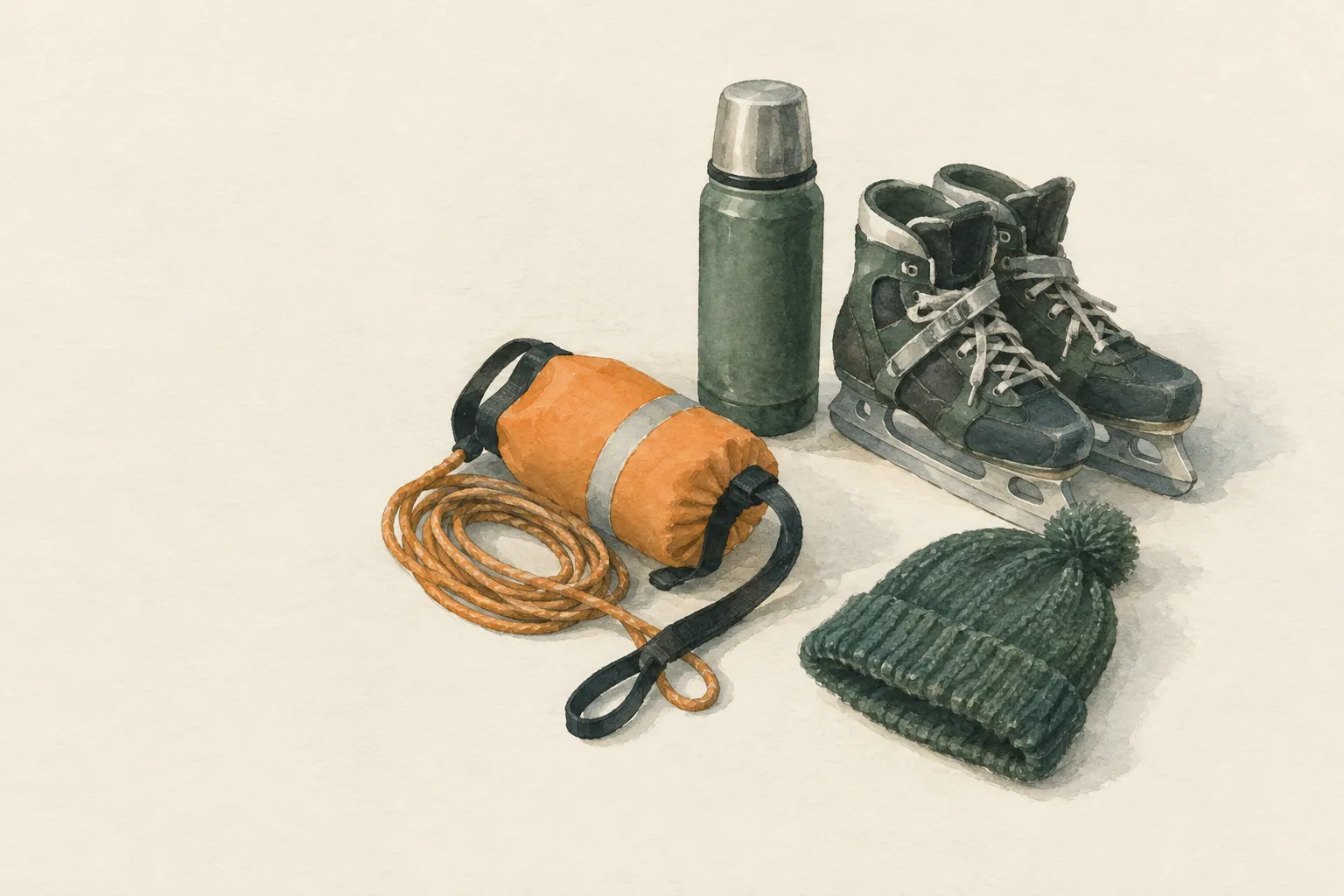
The most important safety point: if someone else falls through, you do not run after them. Call the emergency number (112 in the EU) and help from the shore, for example with a long branch, a rope or a jacket.
How it works
Water is special: when it freezes, it becomes lighter than it was as a liquid. That is why ice floats on top and a lake freezes from the surface down. But how fast and how strongly the ice grows depends on many things: the cold of recent days and nights, the wind, currents in the water, springs on the bottom and plants growing through the ice.
Snow on the ice acts like a blanket. It insulates and slows the growth of the ice beneath, while its weight presses on the surface. Where streams flow in or out, at reeds, jetties and bridge piers, the ice often stays thinner. Thaws make ice rotten even when it still looks thick. You usually cannot see any of this from above – which is why this text deliberately gives no ice thickness as a rule of thumb.
Anyone who falls into cold water first experiences cold shock: uncontrolled gasping and rapid breathing. That is dangerous if your head is under water at the time. After a short while this reflex eases. Then there is a limited period in which your arms and hands still work well, before the cold weakens the muscles. Self-rescue has to succeed in that time.
What really matters
The most important decision is made on the shore: has the ice been opened? Many councils officially open ice areas or close them with signs. Without that approval you stay off – no matter how cold the last few days were, how many people are already on the ice or how solid it feels at the edge. Flowing water is especially unpredictable; ice there is almost never reliable.
Even on approved ice it pays to be alert. Keep away from inlets and outlets, reeds, jetties and dark or wet patches. Do not walk bunched together as a group, because that concentrates the weight on a small area. Some people who are regularly out on ice wear ice picks around their neck – two handles with spikes that make it easier to pull yourself out of the water onto the slippery ice.
For an emergency, remember four steps. First: calm your breathing, keep your head above water and do not fight wildly straight away. Second: turn towards the side you came from – the ice held you there a moment ago. Third: spread your arms far onto the ice, kick your legs until your body is horizontal and slide yourself out flat. Fourth: do not stand up, but roll or crawl away until you are on safe ground.
Safety: what to watch out for
When someone else falls through, the strongest impulse is to run after them. That is exactly what often puts the helper in the water too. Stay on the shore or on safe ground, call the local emergency number (112 in the EU) and reach or throw something: a long branch, a rope, a ladder, a scarf or a jacket. Talk to the person loudly and calmly, encourage them to hold on and tell them what to do. Rescue out on the ice itself is a job for trained rescuers.
Anyone who has been in icy water needs medical help afterwards, even if they feel fine again. Hypothermia can show up with a delay. Until help arrives, shield the person from wind, replace wet clothing with dry clothing if possible or wrap them up warmly, and get them into a warm room.
Dogs love running onto ice. Do not let them off the lead by frozen water. If a dog falls through, the same applies as with people: do not go after it, call emergency services and call the dog from the shore. Fire services help with animals in the ice too.
Good to know
You often hear that you can judge ice by its colour, or that it is safe after a certain number of cold days. Such rules of thumb give false security. Ice can hold in one spot and break a few metres further on. The most reliable information is the official approval on site.
The British lifeboat charity RNLI describes with “Float to Live” that cold shock passes after a short time and that you should stay as calm as possible until then. This idea also helps when falling through ice: breathe first, then act.
With children it is worth discussing the rules before winter: never go to the ice alone, only onto approved areas, and if someone falls through, never go after them but shout for help. Children who know these sentences often act more safely in an emergency than adults deciding on the spur of the moment.
Step by step
Check whether it is open
Follow local notices, signs and approvals from the authorities. Without approval stay off the ice.
- 1
Check whether it is open
Follow local notices, signs and approvals from the authorities. Without approval stay off the ice.
- 2
In the water: calm your breathing
Keep your head above water and do not fight wildly until the gasping eases.
- 3
Turn back the way you came
Turn towards the side you came from; the ice held there before.
- 4
Slide out flat
Spread the arms far onto the ice, kick the legs to get horizontal and slide yourself flat onto the ice.
- 5
Roll away, do not stand up
Lying on the ice, roll or crawl away from the hole and only stand up on safe ground. Then get help and warmth immediately.
Common mistakes
- Judging ice by its colour or the cold of recent days
- Walking close together as a group
- Following a person who fell through onto the ice
- Standing up right after climbing out
- Carrying on without medical check after falling in
Quick view
Materials
Mobile phone
The battery drains quickly in cold and with continuous screen and GPS use.
Do not plan on it as your only means of navigation or emergency calls.
Rope
For throwing from the shore
Never use unknown or damaged rope for life-safety purposes.
Suitable for
- Winter walks by lakes
- Families with children in winter
Not suitable for
- Measuring or approving ice yourself
- Flowing water – ice there is particularly unpredictable
Prerequisites
- Know local approvals or warnings
Safety
- Anyone who has been in icy water needs medical help even if they feel fine again – hypothermia can show up with a delay.
How it works
Ice grows unevenly. Currents, springs, plants, snow acting as insulation and thaws weaken it in places without it being visible. Falling into cold water triggers cold shock with uncontrolled gasping, which passes after a short time. After that there is a limited time while arms and hands still work. The ice you came across has already held you – that is the way back.
Advantages
- Basic rules are easy to remember
- Self-rescue is often possible when done calmly
Disadvantages
- Load capacity cannot be seen from outside
- Cold shortens the time to act
Deep knowledge
Background
The British lifeboat charity RNLI describes with "Float to Live" that cold shock passes after a short time and that you should stay as calm as possible until then. The Wilderness Medical Society describes hypothermia and caring for hypothermic people.
This entry deliberately gives no ice thicknesses: they depend on the type of ice, the body of water and the weather, and a number would give false security.
Variants
- Dog on the ice
- Do not let dogs run loose on frozen water. If a dog falls through, do not follow it – call emergency services and call the dog from the shore.
Common mistakes
- Judging ice by its colour or the cold of recent days
- Walking close together as a group
- Following a person who fell through onto the ice
- Standing up right after climbing out
- Carrying on without medical check after falling in
Limits and risks
- No ice thicknesses
- No ice rescue training
Material alternatives
Derived from material properties: a substitute must have all relevant properties. Observe the notes on the substitute.
- Mobile phone
- Headlamp / flashlight, Battery lantern / LED light
- Rope
- Paracord (Not a climbing or safety rope.)
Results come exclusively from structured entries. No improvised instructions are generated.
Sources
Royal National Lifeboat Institution (RNLI), UK: Respect the Water – Float to Live
Cold shock and staying calm in cold water
Wilderness & Environmental Medicine (Wilderness Medical Society) (2019): Wilderness Medical Society Clinical Practice Guidelines for the Out-of-Hospital Evaluation and Treatment of Accidental Hypothermia: 2019 Update
Hypothermia after cold-water exposure
European Commission: 112 – the European emergency number
European emergency number 112