Dead air and why wet clothing chills
Clothing, sleeping bags and pads do not warm by themselves – they trap air. Still air conducts heat poorly and is therefore a good insulator. If the material gets wet, water replaces the air: water conducts heat roughly 20 to 25 times better than air, and as it evaporates it draws extra heat from the body. So: stay dry, adjust layers, avoid cotton in the cold.
- 5 minutes reading
Explained simply
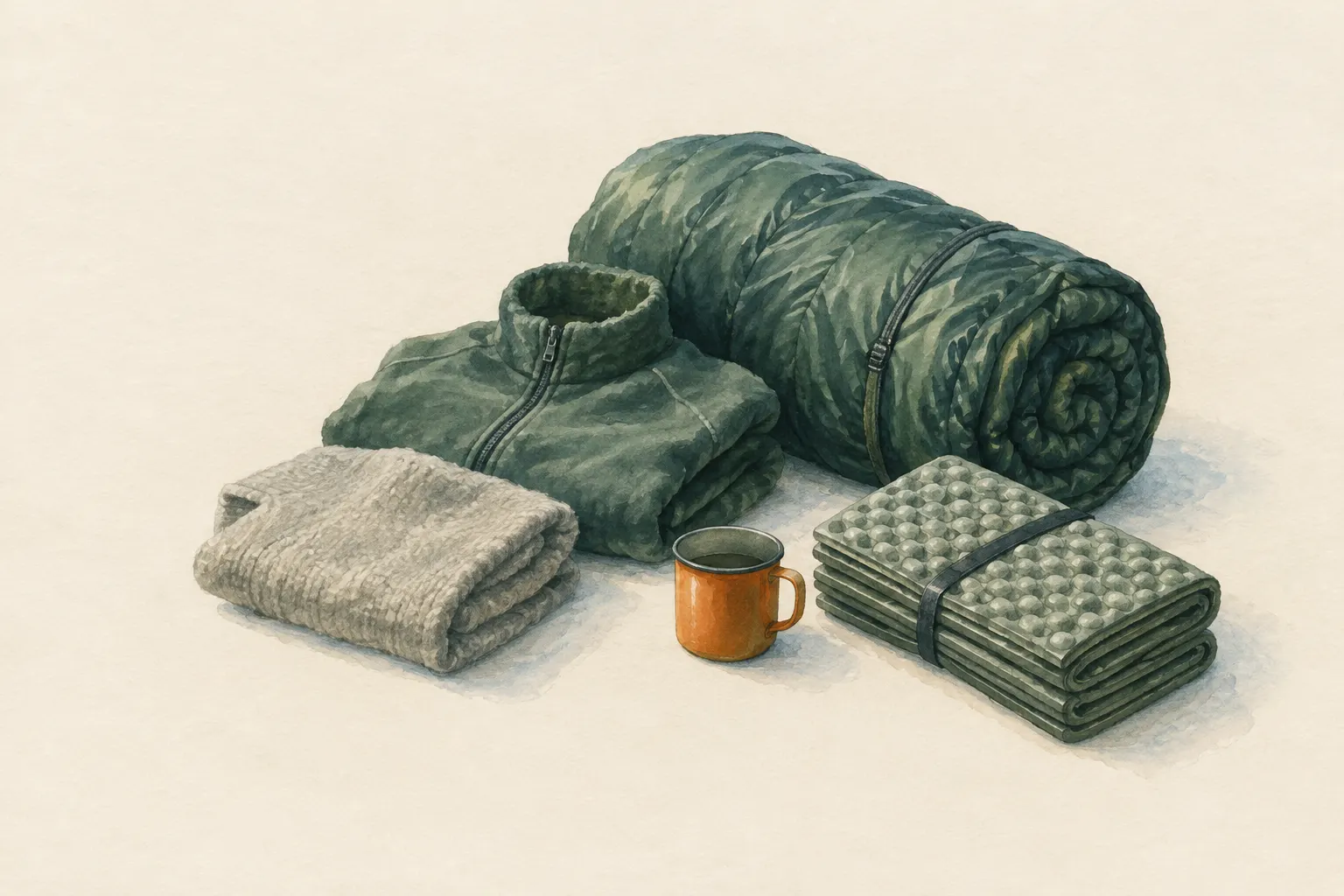
A jacket, a jumper or a sleeping bag does not make any heat. The heat comes from you. Clothing only traps air – lots of air in tiny spaces between the fibres. Still air hardly lets heat through, so your warmth stays with you. That is why a thick, fluffy down jacket is so warm: it is made almost entirely of trapped air. It is like a bird fluffing up its feathers in winter.
When clothing gets wet, something unfortunate happens: water pushes the air out of the spaces. But water conducts heat roughly 20 to 25 times better than air. On top of that, the water slowly evaporates and takes even more heat from your body as it does. Wet clothing is therefore almost as if you were wearing none – sometimes even worse.
The most important point: in the cold, stay as dry as you can – from rain outside and from sweat inside. Bring a dry spare layer packed waterproof. Wet clothing in wind and cold can lead to dangerous hypothermia, even when it is not freezing.
How it works
Air is a poor conductor of heat as long as it does not move. When it moves, it carries heat away by convection. Good insulating materials – fibres, down, foam – solve this problem by dividing the air into a great many small pockets. In these pockets the air can hardly circulate. This is called “dead air”.
A simple rule follows from this: what matters most for warmth is how thick the air-filled layer is – experts call this loft. The material itself matters less than many people think. If the layer is compressed, air escapes and insulation falls. That is why a sleeping bag hardly warms you underneath your body, and why a sleeping pad is so important.
When the material gets wet, water fills the pockets. At room temperature water conducts heat roughly 20 to 25 times better than air. In addition, evaporating the water costs a lot of energy, which is drawn from the skin. Wet clothing therefore loses heat in two ways at once: through conduction and through evaporation.
Gear and materials
Not every material behaves the same when wet. Wool and many synthetics keep part of their loft even when wet and still provide some warmth. Cotton, on the other hand, soaks up a lot of water, collapses when wet and dries slowly. That is why mountaineering handbooks advise avoiding cotton on cold, wet trips, for example jeans or cotton T-shirts.
Down is very warm for its weight when dry, but loses a large part of its loft when wet. Protect down jackets and sleeping bags particularly carefully from rain, snow and condensation. A sleeping bag should also be stored loosely, not permanently compressed, so that the filling keeps its loft.
The layering principle follows directly from this physics: a layer next to the skin moves moisture outwards, one or more insulating layers hold still air, and an outer layer keeps wind and rain out. Because individual layers can be put on and taken off, warmth can be matched to exertion.
What really matters
Sweat wets you just as much as rain, only from the inside. Anyone climbing a slope in a thick jacket sweats through the insulating layer and then gets cold during the break. Better: take off a layer before the climb, open zips, go more slowly. During the break, put on a warm layer immediately, before you cool down.
Put the rain jacket on before the insulating layer gets wet, not when you are already soaked. At camp, swap wet things for dry ones before you cool down. Dry socks and a dry layer for sleeping are often more important than an extra item of clothing for the daytime.
Safety: what to watch out for
Wet clothing in wind and cold can lead to hypothermia, even at temperatures above freezing. Wind increases both convection and evaporation. Watch for early signs such as violent shivering, clumsiness and confusion – in yourself and in others. With confusion, marked drowsiness or reduced consciousness, call the local emergency number (112 in the EU).
Never dry clothing directly over an open fire or on a stove; synthetics in particular melt quickly and can catch fire. Never run stoves or fires for drying or warming inside a tent or enclosed space – there is a risk of carbon monoxide poisoning.
Good to know
In very cold environments, some experienced people use a vapour barrier: a thin layer impermeable to water vapour close to the body, so that sweat does not get into the insulation in the first place. This only works with experience, because you easily get wet underneath if you dress too warmly.
The same physics explains many everyday things: double-glazed windows hold a still layer of air or gas between the panes, animals grow a dense winter coat, and a layer of newspaper or dry leaves under clothing can provide some insulation in an emergency. It is always about trapping air and staying dry.
Step by step
Avoid sweating
Remove a layer before climbs, open zips – sweat from inside wets you just as much as rain.
- 1
Avoid sweating
Remove a layer before climbs, open zips – sweat from inside wets you just as much as rain.
- 2
Keep rain out
Put on the rain and wind layer in time, before the insulating layer gets wet.
- 3
Choose material deliberately
In cold and wet conditions use wool or synthetics rather than cotton; keep down dry.
- 4
Change into dry
At camp swap wet clothing for dry before you cool down.
Common mistakes
- Cotton jeans on cold, wet trips
- Sweating through the insulating jacket under the rain jacket
- Storing the sleeping bag compressed
Quick view
Suitable for
- Choosing clothing and sleep systems
- Behaviour in rain and sweat
Not suitable for
- Product comparisons
Prerequisites
- Basic concepts of heat transfer
Safety
- Wet clothing in wind and cold can lead to hypothermia, even above freezing. Carry a dry spare layer in waterproof packaging.
How it works
Air is a poor conductor of heat as long as it does not move. Fibres, down and foam divide air into many small pockets where it can barely circulate. Thickness (loft) therefore matters more than material. Water has a much higher thermal conductivity and fills the pockets when wet. In addition, evaporating water takes a lot of energy, drawn from the skin. Wool and many synthetics keep part of their loft when wet; cotton and down largely lose it.
Advantages
- Explains the layering principle
- Helps you stay warm with little gear
Disadvantages
- Staying dry requires discipline
Deep knowledge
Background
Physics textbooks list the thermal conductivity of air and water; at room temperature the ratio is of the order of 20 to 25. Mountaineering handbooks derive the layering principle and the warning against cotton in cold and wet conditions from this.
The same physics explains why pads under the body matter more than a thicker sleeping bag: compressed material traps hardly any air.
Variants
- Vapour barrier
- In very cold environments some people use a vapour barrier layer so that sweat does not soak the insulation. This requires experience.
Common mistakes
- Cotton jeans on cold, wet trips
- Sweating through the insulating jacket under the rain jacket
- Storing the sleeping bag compressed
Limits and risks
- No product values
Sources
David Halliday, Robert Resnick, Jearl Walker – John Wiley & Sons: Fundamentals of Physics
Thermal conductivity of air and water, latent heat of vaporisation
The Mountaineers Books (2017): Mountaineering: The Freedom of the Hills, 9th edition
Clothing layers and materials in cold and wet conditions