Heat transfer: conduction, convection, radiation, evaporation
Heat always flows from warmer to colder – along four paths: through direct contact (conduction), through moving air or water (convection), as invisible infrared radiation (radiation) and through the evaporation of moisture. Almost every technique for keeping warm, cooling down or cooking affects one or more of these paths. Knowing them explains why sleeping pads, windbreaks, emergency blankets and dry clothing work.
- 10 minutes to read
Explained simply
Heat is like water that always flows downhill: it always moves from warmer to colder, never the other way round. Your body is almost always warmer than its surroundings, so it is constantly losing heat. The only question is how fast. There are four paths for this – and for each path there is a matching “door” you can close.
First, touch: when you sit on cold ground, heat flows straight into it (this is called conduction). Second, wind and water: they blow away the warm air around you (convection). Third, radiation: you give off invisible heat, just like a stove – you cannot see it, but thermal cameras can show it. Fourth, evaporation: when sweat or wet clothing dries, the water takes heat with it, like wet hair after swimming.
That is why a pad helps against the ground, a windbreak against wind, a roof against the cold sky and dry clothing against evaporation. The most important point: if someone is very cold, shivering and confused, or dizzy and confused in the heat, call the local emergency number (112 in the EU).
How it works
Heat is the energy of motion of the tiniest particles. In a warm object the particles jiggle more vigorously than in a cold one. When two materials touch, the fast particles bump into the slow ones and pass on energy – that is conduction. How well a material conducts varies greatly: metal and stone conduct well, water also much better than air, while still air conducts very poorly.
In convection the material itself moves. Air that your skin has warmed becomes lighter and rises or is blown away by the wind; cold air moves in and has to be warmed again. Radiation needs no contact at all: every object sends out invisible infrared light, the more the warmer it is. This is how the sun warms the earth across empty space, and how you feel the heat of a campfire on your face.
Evaporation is a special case: turning liquid water into vapour takes a lot of energy. The water draws this energy from the surface it is lying on – your skin or your clothing. That is why sweat cools you, and why you get cold so quickly in wet clothing. Every breath also costs some heat and moisture, especially in cold, dry air.
What really matters
In real life several paths are almost always at work at once. Someone sitting on a rock in the wind wearing a sweaty jacket loses heat through conduction, convection and evaporation at the same time. A good solution therefore closes several doors at once rather than just one very well.
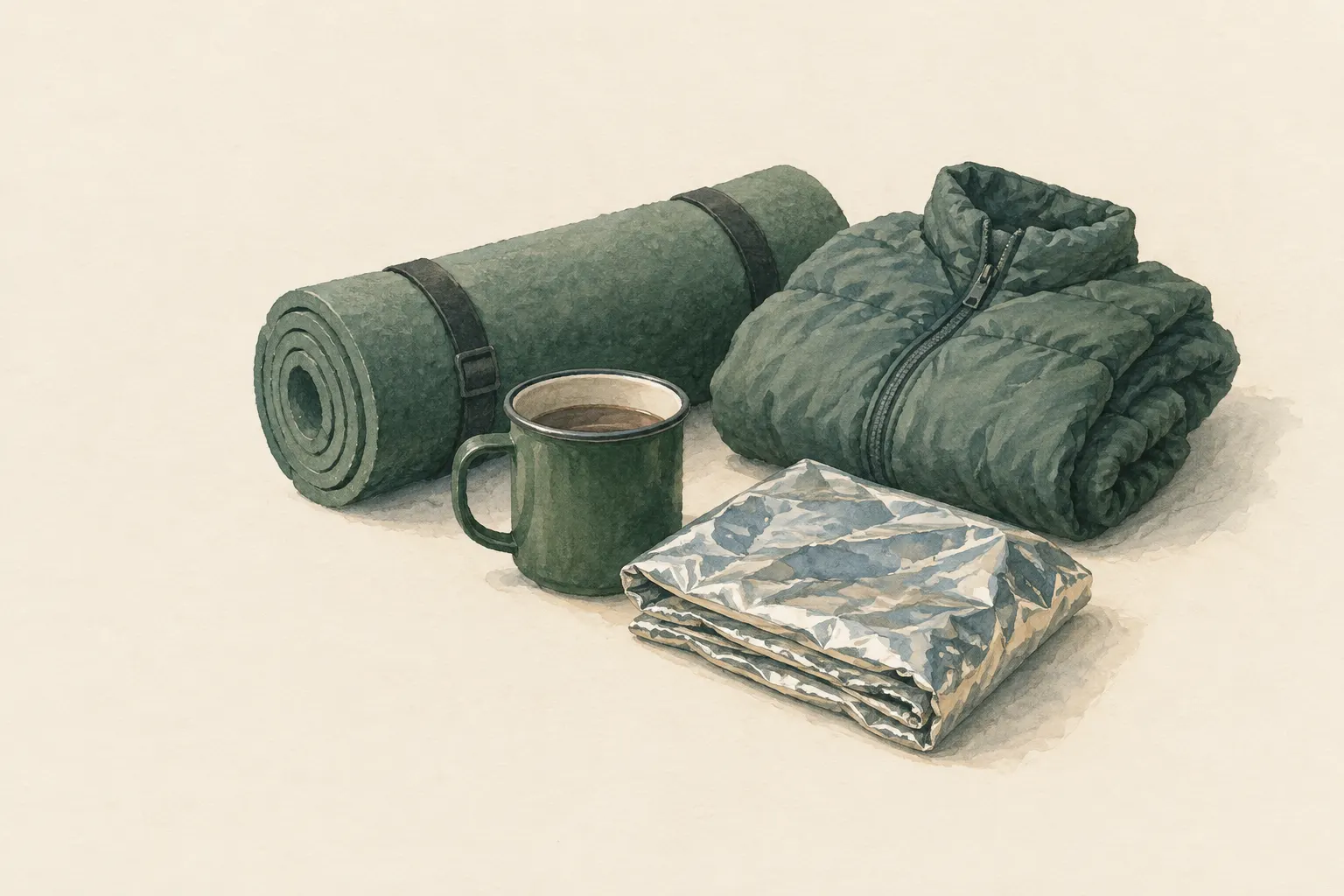
The ground is the path most often forgotten. A thick sleeping bag helps little if you lie on cold, damp ground without a pad, because the filling is squashed under your weight and then holds hardly any air. Sleeping pads, dry leaves in a thick layer or a backpack as a seat interrupt conduction.
The emergency blanket is a good example of the limits of a single item. It reflects heat radiation and keeps wind off, but because it is thin it hardly insulates against conduction. It works best combined with a pad, dry clothing and wind protection.
In heat, everything is reversed
In heat you want to get rid of heat, not keep it. The sun and hot surfaces such as tarmac or rock radiate heat onto you; if the air is warmer than your skin, it heats you as well. That is why shade is so effective: it blocks most of the radiation from above.
When the air is warmer than the skin, the body is left almost only with sweating. But sweat only cools if it can evaporate. In humid, muggy air that is harder – sweat drips off instead of evaporating and then hardly cools. That is why muggy weather feels so draining.
The same physics explains everyday cooking tricks: a lid on the pot reduces evaporation and convection, and a windscreen around the stove stops the wind from carrying the heat away. Both save fuel and time.
Safety: what to watch out for
This entry explains physics, not medicine. You cannot judge from these basics alone whether someone is hypothermic or has a heat illness. With signs such as violent shivering, confusion or drowsiness in the cold, or dizziness, nausea and confusion in the heat, call the local emergency number (112 in the EU).
A common mistake is working so hard in the cold that you sweat heavily. The wet clothing then cools you as soon as you stop. Better to take off a layer before you start sweating and put something on again straight away during breaks.
Water conducts heat much better than air. Anyone who gets wet or falls into cold water therefore cools down much faster than in air at the same temperature. Never run heat sources such as stoves or fires in tents or enclosed spaces – there is a risk of carbon monoxide poisoning.
Good to know
Why does a metal railing feel colder in winter than a wooden one, even though both are equally cold? Because metal draws the heat from your hand away much faster. Your skin does not measure temperature but how fast it is losing heat. That is exactly why the feeling is often misleading.
Frost on clear nights is also explained by radiation: a cloudless sky sends back hardly any heat, so ground, cars and tents cool strongly, sometimes even below the air temperature. Under trees or with cloud cover it often stays a little milder. That is a good reason not to pick a camp spot completely open under the sky.
Quick view
Suitable for
- Understanding shelter, clothing and insulation
- Understanding heat protection and cooking
Not suitable for
- Medical assessment of hypothermia or heat illness
Prerequisites
- None
Safety
- This entry explains physics. If there are signs of hypothermia or heat illness, call the local emergency number (112 in the EU).
How it works
Conduction: heat travels through materials in contact. Metal, stone and water conduct well, still air poorly – which is why materials with trapped air insulate, and wet clothing or cold ground cool strongly. Convection: moving air or water constantly carries away the warmed layer next to the body and replaces it with cold. Wind and flowing water therefore increase heat loss considerably; a windbreak interrupts this path. Radiation: every body radiates heat as infrared, the more the warmer it is. A clear night sky absorbs a lot of radiation, while clouds, trees or a roof reflect some back. Reflective foils can reduce radiative losses, but only if they do not lie directly on the skin and other paths are also blocked. Evaporation: evaporating water requires energy, which is drawn from the skin. This is the cooling mechanism of sweating – vital in heat, dangerous in cold if clothing is soaked with sweat. Heat is also lost through evaporation in breathing.
Advantages
- Explains many techniques with a few principles
- Helps with improvising
Disadvantages
- Simplified presentation
- No figures for specific situations
Deep knowledge
Background
The four paths of heat transfer are fundamentals of thermodynamics and are covered in physics textbooks such as “Fundamentals of Physics”. In wilderness medicine, for example in the Wilderness Medical Society guideline on hypothermia, they form the basis of protective measures.
In everyday situations the paths are almost always combined. A good solution therefore interrupts several at once: a sleeping pad against conduction, a windbreak against convection, a roof or foil against radiation, dry clothing against evaporation.
Illustrations
Variants
- In heat, the other way round
- In heat the body gains heat through radiation (sun, hot surfaces) and convection (hot air). Shade blocks radiation; when the air is warmer than the skin, evaporation of sweat remains the main cooling path – and it works less well in high humidity.
- When cooking
- A lid reduces losses through evaporation and convection; a windscreen for the stove reduces convection. Both save fuel.
Common mistakes
- Only covering up and forgetting the ground (conduction)
- Underestimating wind protection (convection)
- Treating an emergency blanket as the sole solution (only radiation and wind)
- Sweating heavily in the cold (evaporation)
Limits and risks
- No calculation models or material data
- No substitute for weather and health information
Sources
David Halliday, Robert Resnick, Jearl Walker – John Wiley & Sons: Fundamentals of Physics
Conduction, convection and radiation as paths of heat transfer
Wilderness & Environmental Medicine (Wilderness Medical Society) (2019): Wilderness Medical Society Clinical Practice Guidelines for the Out-of-Hospital Evaluation and Treatment of Accidental Hypothermia: 2019 Update
Heat-loss paths as the basis of protective measures against hypothermia