The body's water balance and dehydration
A large part of the body is water, and the body constantly loses water through breathing, skin, sweat and urine. Thirst and concentrated urine are the signals it uses to counteract this. In heat, exertion, cold, altitude, diarrhoea or vomiting, losses can outpace replacement. This entry explains the basics – it is not a treatment guide.
- 8 minutes to read
Explained simply
A large part of your body is water – in your blood, in every cell, in your muscles. Water carries nutrients, helps you cool down and flushes out waste. Because you are constantly losing water – when you breathe, through your skin, when you sweat and when you go to the toilet – you need to top up regularly.
Your body has a built-in warning system. When water is short, your brain signals “thirst” and your kidneys save water: you pee less and it gets darker. You can think of it like a fuel gauge. But be careful: in the cold and high up in the mountains this gauge is often quiet – you still need water.
The most important point: if someone is confused, faints, has not needed to pee for a long time, or keeps vomiting or has diarrhoea – especially small children and older people – call the local emergency number (112 in the EU). And only drink safe water, because dirty water can cause diarrhoea, and then you lose even more.
How it works
In adults, water makes up roughly half to about two thirds of body weight, and in babies even more. Part of it is inside the cells, the rest outside – between the cells and in blood plasma, the liquid part of the blood. Water moves back and forth between these spaces, depending on where there are more dissolved substances such as salts.
When the body loses water, the blood becomes more “concentrated”: there are more dissolved substances in the same volume. Special sensors in the brain notice this. They trigger thirst and cause the hormone ADH (also called vasopressin) to be released. ADH is like an order to the kidneys: “Hold on to water!” The kidneys then take more water back from the forming urine into the blood, and urine becomes scarcer and darker.
If the amount of water falls further, blood volume also shrinks. The heart has to beat faster to pump enough blood. You become tired, less focused and less capable, and the body finds it harder to cool itself, because there is less water for sweat and less blood available for the skin.
What really matters
How much water someone needs varies greatly: body size, heat, exertion, clothing, altitude and health all play a part. That is why this entry deliberately gives no fixed drinking amounts. It makes more sense to drink early and regularly rather than waiting until thirst is very strong.
Sweat carries away not only water but also salt. Someone who drinks only very large amounts of plain water during long exertion while eating hardly anything can develop a dangerous sodium deficiency (hyponatraemia). Normal meals usually provide enough salt. The rule of thumb: drink according to thirst and need, not “as much as possible”.
Alcohol does not count as a fluid source, because it suppresses the release of ADH so that the kidneys excrete more water. Food, on the other hand, also contains water: soups, fruit and vegetables make a noticeable contribution to the water balance.
Typical situations
Heat and exertion are the best-known water thieves, because the body sweats a lot. Shade, breaks during the midday heat and an adjusted pace often reduce losses more than any water bottle can make up for.
Less well known are cold and altitude. Cold air is dry; with every breath out you release moisture – visible as a cloud of breath. At the same time, thirst is often weaker in the cold, and people dislike drinking cold water. Warm drinks help with drinking regularly. At altitude you also breathe faster and deeper, which increases losses further.
Diarrhoea and vomiting can cost a great deal of water and salt in a short time. That is one reason why clean or properly treated drinking water is so important: contaminated water causes exactly the illnesses that make water loss worse.
Safety: what to watch out for
This entry explains basics and is not a treatment guide. Warning signs that mean you should call the local emergency number (112 in the EU) or get medical help include confusion, reduced consciousness, fainting, no urine for many hours, and persistent vomiting or diarrhoea.
Small children, older people and the chronically ill are at particular risk. Children lose fluid quickly relative to their size, and older people often sense thirst less well. Actively offer them drinks and watch for changes in behaviour. Anyone who has been given a fluid restriction by a doctor, for example because of a heart or kidney condition, follows that instruction.
Good to know
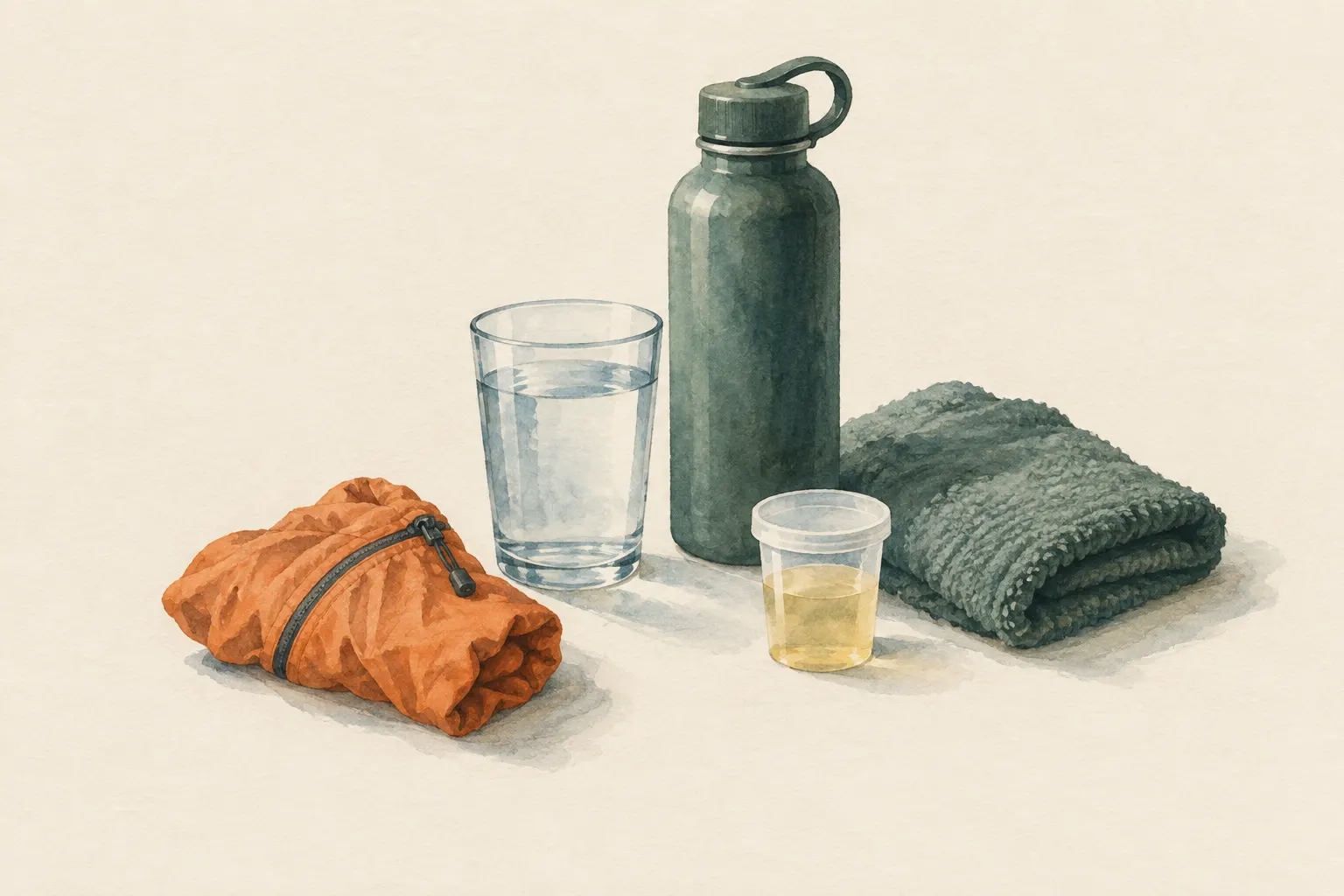
Urine colour is a simple but rough indicator: pale and plentiful usually suggests enough water, dark and scant too little. Some foods, vitamins or medicines change the colour, however, so it is only one clue among several.
For household emergency stocks, authorities plan with fixed reference values per person per day, because planning needs a number. That is different from the actual need of a particular person on a hot day – which can be considerably higher. More on this is in the entries on water needs and water storage.
Quick view
Suitable for
- Understanding water needs and stock planning
- Planning trips in heat, cold or at altitude
Not suitable for
- Diagnosing or treating illness
- People with a medically prescribed fluid restriction – medical instructions apply
Prerequisites
- None
Safety
- Too much water can also be harmful: drinking very large amounts of plain water during long exertion while taking in little salt can cause a dangerous sodium deficiency. Drink according to thirst and need, not “as much as possible”.
- Drink only safe or treated water; diarrhoea from contaminated water makes fluid loss worse.
How it works
Body water is distributed between the inside of cells and the space outside them, including blood plasma. When the body loses water, the concentration of dissolved substances in the blood rises. Sensors in the brain detect this, trigger thirst and, through the hormone ADH (vasopressin), make the kidneys excrete less water – urine becomes darker and scarcer. Sweat loses salts as well as water. If blood volume falls, the heart has to beat faster; performance, concentration and temperature regulation decline.
Advantages
- Explains why water is a top priority
- Helps to recognise warning signs early
Disadvantages
- No quantities – needs are highly individual
- No treatment guidance
Deep knowledge
Background
Regulation of body water, thirst and kidney function are core topics of physiology and are described in detail in textbooks such as the “Guyton and Hall Textbook of Medical Physiology”. In its fact sheet on heat and health, WHO points out that fluid loss in heat is an important risk factor, especially for older people and children.
In practice this means: take in water early and regularly, limit sweat losses through shade and adjusted activity, and get help early when warning signs appear.
Variants
- People at particular risk
- Small children, older people and the chronically ill lose fluid faster or sense thirst less well. Actively offer them drinks and watch for warning signs.
- In cold and at altitude
- Cold, dry air draws moisture with each breath, and thirst is often weaker. Warm drinks help with drinking regularly.
Common mistakes
- Ignoring thirst in the cold or at altitude
- Only drinking once very thirsty
- Counting alcohol as fluid
- Drinking only large amounts of plain water and eating nothing during long exertion
Limits and risks
- No diagnostic or treatment guidance
- No fluid quantities for heat or sport
Sources
John E. Hall – Elsevier: Guyton and Hall Textbook of Medical Physiology
Regulation of body water, thirst and ADH
World Health Organization: Heat and health (fact sheet)
Fluid loss in heat as a risk factor; groups at risk