Cooking and boiling water safely over a fire
Cooking works best over embers, not high flames: the heat is more even, the pot gets less sooty and stands more stably. The biggest risks are pots of boiling water tipping over, hot handles and unsuitable containers.
- 10–30 minutes depending on quantity, plus setup
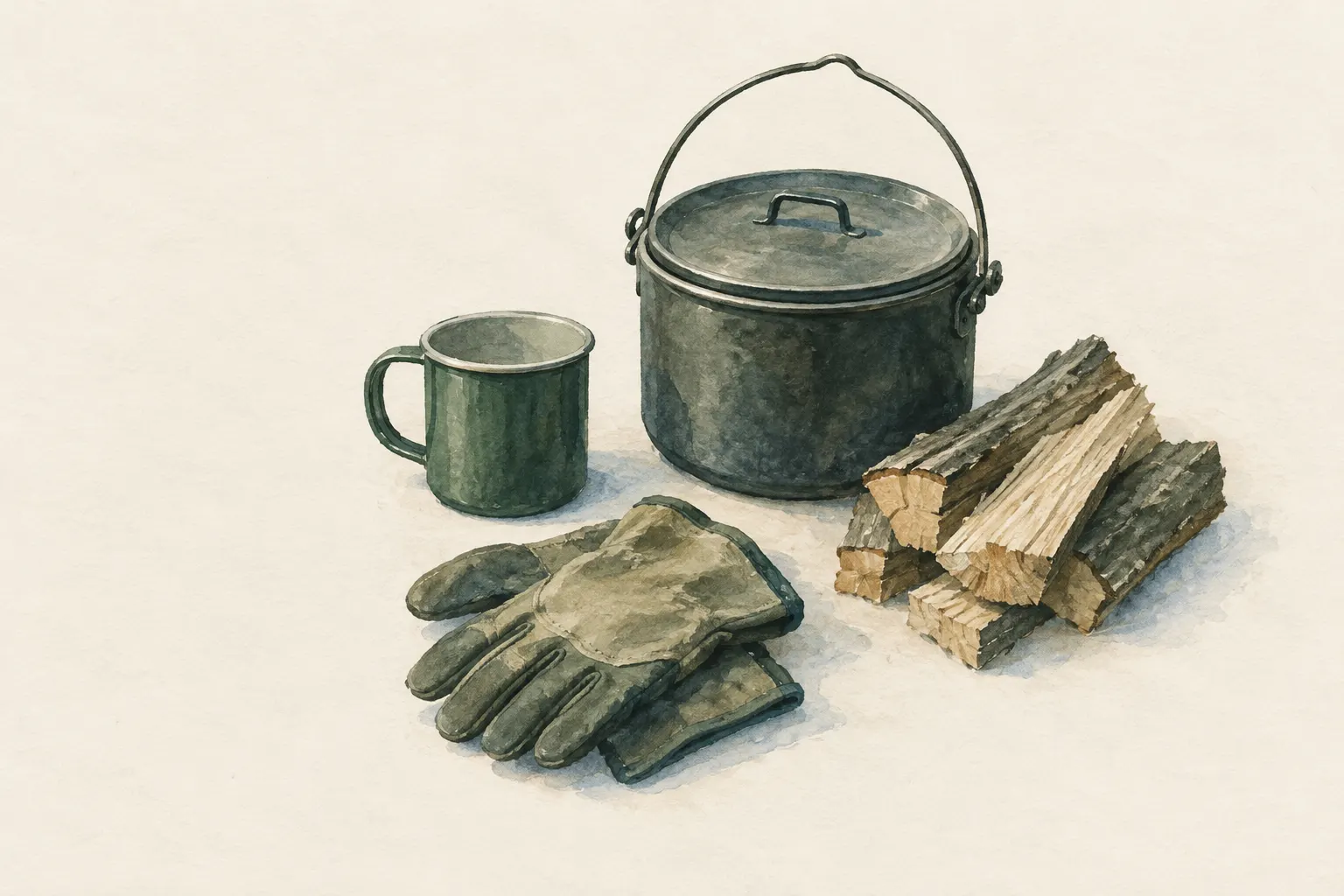
Explained simply
To cook, you do not need big flames but embers – the red-glowing pieces of wood left once the fire has burned for a while. Embers are like a hotplate: they give off even heat. High flames, on the other hand, flicker, blacken the pot and burn the outside of your food.
The pot must stand firm and level, for example on flat, dry stones or a grill. Do not fill it to the brim, and cook with a lid – it is faster and saves wood.
The most dangerous thing is boiling water that tips over. It badly scalds the skin. Touch hot handles only with a glove, a pot holder or a sturdy stick, and keep children away from the cooking area.
How it works
Embers radiate heat, much like a hotplate or a radiator. This heat is even and easy to control: more embers under the pot means more heat, raking embers aside means less. Flames, by contrast, leap up irregularly, spread heat unevenly and leave a lot of soot.
For embers to form, the fire has to burn for a while. How long depends on the wood and the weather; dense hardwood usually forms better, longer-lasting embers than fast-burning softwood. A practical solution is to keep the fire burning to one side and keep raking fresh embers from it into a cooking zone.
A lid keeps the heat in the pot. The water boils faster, you need less wood, and less ash falls into the food.
What really matters
Stability is the most important thing. Set the pot on flat, dry stones, a grill or a stable stand and check whether it wobbles before you fill it. A pot with a bail handle can also hang from a tripod or an angled, anchored stick – then the structure must carry the full weight safely, and cords must not hang into the flames.
Fill the pot to at most about two thirds. Boiling water bubbles and sloshes, and a pot filled to the brim boils over or spills when lifted. Clear the path from the fire to the place where you will set it down before lifting the hot pot, and never reach across the fire.
Use only heat-resistant metal pots. Plastic vessels melt, and galvanised buckets or coated containers can give off harmful fumes when strongly heated. Sealed cans or vessels must never go into the fire: steam pressure inside can make them burst and spray hot contents.
Boiling water
Boiling is one of the most reliable ways to kill pathogens in water. If there is no stove, a fire can be the heat source. The water must reach a rolling boil; exactly how long is given in the entry on boiling water. Also follow the advice of local authorities, for example boil-water notices.
Important to know: boiling kills germs but does not remove chemicals, heavy metals or dirt. Cloudy water can be left to settle first and poured through a cloth – this makes it clearer but not safe; boiling is the decisive step. At high altitude water boils at a lower temperature, so some authorities give longer boiling times there.
Let boiled water cool in a clean, covered container so it does not get contaminated again.
Safety: what to watch out for
Boiling water and hot fat cause severe scalds. Handle the pot and handles only with a glove, pot grabber or sturdy stick; metal handles get very hot too. Keep children away from the cooking area. Cool burns and scalds at once with cool, not ice-cold, running water; for large or deep wounds, burns to the face or hands, and burns in children, call the local emergency number (112 in the EU).
Never cook inside a tent, shelter or enclosed room, not even “just briefly” because of rain. Fires, embers and stoves produce carbon monoxide, which is invisible and odourless and can be fatal.
There are basic rules for the food too: wash your hands, keep raw meat and ready food apart, and cook meat all the way through. Over a fire, food quickly turns black outside while still raw inside – smaller pieces and embers instead of flames help.
When it makes sense – and when not
Cooking over a fire is worthwhile where fires are allowed and you need one anyway, for example for warmth, or when no stove is available. But it costs time, wood and attention and leaves soot on the pots.
During a fire ban, cooking over an open fire is not possible. A stove is then often still allowed, but not always – check the local rules here too. After cooking, as with any fire: put it out completely until everything is cold.
Step by step
Build a bed of embers
Let the fire burn until an even bed of embers has formed – how long that takes depends on the wood. Rake embers to one side to create a cooking zone.
- 1
Build a bed of embers
Let the fire burn until an even bed of embers has formed – how long that takes depends on the wood. Rake embers to one side to create a cooking zone.
- 2
Stable pot support
Set the pot on flat, dry stones, a grill or a stable tripod. Check for wobbling before filling it.
- 3
Do not fill to the brim
Fill the pot to at most about two thirds and cook with a lid.
- 4
Boil water
For drinking water, bring water to a rolling boil – the exact duration is in the boiling entry.
- 5
Remove the pot safely
Lift by the handle using a glove, pot grabber or sturdy stick, set it down on a level surface away from the fire, and clear the path beforehand.
Never reach across the fire.
Common mistakes
- Cooking over high flames
- Setting the pot on wobbly stones
- Filling to the brim
- Heating plastic or galvanised containers
- Handling the pot with bare hands or sleeves
Quick view
Materials
Metal pot (stainless steel, aluminium, titanium)
Hot – scalding risk.
Dry firewood
Collect only where permitted.
Water for extinguishing (bucket, canister or pot)
Have several litres ready before lighting.
Suitable for
- Boiling water
- Simple meals
- Emergencies without a stove
Not suitable for
- Plastic, coated or galvanised containers
- Cooking inside a tent, shelter or enclosed room
Prerequisites
- Safe fire site
- A fire that has already formed a bed of embers
Safety
- Cool burns immediately with cool, not ice-cold, running water. For large or deep burns, burns to the face, hands or joints, and burns in children, call the local emergency number (112 in the EU).
How it works
Embers radiate even, controllable heat. A pot standing firmly on stones, a grill or a stable support uses this heat safely. A lid shortens cooking time and saves wood.
Advantages
- No stove or gas needed
- Embers give even heat
Disadvantages
- Soot and smoke
- Wood and time required
- Only where fires are permitted
Deep knowledge
Background
Boiling is one of the most reliable ways to make water microbiologically safe; a fire is a heat source for it when no stove is available. The time for building embers is a guideline and depends on wood and weather.
A stove is often still allowed during a fire ban, but not always – check local rules here too.
Variants
- Hanging pot
- A pot with a bail handle can hang over the embers from a tripod or an angled, anchored stick. The structure must safely carry the full weight; do not let cords hang into the flames.
Common mistakes
- Cooking over high flames
- Setting the pot on wobbly stones
- Filling to the brim
- Heating plastic or galvanised containers
- Handling the pot with bare hands or sleeves
Limits and risks
- Does not remove chemicals from water
- Not applicable during a fire ban
Material alternatives
Derived from material properties: a substitute must have all relevant properties. Observe the notes on the substitute.
- Metal pot (stainless steel, aluminium, titanium)
- Single-wall stainless steel bottle (Heat only single-wall bottles without paint/plastic; remove the lid before heating.)
- Dry firewood
- Tinder (Carry in waterproof packaging.), Char cloth (charred cotton) (Store dry in a tin.), Finest-grade steel wool (Store separately from batteries – fire risk.), Fatwood (resin-rich wood) (Collect only dead wood where permitted.), Stove fuel (canister, liquid fuel, alcohol) (Store fuels apart from food and in original containers or bottles intended for them.), Petroleum jelly cotton balls (Use only pure cotton.)
Results come exclusively from structured entries. No improvised instructions are generated.
Sources
Centers for Disease Control and Prevention: Making Water Safe in an Emergency
Boiling as a water treatment method
World Health Organization, Regional Office for Europe (2010): WHO guidelines for indoor air quality: selected pollutants (carbon monoxide chapter)
Carbon monoxide from combustion in enclosed spaces
Headquarters, Department of the Army (USA) (2002): FM 3-05.70 Survival
Cooking with fire in the field